
DBT is a structured psychotherapy that pairs acceptance of the moment with concrete skills for changing harmful reactions, built for severe emotion swings and now used more widely. You're staring at your phone after a hard conversation, your chest is tight, and part of you wants to send the text, skip work, or shut everyone out, while another part knows you'll regret it in the morning. That collision is exactly where understanding what DBT is helps most. It doesn't ask you to pretend you're calm. It teaches you to stay safe, name what's happening, and choose a next move you'll still respect later.
What Dialectical Behavior Therapy Actually Means
DBT is a structured psychotherapy that pairs acceptance with behavior change to build skills for intense emotion, crisis and self-harm. A clinical overview of DBT describes it as developed by psychologist Marsha M. Linehan in the late 1980s, initially for people with chronic suicidal behavior and borderline personality disorder. That's a serious origin, and it matters for how you read everything else. This wasn't designed as a set of soothing tips for a bad day.
Say a partner doesn't reply for two hours. One urge says stay with the fear and wait. Another says send six messages, demand an answer, or end the relationship first so you don't feel rejected. Neither urge is the whole truth, but the second one can create the very loss you're afraid of.
This visual lays out that fork between staying with a feeling and making it worse.
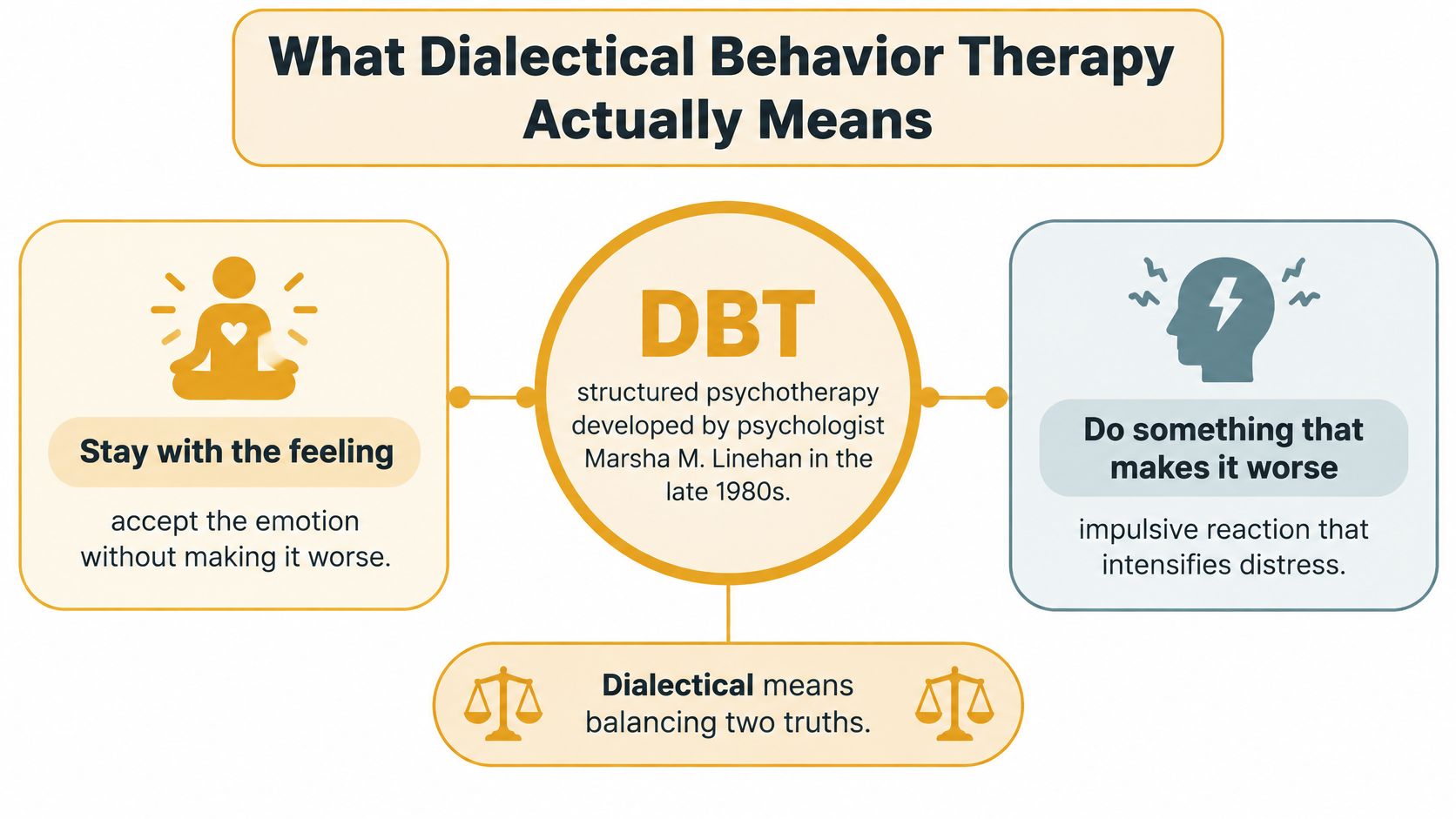
Two hands on the same rope
Picture two hands on the same rope. One hand holds the present as it is, painful, unfair, unresolved. The other pulls toward a safer next action. Dialectical means you don't have to drop either hand to be honest.
Mindfulness is mostly the acceptance side. You notice sensations, thoughts, and urges without obeying them automatically. Behavior change is the other side. You build specific responses for the moments when your old pattern takes over, and you practice them until they're available under pressure.
People often think acceptance must come first, like you have to feel peaceful before you can act differently. DBT pursues both at once. You can accept that anger is here and still refuse to insult someone. You can accept that grief hurts and still eat, sleep, and answer one kind message.
A full treatment, not a single exercise
Standard DBT organizes skills into four domains, named here and mapped next:
- Mindfulness: noticing the present moment without judgment
- Distress tolerance: getting through a spike without harm
- Emotion regulation: reducing how often and how hard emotions hit
- Interpersonal effectiveness: handling requests, limits, and repair
The full clinical model traditionally combines individual therapy, group skills training, between-session coaching, and therapist consultation teams. A worksheet or app prompt can teach one skill. It isn't full DBT, and presenting it that way would overstate its scope.
DBT has since been adapted for adolescents, substance-use disorders, eating disorders, and depression, but its strongest historical identity remains treatment for severe emotion dysregulation, recurrent self-harm, and suicidal behavior. That range shows the skills travel well. The original center shows why the full model carries support around the person, not just information.
Acceptance is a clinical strategy, not the opposite of change.
Four Skills for Moments That Feel Too Big
Start by matching the moment to its job. A crisis skill won't fix a months-long sleep problem, and a long-term regulation skill may be too slow when your hands are shaking. This table keeps the choice simple.
The four DBT skill domains at a glance
| Skill | Job in the moment | A move to try |
|---|---|---|
| Mindfulness | Notice what is happening without judging or fixing it | Name one body sensation for 60 seconds |
| Distress tolerance | Survive a crisis without a harmful action | TIPP, cool water, brief movement, paced breath, muscle release |
| Emotion regulation | Lower the volume of feelings over hours and days | Check the facts, name the emotion, try opposite action |
| Interpersonal effectiveness | Ask, refuse, or repair while keeping self-respect | One DEAR MAN sentence, describe, express, assert, reinforce |
Mindfulness for the 2 a.m. spiral
You're awake at 2 a.m. replaying a meeting. Mindfulness asks for three moves, observe, describe, and participate. Instead of arguing with the story, you might say, "anger in the chest, jaw tight, thought that I sounded foolish." Stay with that plain description for 60 seconds.
You're not fixing the meeting. You're separating a sensation from a verdict about your worth. That gap is small, but it's where the next choice lives. Many people find their breathing slows on its own once they stop wrestling every thought.
Distress tolerance after a sharp text
A friend's short text lands like rejection, and your urge is to fire back or disappear for days. Distress tolerance is for surviving that spike without a harmful action. The classic TIPP cluster uses temperature such as cool water on the face, intense brief movement, paced breathing, and paired muscle relaxation.
These moves work through the body for minutes, not as a lifestyle. Cool water, a brisk minute of movement, and longer exhales can lower arousal enough that you can delay the reply. The goal isn't to feel fine. The goal is not to make a hard ten minutes into a week of repair.
Emotion regulation across a low week
Emotion regulation works over hours and days. You check the facts, name the emotion accurately, and ask whether the urge fits those facts. If shame says hide after you made a correctable mistake, the facts may point to apology and rest, not isolation.
That's where opposite action comes in. When the urge is to isolate, lash out, or shut down and it doesn't fit the facts, you do the safer opposite in a small way. You text one person, lower your voice and stay in the room, or get dressed and step outside. Repeated over a low week, these choices change the conditions that keep feeding the emotion.
Interpersonal effectiveness for a real boundary
With a partner, you need quiet after work but you fear sounding selfish. DEAR MAN gives your ask a clean shape. Describe the situation, Express how you feel, Assert what you need, and Reinforce why it helps the relationship. Then stay Mindful of your goal, Appear confident, and Negotiate if needed.
One sentence might be, "When I walk in to immediate questions I feel overloaded, so I need twenty quiet minutes, and then I'll be more present for dinner." You've asked clearly without attacking or apologizing for existing. That's self-respect and care held together.
These are taught and rehearsed skills, not personality traits you're supposed to be born with. One technique is useful practice material. It isn't a full program, and knowing the weekly structure of real care helps you judge what support you need.
What a Full Course of DBT Includes
DBT is a system, not just a weekly conversation. Each part does a job the others can't do well alone. The diagram below shows how those parts fit together.
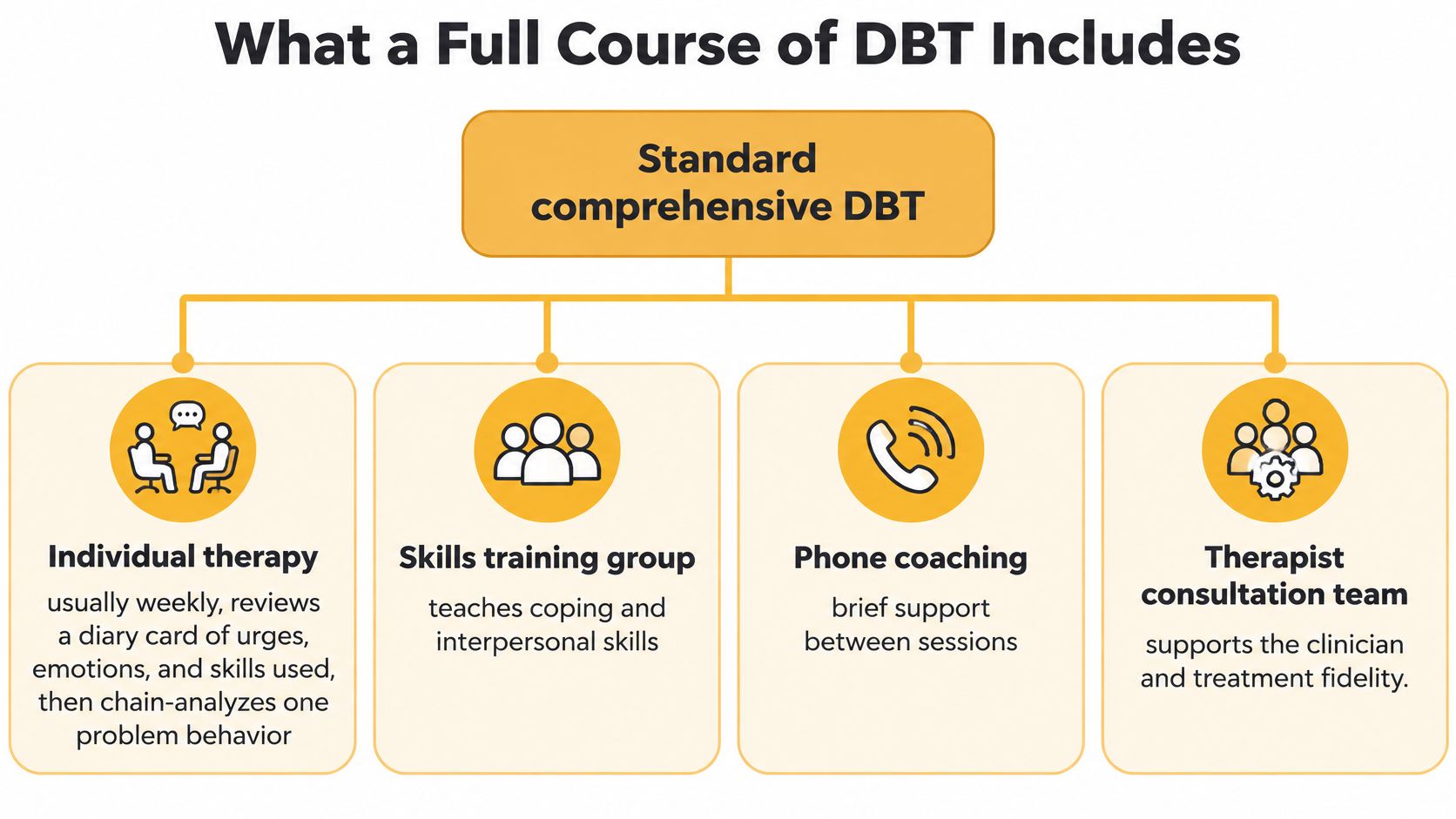
Components of a full DBT course
| Mode | Job | Typical format |
|---|---|---|
| Individual therapy | Review the diary card and chain-analyze one target behavior | Usually weekly, one-on-one |
| Skills group | Teach and rehearse the four skill domains with homework | Weekly, about two hours per class, modules often run about six months |
| Phone or between-session coaching | Brief help to use a skill before a crisis behavior | Brief, as needed |
| Consultation team | Keeps the therapists' approach consistent | Weekly team meeting for clinicians |
In individual therapy, you usually bring a diary card tracking urges, emotions, and skills used. You and your therapist pick one target behavior and chain-analyze it from the prompt, through thoughts and body cues, to the consequence. That slow replay finds the earlier links where a different move could work next time.
The skills group feels more like a class than group therapy. You learn a skill, hear examples, and get homework to practice in real life. Between-session coaching is brief and practical. You contact the therapist before a crisis behavior to get help using a skill in that moment, not to hold a second therapy hour on the phone.
This short video gives another view of how the pieces work as one treatment.
The consultation team supports the therapists. DBT work is demanding, and the team helps clinicians stay consistent, compassionate, and faithful to the model. You may never meet that team, but you feel its effect when your treatment stays steady week after week.
Who it was built for, and how it's studied
DBT was designed first for adults with borderline personality disorder, recurrent self-harm, or suicidal behavior and severe emotion swings. Adaptations now serve adolescents and people dealing with substance use, eating disorders, and depression. Newer work reaches further. A 2025 Australian randomized clinical trial of online DBT for chronic pain included 89 adults, and 79 participants, or 89%, completed the 9-week assessment.
For scale in the original territory, a 2024 benchmark study in the International Journal of Clinical and Health Psychology included 673 adult participants, comprising 534 receiving a full DBT program and 139 receiving a skills-group intervention. Those numbers show a model studied beyond one clinic's story. They don't promise the same result for every person.
A fair expectation: weekly contact, homework between sessions, and a hierarchy that treats life-threatening behavior before therapy-interfering behavior and quality-of-life goals.
Finding the right level of help
Look for a clinician trained in DBT, and ask directly whether they offer the full model or DBT-informed therapy. Both can be valuable, but they're not the same offer. Expect an intake, goal setting, and an agreement about attending sessions and completing homework before the skills work begins. That agreement isn't bureaucracy. It's how you and your therapist protect the treatment when motivation dips, which it will for almost everyone at some point.
Safety Limits and Mix-Ups Worth Dropping
Use skills practice for distress you can stay safe with. Use urgent human care when you can't. That split comes before any exercise in this article, and it stays in force the whole way through.
If you have active suicidal intent, a plan, recent self-harm you cannot stay safe from, or danger to someone else, don't reach for a worksheet. Contact local emergency services or a crisis line and tell a person who can stay with you. Reading about what DBT is can wait. Safety can't.
DBT was built for exactly these risks inside a staffed program with coaching and a consultation team. That's why self-guided tips can't carry that load. The structure around the skills is part of the treatment, not decoration.
Three mix-ups to let go
- DBT is not just mindfulness: noticing the present is one domain, while crisis survival, regulation, and relationship skills carry equal weight.
- DBT is not positive thinking: you don't replace a painful thought with a cheerful one, you check facts and choose a workable action.
- DBT is not a self-diagnosis: a quiz can't tell you that you have borderline personality disorder, and a label isn't a treatment plan.
Learning the name of a method isn't the same as receiving psychotherapy. The American Psychological Association health advisory on AI chatbots and wellness apps advises that generative-AI chatbots, wellness apps, and digital wellness tools should not be relied on to deliver psychotherapy or psychological treatment, and that they may be appropriate as supportive adjuncts to an ongoing therapeutic relationship, not substitutes for one. A tool can feel structured and emotionally useful. That feeling doesn't turn it into a clinician.
There's another reason for caution. The APA overview of red flags in mental health apps notes that many apps lack rigorous testing, citing research finding that fewer than 4% of anxiety apps had undergone a randomized clinical trial assessing feasibility and efficacy. Using the words CBT, DBT, or mindfulness doesn't prove an app treats a condition.
We state our own limit plainly. LUNO is not a replacement for therapy. It's a self-guided mental wellness companion that can support reflection, emotional awareness, and daily practice, and it is not a crisis service. You can read exactly where that boundary sits on our Luno safety page.
The safety split: if you can stay safe, a ten-minute practice may help. If you can't, a person needs to be involved now.
Five Ten-Minute Practices Used Safely
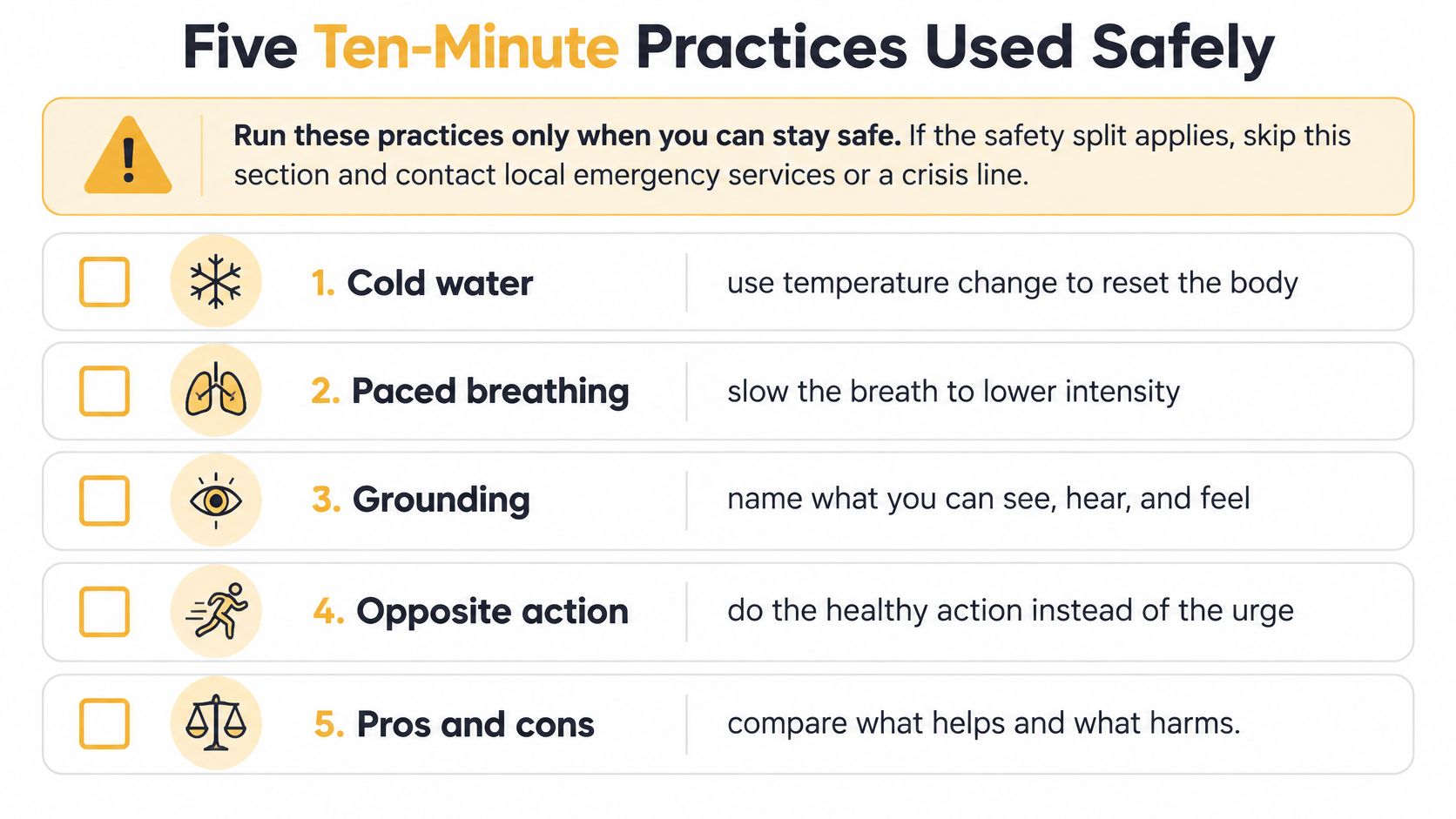
Run these practices only when you can stay safe. If the safety split applies to you right now, skip this section and contact local emergency services or a crisis line. Each practice below gives you the action, a clear done signal, and one common slip to watch for.
Here's the set at a glance before you work through the details.
Wise mind check: Set a one-minute timer. Name the emotion urge out loud, then name the reasonable fact. Write one sentence that honors both, such as "I feel furious and unheard, and I still need this working relationship tomorrow." Done when the sentence is written. The common slip is using it to argue yourself out of every feeling, which turns balance into self-dismissal.
STOP: Stop where you are. Take a breath. Observe your body and surroundings, feet on the floor, sounds in the room, tension in your shoulders. Then proceed with one small action, drinking water or stepping outside. Done when that action is taken. The slip is skipping the observe step, because without it you often proceed straight into the old reaction at a slightly slower speed.
Temperature: Hold a cool cloth to your face or splash cool water on your cheeks for about 30 seconds while breathing out longer than you breathe in. Stop if you feel faint or have a medical reason to avoid sudden cold. Done after 30 seconds. The slip is expecting the spike to vanish. You're lowering body arousal a notch, not deleting the problem that caused it.
Opposite action for low mood: Use this only when low mood doesn't match the facts and no safety issue is present. Choose one ten-minute move, a short walk, a shower and clean clothes, or one message to a friend. Done when the ten minutes end. The slip is choosing a move so large it's abandoned. A finished small step teaches your brain more than an ambitious plan you never start.
One-line DEAR MAN: Write a real request for this week in under 40 words. Keep it to the situation, your feeling, your ask, and the benefit. Done when the sentence is sent or rehearsed aloud once. The slip is writing a speech. Long defenses invite debate about your tone instead of an answer to your request.
Make one of them yours
Don't rotate through all five like a sampler. Choose one practice for seven days and note your urge level before and after, even as a rough number in your phone. Repetition is what turns a clever idea into a response you can find when you're tired, embarrassed, or overwhelmed. If a practice consistently makes things worse, stop it and bring that information to a clinician. That's useful data, not failure.
A skill counts when you've used it on purpose in a real moment, not when you can explain it perfectly on a calm afternoon.
Practice Between Sessions or Before Therapy
DBT assumes something honest about real life. You need skills at the grocery store, in a tense bedroom conversation, and on a Sunday night before work, not only in a therapy room. The hours between appointments are where the treatment either becomes yours or stays theoretical.
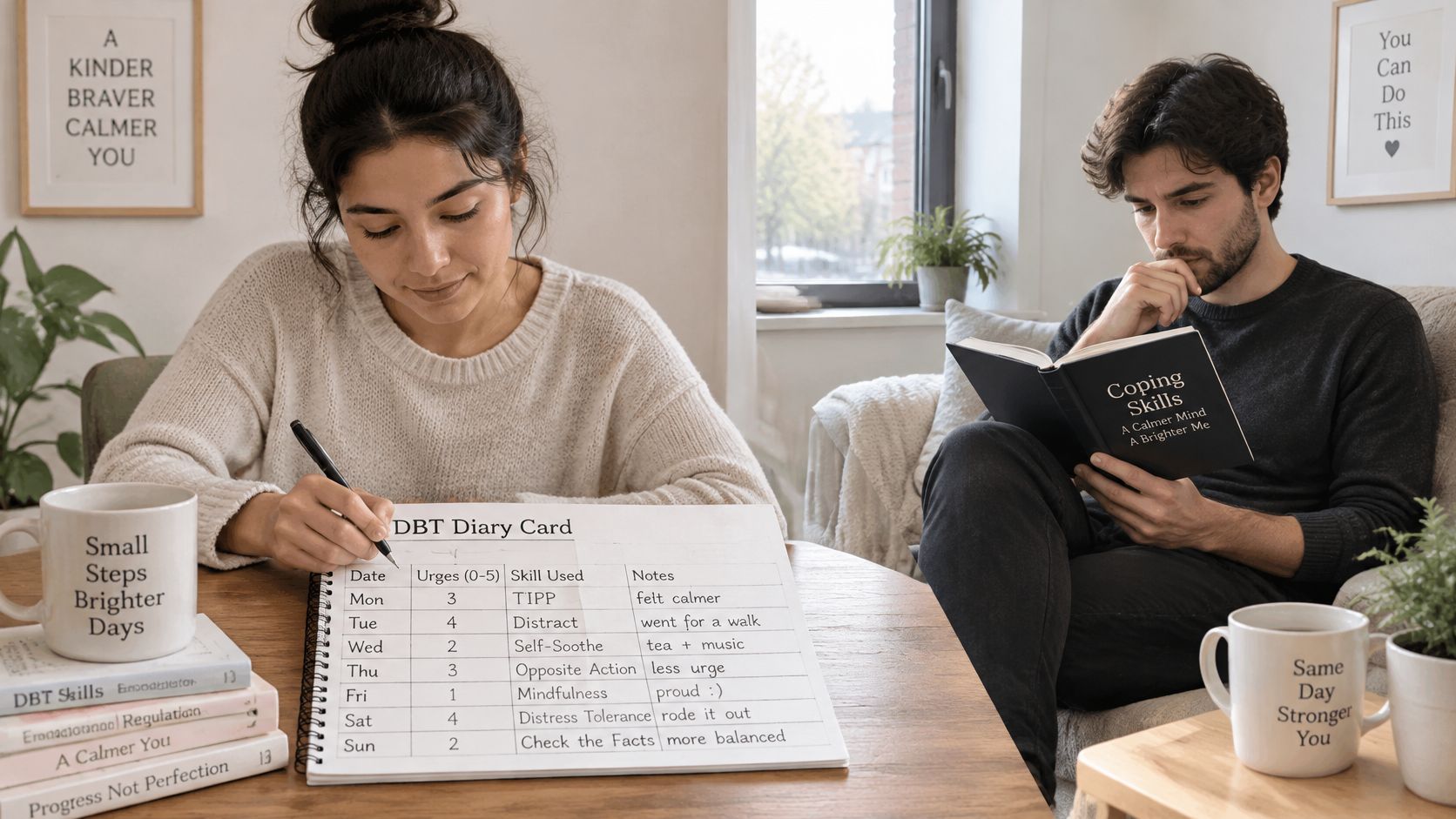
Say you're already in DBT. Each evening you track your strongest urge, the emotion underneath it, and which skill you tried. That log becomes homework you bring to your next session, so your therapist sees patterns you'd forget by Thursday. Small entries beat polished essays here.
Now say you're not ready for therapy yet. You might choose one daily practice aimed at what you're carrying, anxiety, sleep, mood, burnout, grief, or relationships. People can find any topic they need, and that matters, because a generic calm-down script rarely fits the person whose real problem is grief at bedtime or dread before work.
What self-help can and cannot do
The WHO guideline on self-help interventions describes individually delivered self-help as structured techniques for managing psychological distress, delivered digitally, in print, or by video, either with or without brief support. It identifies interventions based on CBT, DBT, problem-solving therapy, and mindfulness as possible support for people with suicidal thoughts, although that recommendation is conditional and the certainty of evidence is low.
The level of support matters too. The WHO page on psychological self-help interventions reports that both guided and unguided self-help can reduce symptoms, while guided approaches may achieve results comparable to more intensive in-person care, and it describes one model using 15 minutes of support per week for five weeks from a trained and supervised non-specialist helper. Structure and a human touch add weight that a prompt alone doesn't.
That's the right expectation for any app, including ours. A structured check-in can feel supportive and can feel like therapy homework, because we adapt each day's plan to what you share. But Luno feels like therapy while not being therapy, and our guidance at Luno Self Care is general self-improvement guidance, not individualized clinical advice. Bring your log to a therapist when you have one. It makes your first sessions sharper.
Choose Your Next Step and Keep It Honest
Pick one of these three paths today. Don't pick the one that sounds most independent. Pick the one that matches your safety and your pattern.
- Immediate danger comes first: if you can't stay safe from suicidal behavior or self-harm, contact local emergency services or a crisis line and tell a person who can stay with you. Don't start any app plan.
- Recurring crises need a clinician: if emotion swings, self-harm urges, or relationship crises keep returning, ask a licensed clinician about full DBT and use these skills only as between-session homework.
- Safe and ready to practice: if you're safe and want daily structure, a self-guided companion can help you build the habit with gentle accountability.
Our path three looks like this. You share your story in your own words, choose from 10 evidence-based healing protocols in 14-day arcs, from Anxiety Relief and Sleep Repair to Relationship (DBT Attachment), Grief & Loss, Burnout Recovery, and a Custom Package, then check in daily so each plan adapts overnight. Details sit on our Luno FAQ page.
Check yourself after one week. You used one named skill on purpose, and you know exactly who you'd call if safety changes. That's a strong, honest start.
When you're safe and ready for daily structure, Luno: Self Care turns your check-ins into a personalized next-day plan drawn from methods including DBT skills for relationships, emotions, and hard moments. It can feel like therapy homework designed for your actual life, and we'll always say clearly that it isn't therapy or a crisis service. Come share your story, choose the topic you're really carrying, and take your first small, skillful step today.