
CBT is a structured, time-limited psychotherapy that identifies unhelpful automatic thoughts and practices new behaviors, not generic positive thinking.
If changing your thoughts were enough, why would you still feel anxious after telling yourself everything will be fine? That gap matters. CBT isn't about finding a reassuring sentence and repeating it until distress disappears. It's about checking what happens between a situation, your interpretation, your body, your feelings, and what you do next.
The useful question isn't whether you can become a more positive person. It's whether you can understand a difficult pattern well enough to try something different, in a way that fits your life.
What CBT Actually Is
Cognitive behavioral therapy, or CBT, is a structured, problem-focused psychotherapy based on the idea that thinking, emotion, and behavior influence one another. You and a therapist identify a pattern that's causing difficulty, examine how it works, and practice responses that give you more options.
The approach developed during the 1960s, particularly through Aaron Beck's cognitive therapy work; his 1967 formulation emphasized how problematic thinking styles could contribute to and intensify psychiatric symptoms, within the approach described by the National Institute of Mental Health's psychotherapy guidance. NIMH describes CBT as an evidence-based treatment that can reduce symptoms of depression, anxiety, and other mental disorders.
A method rather than a mindset
The core method is practical: identify automatic thoughts that are inaccurate or harmful, examine how they affect feelings and actions, and practice more constructive responses. Tools include thought records, behavioral experiments, exposure, problem-solving, activity scheduling, and relapse-prevention planning.
That doesn't mean your therapist assumes every painful thought is wrong. Sometimes the situation really is difficult. The work might involve recognizing a genuine problem, separating it from a sweeping judgment about yourself, and deciding what action would help.
What people think CBT is versus what it does
| People assume | What CBT actually does | Why the difference matters |
|---|---|---|
| Positive thinking | Tests specific automatic thoughts with records and experiments | Cheerfulness without evidence can backfire |
| Only talking about feelings | Links thoughts, body, emotion, and behavior, then changes one of them | Insight without a new action often leaves the loop intact |
| Endless exploration of the past | Stays present-focused, active, and time-limited | The aim is usable skills and a relapse plan, not an open history |
| Any self-help tip | A trained professional checks diagnosis, risk, comorbidities, and progress | Worksheets alone do not assess safety |
Where professional judgment comes in
Active and time-limited doesn't mean rushed or indifferent to your history. A therapist can explore earlier experiences when they help explain a present difficulty, without making historical exploration the whole treatment.
Clinical CBT also includes responsibilities that a worksheet can't carry. A trained professional considers diagnosis, safety, co-occurring conditions, and whether treatment is helping. They can adjust the approach when an exercise isn't appropriate.
Use the table as a filter for advice you encounter online. If someone calls a motivational slogan CBT, ask what thought is being examined, what behavior is being practiced, and how the result will be reviewed.
The Loop Between Thoughts Feelings and Actions
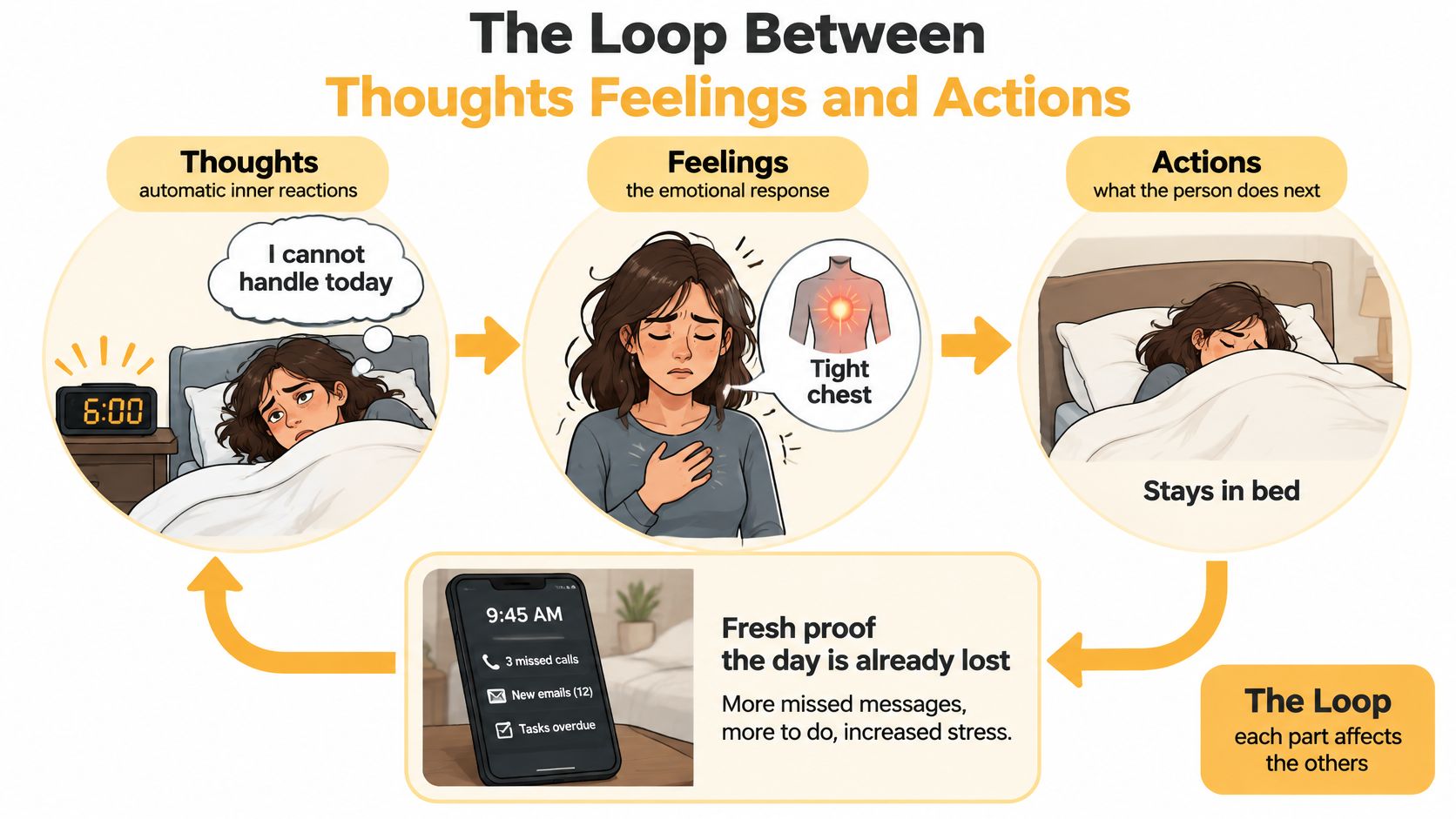
The alarm rings. Before you've moved, you think you can't handle today. Your chest tightens, dread rises, and you stay under the covers.
For a moment, staying put feels protective. Later, unfinished tasks become another reason to believe the day is already lost. Nothing about that sequence requires you to be lazy or weak. It's a pattern you can map.
This morning scene shows how the parts connect.
More than a thought causing a feeling
The cognitive model gives you a map with connected parts: thoughts, emotions, physical sensations, and behavior. The National Institute of Mental Health's depression guidance describes learning to recognize harmful or inaccurate automatic thoughts, examine their effects, and change unhelpful behavior patterns.
An automatic thought is the fast interpretation that arrives before you've deliberately considered the situation. It can feel like knowledge rather than a guess. You notice the conclusion, such as being unable to cope, without noticing how quickly you reached it.
Think of a smoke alarm. An alarm is useful when there's smoke and exhausting when it sounds over burnt toast. CBT doesn't ask you to smash the alarm or pretend you can't hear it. It asks you to check the room before deciding what the sound means.
A strong feeling deserves attention. It doesn't automatically prove that your first interpretation is accurate.
The connections run in several directions. A frightening thought can increase anxiety; anxiety can speed your heart; a racing heart can seem like evidence of danger. Avoiding the situation may bring immediate relief while preventing you from finding out whether your prediction was accurate.
Different places to intervene
You don't always have to begin by debating a thought. You might examine the prediction, or you might change an action and observe what happens afterward.
On that difficult morning, a thought-based response could be noticing that handling the entire day isn't the same task as getting dressed. A behavior-based response could be sitting up and opening the curtains before deciding what comes next. Neither guarantees an immediate mood shift. Both create an opportunity to respond differently.
This is why the same map can help organize anxiety, low mood, avoidance, self-criticism, and everyday coping, even when treatment techniques differ. Behavioral activation, for example, uses planned actions rather than waiting until motivation arrives.
Try sketching a recent difficult hour under these labels:
- Thoughts: What interpretation appeared?
- Feelings: What emotion did you notice?
- Body: What physical sensations were present?
- Actions: What did you do, avoid, or postpone?
Describe what happened without grading yourself. A useful map is specific, not flattering or harsh.
The Skills That Make CBT Active
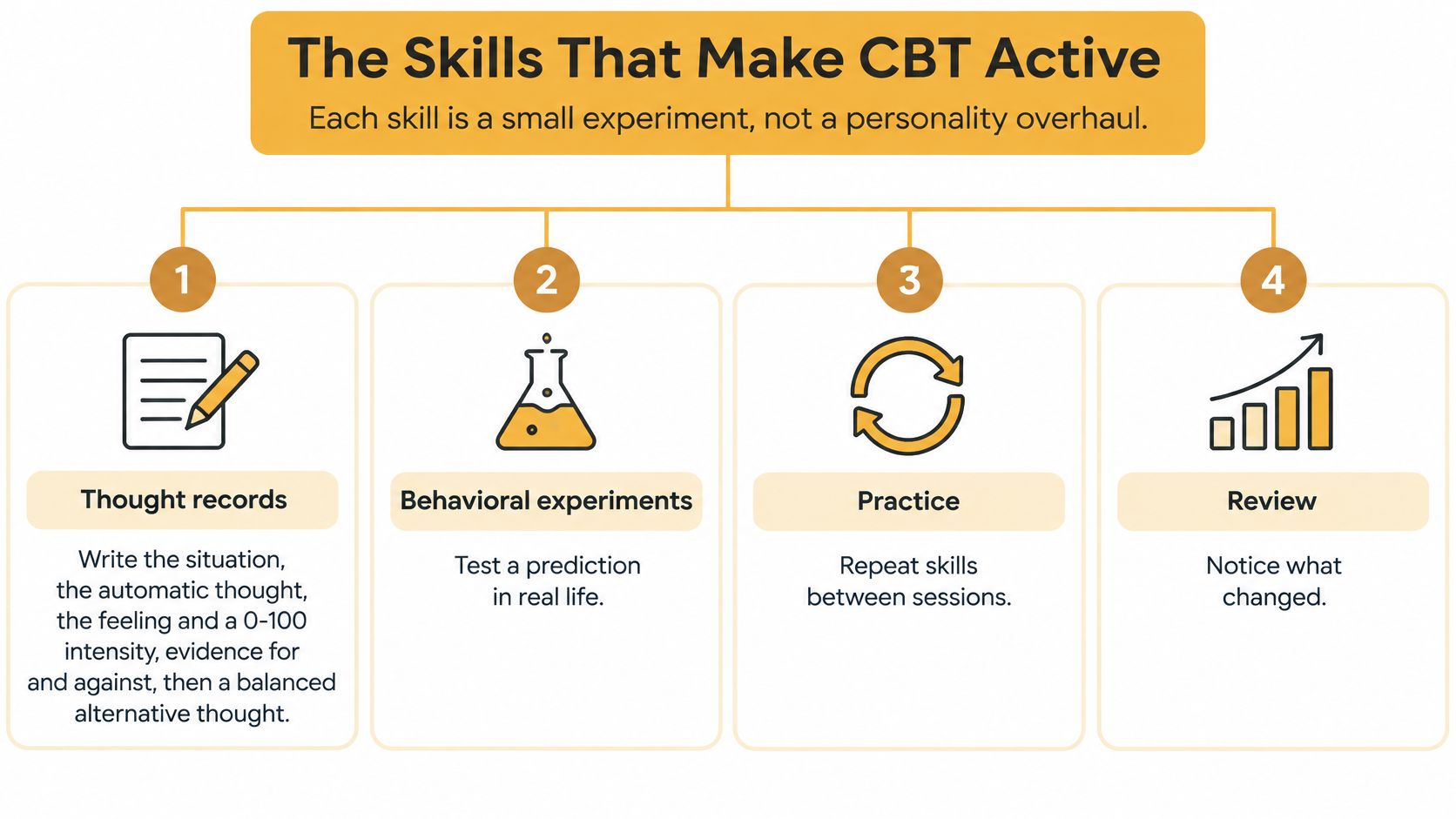
CBT skills work best as small experiments, not attempts to overhaul your personality. Each gives you something observable to practice and review.
The diagram captures that rhythm: notice, test, practice, and review.
Put a thought on paper
A thought record slows an interpretation down enough to examine it. Write the situation, the automatic thought, the emotion, and its intensity on a scale from 0 to 100. Then note evidence supporting the thought, evidence that doesn't fit it, and a balanced alternative.
Say Sunday-night dread brings the prediction that you'll fail at everything tomorrow. A useful alternative isn't a promise of a perfect Monday. It might acknowledge that a demanding meeting is ahead, that you've prepared, and that you can ask for clarification if needed.
The alternative should respect the facts. If you don't believe what you've written, make it more precise rather than more cheerful.
Learn from action
A behavioral experiment starts with a prediction and ends with a comparison. If you expect that speaking up will lead to rejection, a safe test might involve offering a suggestion in a low-stakes conversation and recording the actual response.
A declined invitation offers another example. Rather than concluding that nobody wants your company, you could suggest a different time and see whether the person engages. The point isn't to guarantee acceptance. It's to collect information that your initial conclusion left out.
Exposure addresses avoided situations through planned, repeated contact. With a clinician, you might build a ladder from easier to harder situations, remain engaged rather than escaping at peak anxiety, and review what you learned. Anxiety may ease during practice, but immediate calm isn't the only sign of useful learning.
Safety boundary: When fear, compulsions, or trauma are involved, learn exposure and behavioral experiments with a clinician. Don't use an exercise to test genuine danger.
For another way of approaching the skills, watch this video.
Build activity and prepare for setbacks
When low mood has emptied the week, activity scheduling makes the next action concrete. Plan something doable, such as preparing lunch or walking to the corner, then note the pleasure or sense of accomplishment afterward. Behavioral activation doesn't require you to enjoy every activity before it counts.
Other skills address different sticking points:
- Problem-solving: Define a practical difficulty, list options, choose a manageable step, and review the result. For an overdue bill, the first step might be finding the account details rather than solving your whole financial situation.
- Relapse-prevention planning: Name early warning signs and the skill you'll return to. If withdrawing from friends is an early sign of worsening mood, your plan might include arranging a brief check-in and contacting your therapist.
Choose a skill for a specific situation this week. Repeating a modest, well-chosen exercise is more useful than turning every uncomfortable moment into a therapy assignment.
What to Expect in a Course of CBT
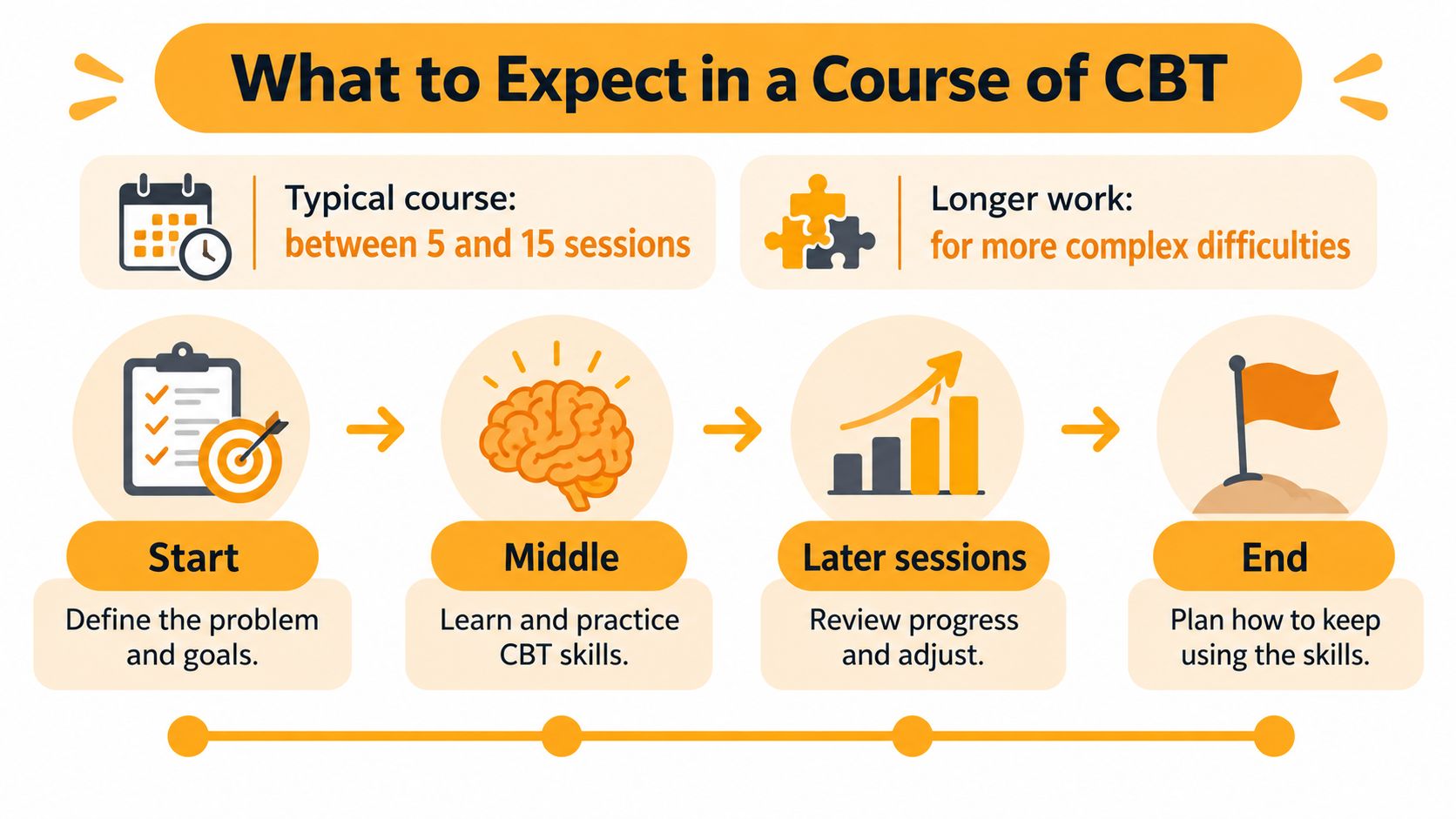
A typical course usually involves between 5 and 15 sessions, depending on the problem, according to the NHS guide to CBT. More complex difficulties may require longer work, so treat the expected length as something to discuss rather than a deadline you must meet.
You don't need to arrive knowing which technique you need. The first task is helping the clinician understand what's happening, how it affects daily life, and what you'd like to change.
The course has a recognizable arc, with room to adjust.
From describing the problem to practicing change
Early sessions involve assessment, including safety, relevant history, current difficulties, and goals. Your therapist may help turn a broad wish, such as feeling less overwhelmed, into something you can recognize in daily life: attending a meeting, returning a message, or getting started on necessary tasks.
Middle sessions focus on applying selected skills to situations you're facing. Sessions are collaborative and often include a check-in, an agreed focus, practice, and a task to try afterward. You're allowed to say that a goal feels unrealistic or that an exercise doesn't make sense.
Later sessions involve reviewing progress, adjusting what hasn't helped, and preparing to keep using effective skills after regular appointments end. A relapse plan identifies warning signs and a response, rather than assuming you'll never struggle again.
What between-session work feels like
Practice isn't an optional extra. It's where you find out whether a skill helps outside the consulting room.
That might mean a brief thought record after a difficult meeting or a scheduled walk on a low day. It can also involve noticing emotion and body sensations without immediately reacting, or gradually approaching something you've been avoiding. The task should fit your capacity, not become another impossible demand.
If you didn't complete it, tell your therapist what happened. Confusion, exhaustion, fear, or disagreement with the task are useful information. A collaborative clinician helps you adjust the assignment rather than treating noncompletion as a character flaw.
CBT may be offered individually or in groups, in person or remotely. The format changes the experience, but active practice remains central.
Before starting, ask:
- Expected course: How much treatment do you anticipate for this difficulty?
- Practice expectations: What will I be asked to do between appointments?
- Progress review: How will we decide whether this is helping and when to change direction?
Clear answers make it easier to participate with realistic expectations.
How Strong the Evidence Really Is
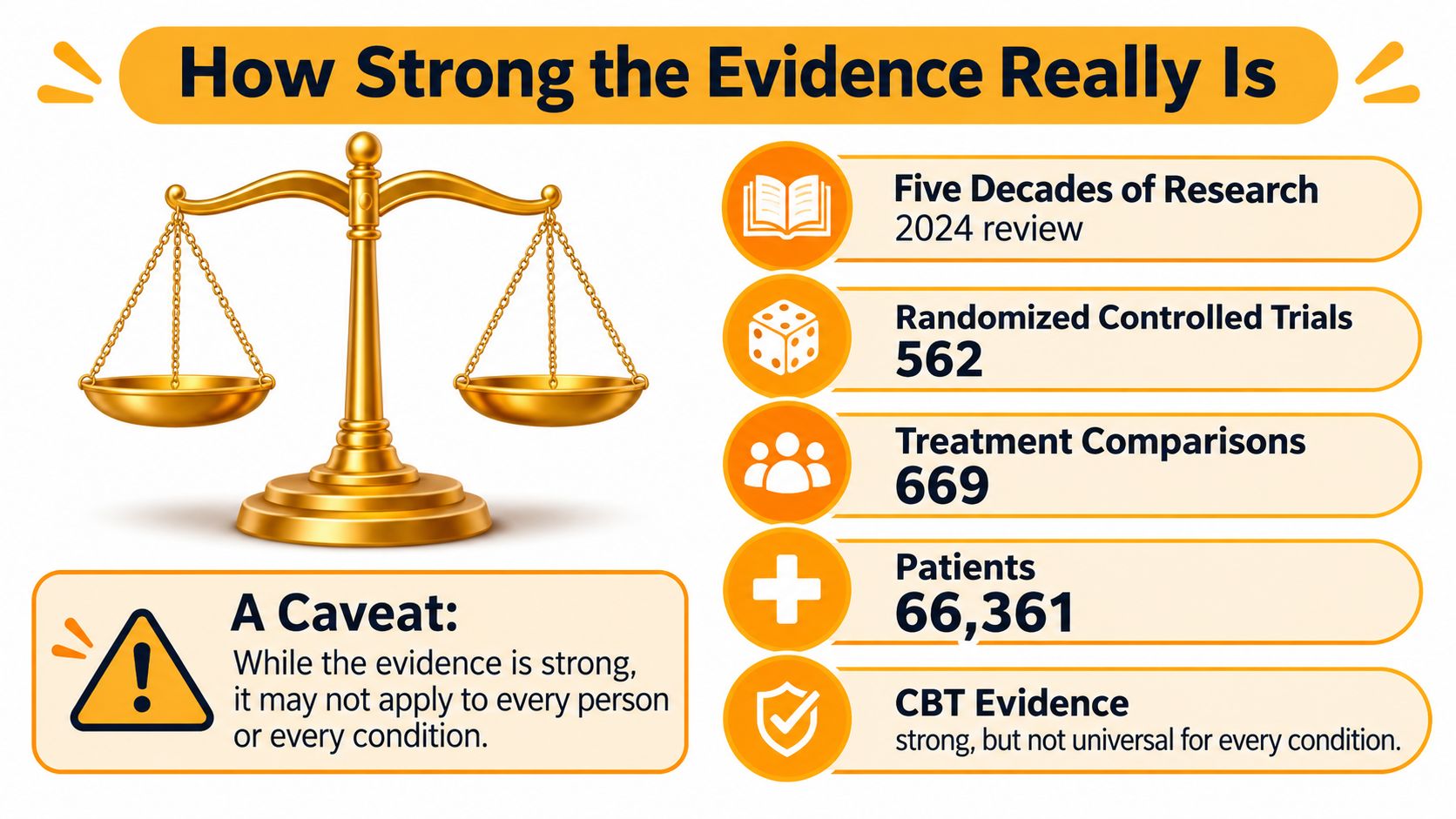
CBT has a substantial evidence base, but well studied doesn't mean universally superior. A 2024 review of five decades of psychological-treatment research covered 562 randomized controlled trials, 669 treatment comparisons, and 66,361 patients, with CBT accounting for 52% of depression psychotherapy trials; the review findings and the NICE anxiety evidence review support distinguishing treatment benefit from claims that CBT always beats other therapies.
The depression review didn't establish that CBT was necessarily more effective than other bona fide therapies. Its prominence tells you a great deal about how extensively it's been examined, but it doesn't settle which approach will suit a particular person.
What the major CBT reviews actually show
| Question | What the evidence shows | What it does not prove |
|---|---|---|
| How studied is CBT for depression? | The large depression review identified CBT as the most extensively examined approach | That CBT always beats other bona fide therapies |
| Does CBT beat waitlist for anxiety? | NICE found statistically significant large improvements in clinician-rated anxiety and moderate improvements in self-rated anxiety, plus moderate-to-large improvements in anxiety, depression, and worry | Certain long-term effects versus inactive controls |
| Is it reasonable for milder depression? | NICE found good evidence for individual CBT, group CBT, and behavioral activation, judged likely cost-effective on average for less severe depression | That every person improves regardless of delivery or engagement |
The anxiety findings covered 11 CBT interventions compared with waitlist controls. That comparison matters: doing better than waiting for treatment is meaningful, but it isn't the same question as doing better than another credible treatment.
This visual summarizes the scale of the evidence, alongside its boundary.
Read the findings as a starting point
Clinician ratings and self-ratings measure different perspectives. A clinician might observe meaningful symptom change while a person still feels substantially affected. Both perspectives deserve attention when deciding whether treatment is worthwhile.
Similarly, average cost-effectiveness doesn't mean a particular course will be affordable, available, or sufficient for you. It supports considering the treatment, not promising an individual outcome.
CBT is commonly used for depression, anxiety disorders, obsessive-compulsive disorder, insomnia, and attention-related difficulties. That list doesn't mean the same exercise treats every condition. Diagnosis affects the techniques, pacing, and length of care.
For a reader asking what CBT is, the practical conclusion is encouraging without being absolute: it's a well-studied framework worth considering. Your outcome still depends on appropriate assessment, delivery quality, engagement, and whether the treatment fits the problem you're trying to address.
Limits and Risks of CBT
CBT isn't a cure-all. Some people don't improve, some stop treatment, and others need a different approach or additional care. Difficulty benefiting isn't proof that someone didn't try hard enough.
Exercises also need sensible boundaries. Exposure can temporarily increase distress, so pacing matters when fear, compulsions, or trauma are involved. A thought record can become counterproductive if you use it to prosecute yourself for having the wrong thoughts.
When practice becomes another problem
Repeatedly checking whether a thought is true can turn into reassurance-seeking, rather than useful testing. If you keep reviewing the same evidence but feel unable to stop, bring that pattern to a clinician instead of adding more worksheets.
Self-guided practice also lacks someone responsible for assessing suicidal thoughts, psychosis, mania, eating disorders, or substance misuse. These concerns need professional assessment, not an app-based attempt to determine whether self-help is enough.
- Immediate danger: If you might act on thoughts of harming yourself or someone else, seek urgent local help or emergency services.
- Worsening functioning: If you can't manage basic responsibilities, sleep, eating, or personal care, arrange clinical support.
- Distress during practice: Pause an exercise that's overwhelming you and discuss it with a qualified professional.
Our safety guidance explains the boundaries of self-guided support.
Choosing more support isn't abandoning the work. It's matching the level of care to the level of risk.
Treatment choice also involves uncertainty about lasting benefit and alternatives. Cultural mismatch can make a technically correct exercise feel irrelevant or invalidating. The answer isn't to avoid CBT automatically, but to choose a format and clinician who can respond to your circumstances.
Why One Worksheet Does Not Fit Everyone
A worksheet can look neutral while assuming a particular kind of life. An example that treats independence as the obvious healthy goal may miss someone whose distress centers on family duty, shared decision-making, or caregiving.
Language, spirituality, stigma, family structure, and explanations of distress all affect whether an exercise makes sense. If those features are ignored, a person may be asked to challenge a belief before anyone has understood what it means.
Keep the method and change the fit
Consider someone who feels torn between rest and caring for relatives. A balanced response doesn't have to reject family responsibility. It might acknowledge that caring matters while testing whether asking for help would disappoint everyone.
The smoke-alarm metaphor may work better as a shared household story than an individual one. Spiritual meaning may belong inside a balanced thought rather than being treated as a distortion to remove. These changes can preserve careful examination and action while respecting the person's values.
An evidence-based framework for culturally adapting CBT discusses adaptations involving language, familiar metaphors, social norms, explanatory models, caregiver involvement, and religious or spiritual elements. Reviews generally report favorable outcomes, but don't establish which specific adaptations help most, and some adaptations are only peripheral or insufficiently described.
Adaptation isn't automatically better
The findings aren't uniform. A Latin American systematic review found no clear difference in effectiveness or retention between conventional and culturally adapted CBT, while other reviews report advantages for adapted approaches.
That uncertainty supports thoughtful adaptation, not a claim that changing the packaging always improves treatment. Translating a worksheet isn't enough if its goals still conflict with the person's relationships or circumstances.
Preserve the core model, examination of thoughts, and behavior change. Adapt the examples, language, goals, and people involved. A culturally familiar story should still lead to an observable question and a useful action.
Use these checks when an explanation feels off:
- Language and meaning: Does this example match how my people talk about distress?
- Values and relationships: Does the goal respect what matters to me and the people connected to me?
- Method: If I change the story, am I still testing a thought and trying a new action?
You don't have to choose between respecting your culture and learning a practical skill.
Practice Daily Skills or See a Clinician
For an ordinary, manageable situation, a short practice can help you turn understanding into observation. It can support work you're already doing in therapy or offer a starting point while you consider seeking care.
A manageable daily sequence
- Name the situation: Describe what happened in a sentence, without judging yourself.
- Catch the thought: Write the automatic interpretation and mark it as a guess, not an established fact.
- Notice emotion and body: Rate the feeling from 0 to 100 and identify where you feel it physically.
- Choose an action: Try a small, safe alternative to avoidance or a scheduled activity.
- Review the result: Compare what happened with what you predicted, including anything still uncertain.
Our Luno: Self Care companion offers 10 evidence-based healing protocols, each in an adaptive 14-day arc: Anxiety Relief (CBT Breathing), Grief & Loss (Narrative ACT), Burnout Recovery (Somatic Boundaries), Sleep Repair (CBT-I), Self-Esteem (Schema IFS), Trauma Processing (Trauma-informed CBT), Relationship (DBT Attachment), Depression Lift (Behavioral Activation), Focus & ADHD (Mindfulness Structure), and a user-defined Custom Package. You can start with the topic you need, with reflection and gentle accountability rather than generic advice.
Know which kind of support you need
Luno feels like therapy, but it is not therapy. A personal, continuous practice can feel therapeutic without creating the professional relationship that the American Psychological Association describes as central to psychotherapy.
We're a self-guided mental wellness companion, not a replacement for therapy, a diagnostic service, or crisis care. AI-generated guidance is general self-improvement support, not individualized clinical advice.
Choose daily practice when you need structure. Book a clinician when the issue is risk of harm, severe impairment, an unclear diagnosis, unmanageable trauma, or no meaningful change despite steady practice.
Luno: Self Care offers personalized daily plans, reflection, and small practices to help you apply CBT-informed skills to everyday situations. Visit Luno: Self Care to choose a topic that fits what you're facing and begin a manageable daily routine, alongside professional care when you need it.