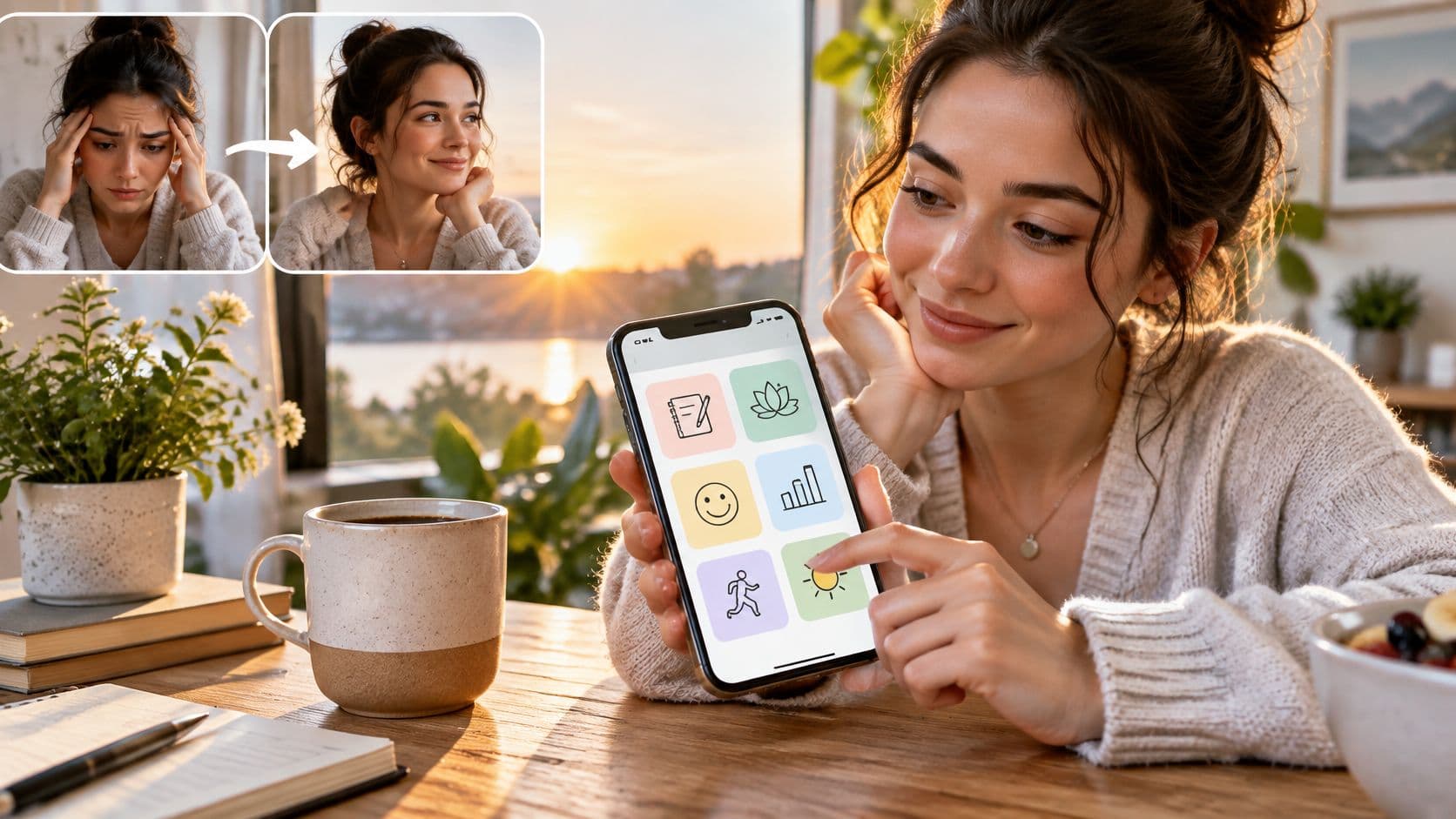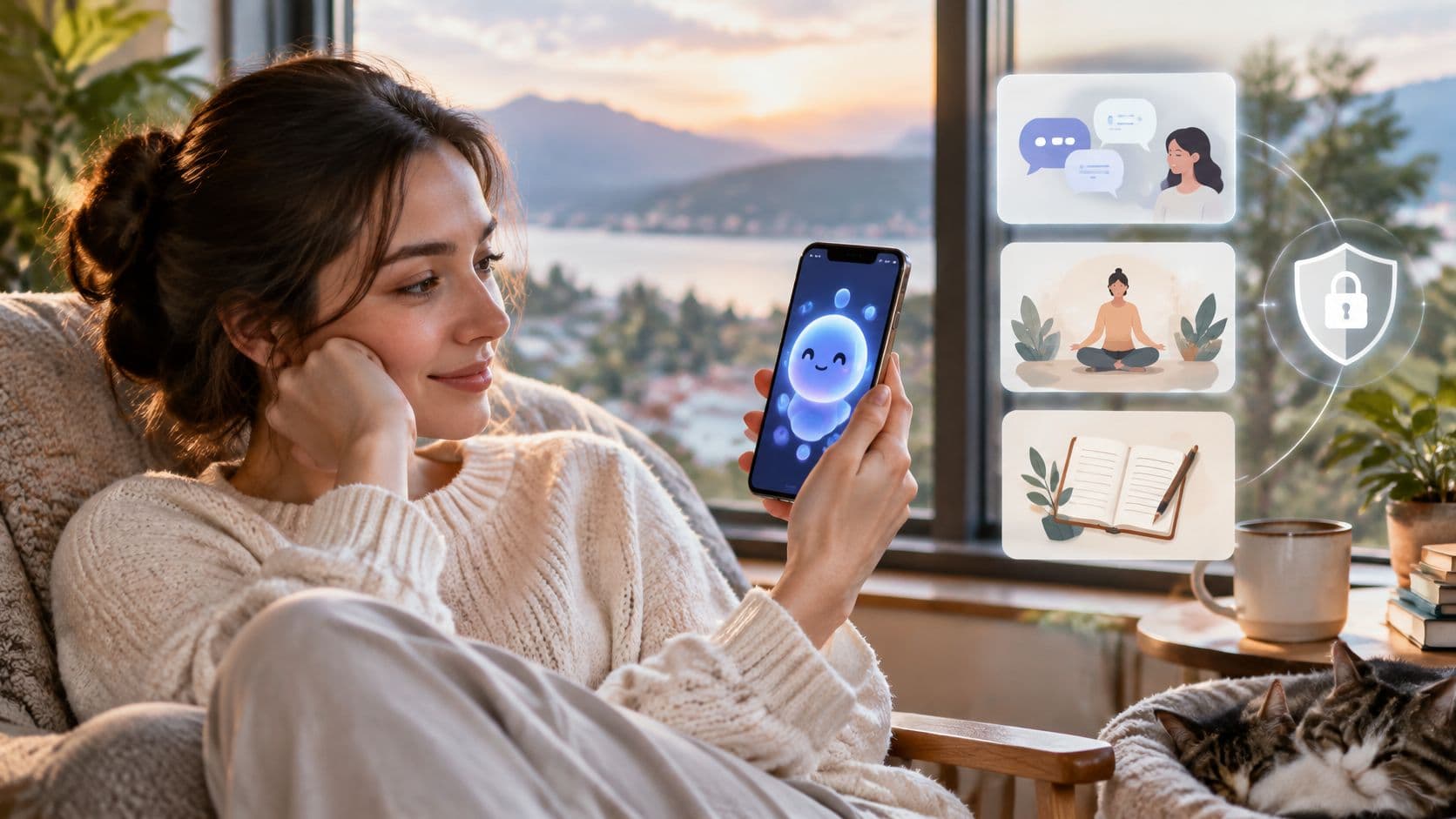
You sent a late-night message because the room was quiet and your mind was not. The companion wrote back with real warmth. It did not build a practice, a journal thread, or a plan you could use in the morning. The next evening starts from zero again.
That is the moment many start comparing Replika alternatives, and they are not all shopping for the same thing. Some want a character to play with. Some want a conversation partner. Some want a structured self-care program.
A 2026 survey by Elon University's Imagining the Digital Future Center screened 4,268 U.S. adult internet users and found that 27% had engaged in significant social, emotional, or personal interactions with systems such as ChatGPT, Gemini, Claude, or Copilot. Among those AI-companion users, 31% said they considered the chatbot a friend. Warmth is already common. A path forward is not.
Judge each option on chat style, therapeutic grounding, journaling, personalization, privacy, pricing, and its honest limits. An app can feel like therapy. It is not therapy, and none of these replaces a licensed clinician or a crisis line. You can look for support on sleep, grief, focus, and plenty of other topics. Depth varies widely.
1. Luno: Self Care
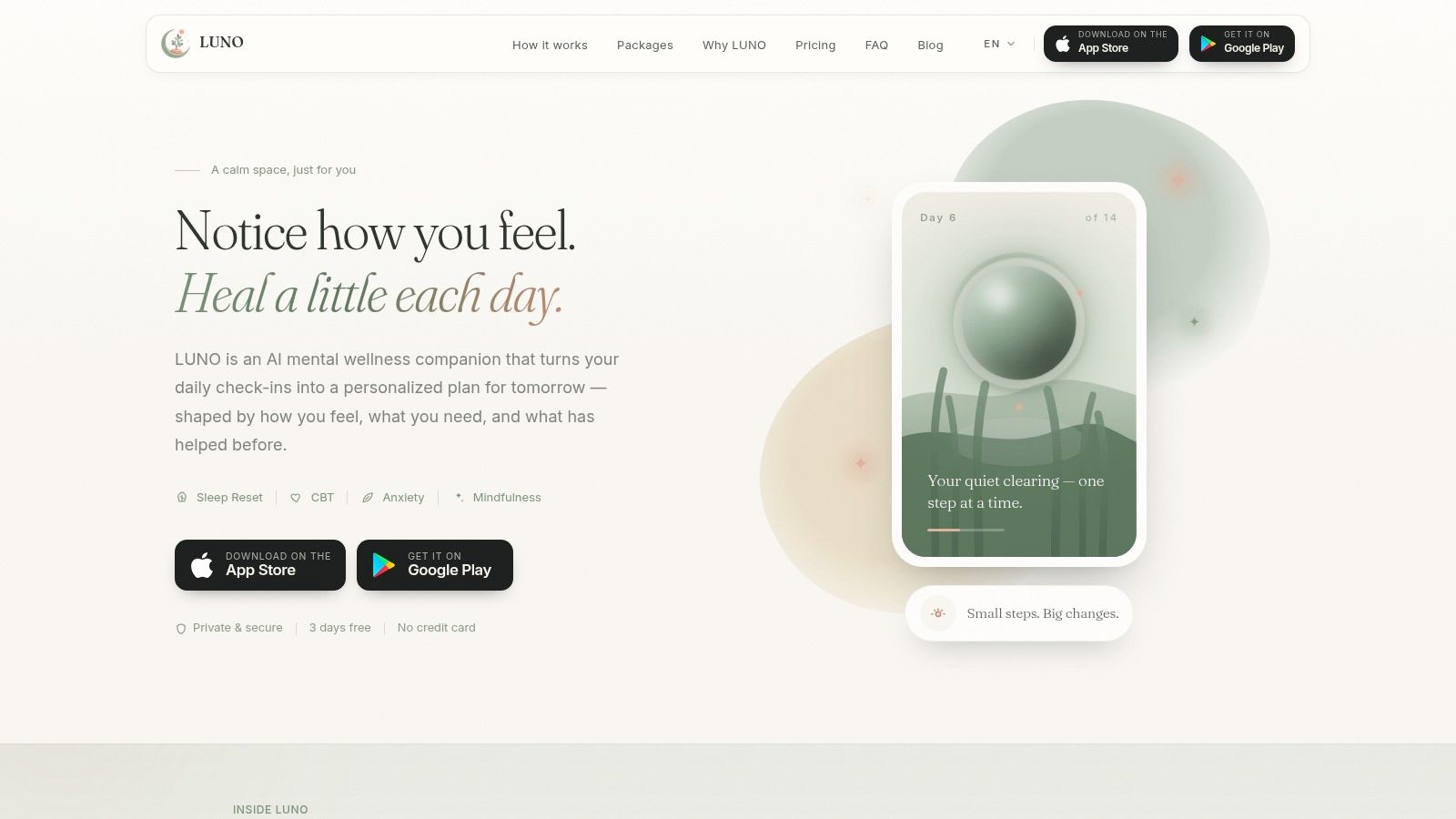
If you want a structured self-care program rather than a companion to roleplay with, Luno: Self Care is the clearest fit in this list. It is an AI mental wellness companion for iOS and Android that turns a daily check-in into a plan for tomorrow. The plan reflects how you feel, what you need, and what has helped before. Living Memory carries patterns, wins, and setbacks across the journey, so a new plan builds on the last one. Skip a day, a week, or a month, and the app re-anchors to your history instead of forcing a hard reset. That continuity matters when motivation is uneven, which is the normal condition for most self-care routines.
The World Health Organization reports that both guided and unguided psychological self-help can reduce symptoms, and that digital delivery can reach people who are otherwise hard to reach. That evidence base explains why good self-help tools borrow the tone and structure of therapy. The line is scope. FDA design guidance says a digital mental-health product should state prominently that it does not diagnose or treat disorders, is not a replacement for psychotherapy, and is not for crisis situations. Luno holds that line. Journeys, suggestions, and check-in feedback are generated by an AI system. A human professional does not review them unless you use one of your plan's Expert questions, and those answers are advisory and limited to the context you provide.
Protocols you can actually name
The National Institute of Mental Health treats anxiety disorders, ADHD, depression, and traumatic events as separate health topics. Luno's ten 14-day protocol packages follow that spread: anxiety, sleep, burnout, depression, grief, self-esteem, trauma, relationships, and focus or ADHD, plus a custom package. Methods include CBT, CBT-I, ACT, DBT, IFS, and somatic practice. That range is the product's main advantage over a general companion. It also sets the limit. Persistent, severe, or overlapping problems need a clinician, and no app should be asked to replace one.
- Adaptive plan: Tomorrow's tasks follow the latest check-in, not a fixed lesson list.
- Journaling: The app offers journaling, with voice journaling available on higher plans.
- Signals: Apple Health integration starts on Grow. Oura is limited to Bloom.
Pricing is simple to compare. Seed is $4.99 a month and includes one improvement journey, daily check-ins, and mood tracking, with no Expert questions. Grow is $9.99. Bloom is $12.99 and includes a five-seat Family plan. Every tier starts with a 3-day free trial with full access to the chosen tier. No credit card is required, and you can cancel anytime before the trial ends. Plans are available monthly or annually, and the price shown in the app can vary by region or currency. Data is encrypted in transit and at rest, is not sold, and is not used to train third-party models. You can export or delete it.
I would steer you to Luno when the problem is follow-through on a specific routine, and away from it when what you want is open-ended companionship. Treat the guidance as general self-improvement support, not individualized clinical advice. Keep your own judgment on health, safety, and significant life decisions. Luno is not a crisis service and not a replacement for therapy.
Practical rule: If the night feels like an emergency, leave the app and contact a local crisis service or a clinician. Use the daily plan for ordinary, repeatable work.
2. Nomi
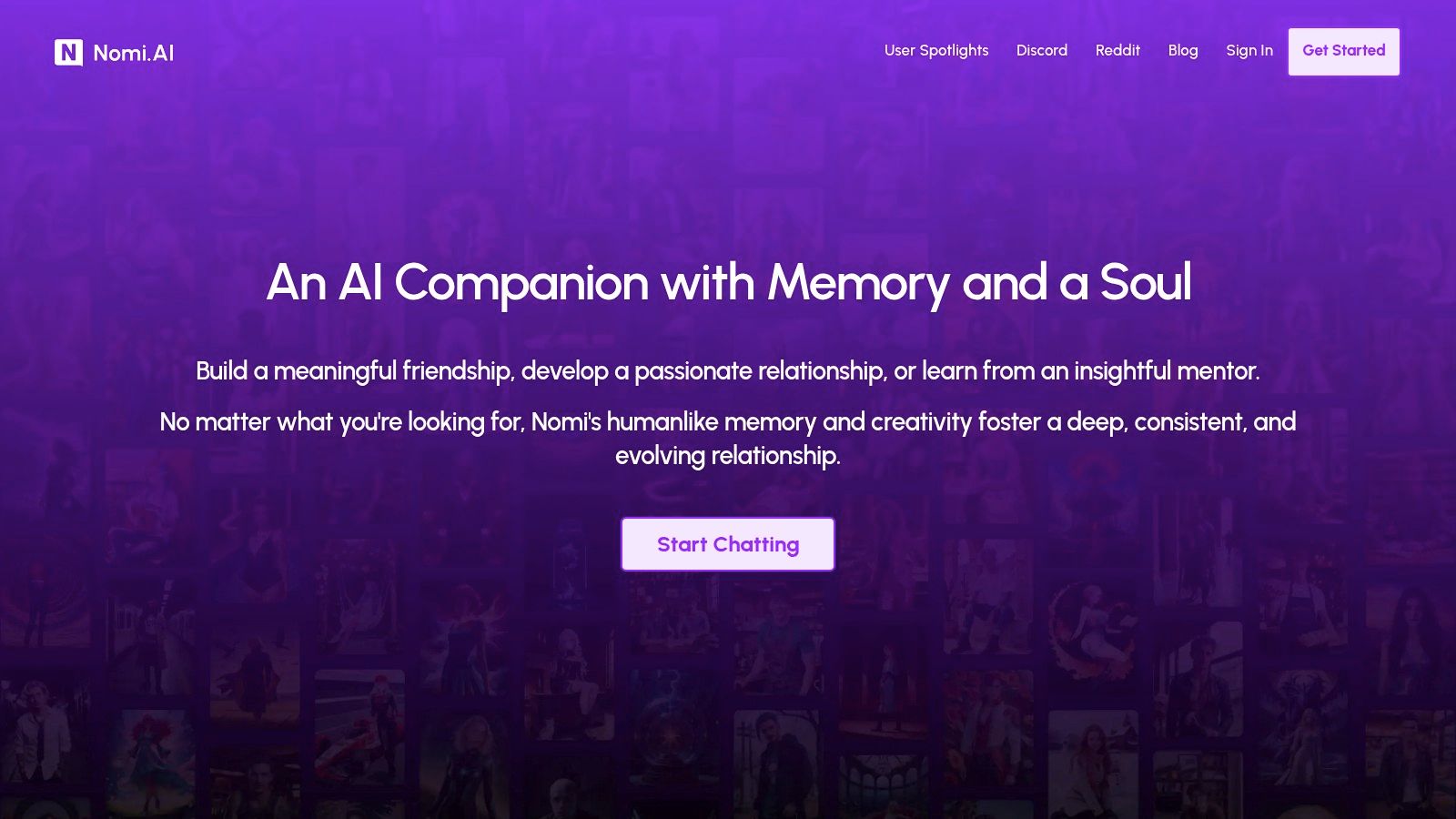
Nomi suits the reader who wants one familiar presence to return to, not a program that assigns homework. The core feature is short-term and long-term memory: it holds the thread of prior chats and uses that continuity to make the next conversation feel like a continuation. You can define a companion's identity and backstory, keep several companions, and open group chats. Voice, image, and visual customization sit alongside text.
That continuity is the appeal for friendship, roleplay, and romantic-companion use. Nomi is built for adults, and it stays in its lane. It will not give you a two-week insomnia protocol or a burnout worksheet, and asking a companion app to do clinical work puts both the tool and the reader in the wrong position. If an app-store listing is unavailable in your region, the web app may still be accessible. Some features require a subscription, so check the checkout screen before you attach a card.
A remembering conversation and a bounded wellness routine do different jobs. Keep Nomi when the need is relationship continuity, shared history, and a personality you chose. Move to a structured program when the goal is a repeatable exercise aimed at sleep, anxiety, or mood. For the structured end of this list, the Luno: Self Care FAQ explains that self-guided approach. I would judge Nomi on whether its memory feels accurate after a week, not on whether it can run a therapeutic protocol.
- Strength: It holds the thread of past chats, which is the whole reason to choose it.
- Flexibility: Several companions and group rooms let you separate moods or storylines instead of locking one persona.
- Limit: Adult companion chat is not structured mental-wellness support, and memory accuracy still needs testing.
You can start at Nomi.
3. Kindroid
Kindroid asks you to build the character instead of picking one off a shelf. Backstory, behavior, and relationship style are yours to tune. Memory is split into short, medium, and long layers, and chat can move from text to voice calls and video calls. Individual and group rooms are both available.
The blank page is the trade-off. People who already know the companion they want tend to like the control. People who wanted to be met, not to write a spec, often stall in setup. Higher memory limits and some call features depend on the paid tier. Recalled details are a design goal, not a guarantee, so test a fact you shared yesterday before you trust a fact from last month.
A companion that lets you edit the personality will feel precise. It will not feel effortless on day one.
Kindroid runs on the web and on mobile. Pricing changes by tier and by platform, so compare the checkout screen with how often you call or generate media. It is a strong Replika alternative for character craft. It is a weak one if you wanted coping skills, sleep steps, or a plan that survives a missed week.
Open it at Kindroid.
4. Character.AI
Character.AI is a library, not a single relationship. You browse user-made characters, spin up your own, and spend an evening in roleplay or storytelling. Web and mobile access, plus a free tier beside paid plans, make it easy to sample personalities without marrying one.
Quality swings. One character stays in voice for a long scene. The next forgets the premise by message twelve. There is no structured wellness track underneath the fiction, and nothing in the interface nudges you toward coping skills or reflection. If you plan to keep months of personal writing inside a single chat history, check the company's own service status first, because a library this large changes shape often.
A 2025 evaluation of 29 commercial AI mental-health chatbot apps found that none met the study's predefined standard for an adequate suicide-risk response. 48.28% were fully inadequate, and 51.72% met only relaxed marginal criteria. Character libraries were not built as crisis tools, and good improv does not change that arithmetic. Before you move sensitive disclosures into any app, test whether it surfaces region-appropriate crisis resources. Luno's safety page spells out where its own limits sit.
Use it for play, fan fiction, and low-stakes conversation. Keep the heavier material somewhere with a protocol behind it. Try the library at Character.AI.
5. Pi
Pi skips the avatar workshop. The pitch is a calmer, personable conversation you can open without designing a backstory. It is on the web and in mobile apps, and the public offering has been free to try, which makes it a low-friction conversation partner for everyday thoughts.
That calm is also the ceiling. You get less control over a persistent persona than you would in Kindroid or Nomi. There is no therapeutic program, no symptom protocol, and no crisis service hiding behind the friendly tone. A 2024 qualitative look at generative mental-health chatbots found high satisfaction alongside a clear drop in engagement when replies felt repetitive, inaccurate, or poorly matched to context. If Pi starts looping, that is your signal to stop treating the chat as support.
Check current data controls before you share anything you would not want retained. I like Pi for a first, low-stakes conversation. I would not park grief, trauma, or a safety plan there.
Start at Pi.
6. Wysa
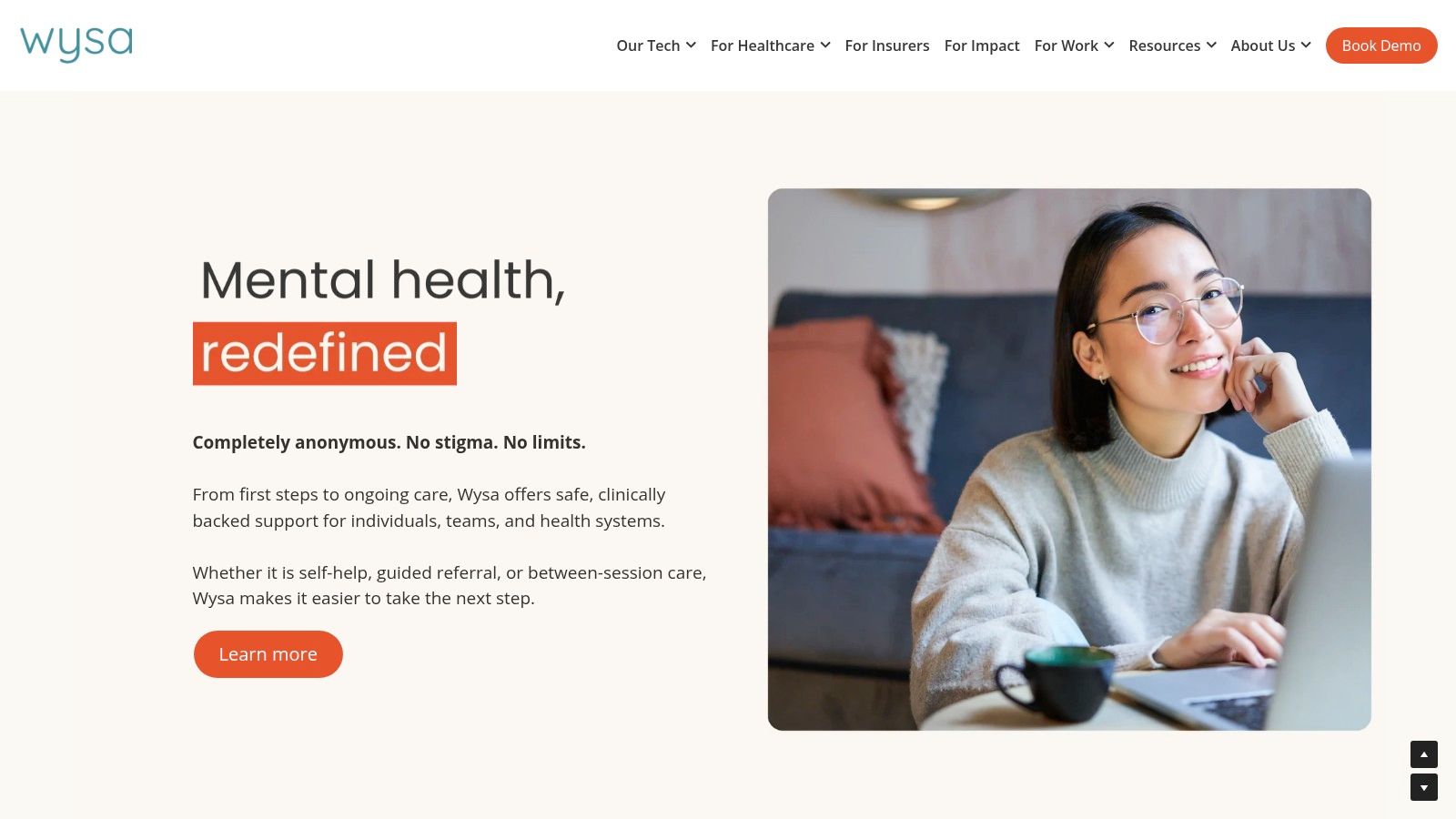
Wysa sits in the structured self-care group. It is a guided program with a chat window, not a companion you shape into a character. The AI talks through thoughts and feelings, then points you at CBT-informed exercises, mindfulness, and breathing. Human coaching appears in some plans and regions. The company says plainly that it is not for emergencies, which is the right frame for a program built around short guided check-ins.
That guided shape is the whole trade. Free access includes some tools, enough to see whether a few minutes of check-ins fit your routine. A coaching plan can cost much more than a basic subscription, so decide what the extra money buys before you commit. The structure helps when you want a skill to practice. It frustrates when you want to wander, build a persona, or keep an open-ended conversation going. Wysa will not follow a backstory or play along with a romantic thread.
The limits are the useful part. Wysa is not a therapist, not a crisis line, and not a replacement for professional care. It is a place to try a breathing exercise, work through a CBT prompt, and notice a mood pattern. If you need a confidant at 2 a.m., you are shopping in a different category.
I recommend Wysa when you want a program with exercises and a clear end point to each session. Start with the free tools and one exercise. That will tell you whether the format feels supportive or mechanical. I would not choose it for companionship, role-play, or a safety plan. Check plan details for your region, because coaching availability varies.
Wysa lives at Wysa.
7. Earkick

Earkick pairs an AI self-care coach with mood and anxiety check-ins, progress views, and habits. Breathing, grounding, and CBT exercises sit beside soundscapes, and the listing includes Apple Watch support. It fits someone who wants to talk and then track a behavior. It does not fit someone shopping for an AI relationship.
The National Institute of Mental Health's caring-for-your-mental-health guidance points to regular activity, sleep, breathing and other relaxation, goals, challenging unhelpful thoughts, gratitude, and staying connected. Those are the kinds of concrete tasks a tracker can nudge. NIMH also frames them as self-care, not proof that an app treats a disorder.
There is a free option, with paid features behind a subscription. The App Store listing says some data may be collected, so read the policy before you sync a watch or a mood history. Our own privacy controls are the standard I would compare against: encryption, export, and deletion, with no sale of reflections and no training of third-party models. Earkick is not clinical treatment and not a crisis resource.
See it at Earkick.
8. CHAI
CHAI is a social shelf of user-made personalities and stories. If you left a single companion because you wanted variety, the range is the appeal. Chat and storytelling run on the web and on mobile, with paid web options that may not match the mobile account experience.
Nothing in that design is a wellness curriculum. Character quality and tone change from one persona to the next, so a lovely first chat does not predict the tenth. Treat it as casual entertainment and creative roleplay.
Before you pour personal history into any character platform, read the rules you are accepting. Our terms of use are a useful contrast: you agree not to misrepresent your age or identity, not to scrape or extract the models, and not to use the service in a way that could harm or overburden it. A story app should be just as plain about what you may not do, and about what it will not do for your health.
Browse CHAI for personas. Do not ask it to hold a care plan.
9. Talkie
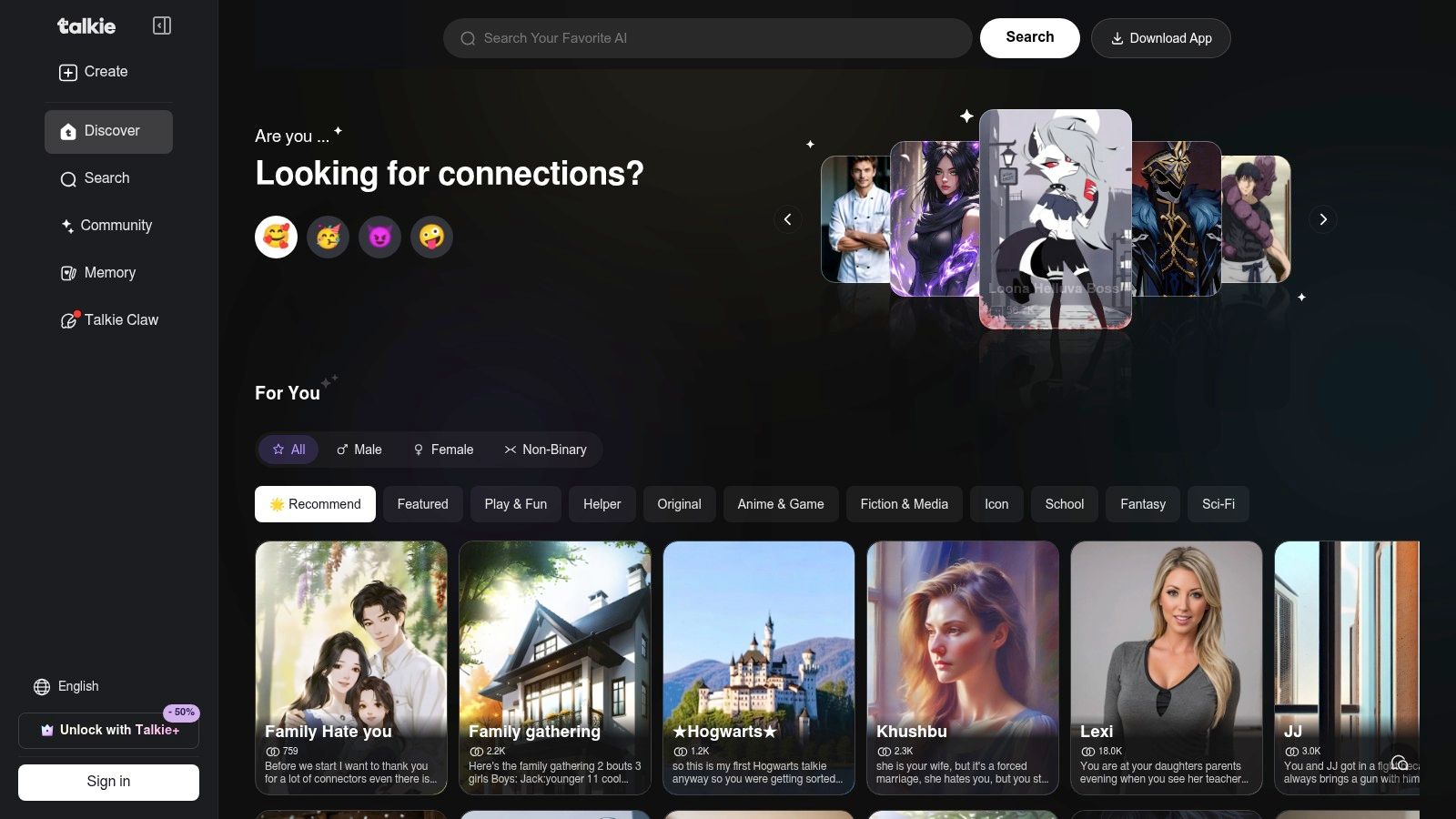
Talkie centers the character library. You browse user-made characters, build your own, and personalize a profile, with text and voice-oriented features. Web access matters, because app listings have changed by store and by region, including the name you might be searching.
It scratches the same itch as persona chat inside older companion apps, and it does that without pretending to be CBT or a daily wellness plan. Content quality is uneven. A character that is funny in the preview can flatten once you leave the script.
If you outgrow it, leave cleanly. Look for export and deletion before you invest months of writing. Our account deletion page is the kind of control I want to see in writing, not buried in a support ticket. Store availability will keep shifting, so confirm the current listing rather than an old review.
The site is Talkie. Keep it in the entertainment column.
10. Youper
Youper is discontinued. If an old roundup sent you looking, the trail ends there: no current feature set, no pricing page, no official site worth assessing. Treat it as closed, not as a hidden gem you failed to find.
Where it sat matters for what you pick instead. Youper belonged to the structured wellness column rather than the persona-chat column, so its disappearance costs you a routine rather than a character. A companion app that shuts down takes a story with it. A self-care app that goes dark pulls the scaffolding out of a hard week, and that is the heavier loss if the scaffolding was the reason you opened the app at all.
I would make data ownership the deciding question for anything you plan to use for months. Confirm you can export or delete what you write before you commit, and keep anything clinically meaningful with a professional or in a journal you own. The apps that survive scrutiny are the ones that state their limits plainly, keep a cancel path visible, and stay available when you need them.
How the Replika Alternatives Differ at a Glance
The useful comparison is the job each app performs and where that job stops. The rows below sort into character play, open chat, and guided self-care.
| Tool | Best for | What you get |
|---|---|---|
| Luno: Self Care | Personalized self-guided wellness | Nine 14-day topics plus a custom package; daily plans adapt; Seed $4.99/month, Grow $9.99/month, Bloom $12.99/month; 3-day free trial |
| Nomi | Ongoing AI companionship | Open-ended companion chat; some features paid |
| Kindroid | Custom AI character building | Character creation and customization; paid tiers |
| Character.AI | Roleplay and varied characters | Character chat; free tier and paid subscriptions |
| Pi | Supportive everyday conversation | Open-ended chat; free public offering |
| Wysa | Guided coping skills | CBT-informed and mindfulness exercises; free tools, paid coaching |
| Earkick | Mood tracking and self-care habits | Exercises and habit tracking; free option with paid features |
| CHAI | Casual character chat | Character-based storytelling; paid web subscription |
| Talkie | Creating AI characters | AI character creation and chat |
| Youper | Nothing current to compare | Discontinued; no live plans or prices |
Read the detail column as a limit. Luno is the only row with a fixed protocol sequence, and it remains self-guided. For sleep or anxiety, pick a row that names a method and states its limits. For company or play, the character tools fit better.
Choosing the Companion That Fits Your Season
Start with the need, not the icon. A character to play with, a conversation partner for ordinary thoughts, and a structured program for sleep, anxiety, or burnout are three different jobs. Free tiers and short trials are how you test whether an app remembers you on a bad day. Read the privacy policy before you paste anything you would not say in a crowded room.
Recent research on AI companions describes emotional support and self-reflection beside pseudo-intimacy, manipulation, privacy risk, and the chance that offline relationships get pushed aside. Safety checks that score one reply at a time miss dependency, withdrawal, and attachment that build over weeks. I would rather have a tool that admits it is not human, skips guilt when you leave, and makes offline contact easier, than a tool that feels exclusive.
A 2025 meta-analysis in the Journal of Medical Internet Research of 14 randomized trials and 6,314 participants found a statistically significant effect of generative-AI chatbots on reducing negative mental-health symptoms, with an effect size of 0.30. That is a modest group finding about chatbots in trials. It is not a personal outcome, and it is not individualized clinical advice. You remain responsible for judgment on health and major decisions.
A small test before you commit
- Memory: Tell it one specific fact, wait two days, and see if it brings the fact back without a prompt.
- A hard day: Describe a rough evening and notice whether you get a next step or only sympathy.
- Exit: Find deletion, export, and cancellation before you pay.
- Scope: If the reply sounds like a therapist, check whether the product says it is not one.
For a self-guided routine, Luno's three-day trial and monthly billing, with cancellation anytime, let you test the daily plan before you commit. If the weight is more than an app can hold, contact a licensed professional or a local crisis service. The right companion for this season is the one that fits the job and lets you leave.
Luno: Self Care turns a daily check-in into a personalized plan for the next day, with 14-day paths for topics like anxiety, sleep, burnout, and focus, while staying self-guided support rather than therapy. If companion chat has been warm but aimless, this is the structured side of the Replika alternatives you have been comparing. Visit Luno: Self Care and use the three-day trial to see whether tomorrow's plan fits today.