You read a message that wasn't meant to hurt, but your body reacts as if it did. Your thoughts race, your voice sharpens, or you go quiet. Later, you replay the moment and wonder why you couldn't respond differently.
Searching for emotional dysregulation treatment can bring a rush of options, but a list of techniques doesn't tell you which one fits your experience. A useful starting point is to notice the pattern: does emotion surge too quickly, linger as rumination, disappear into numbness, push you toward impulsive action, or feel hard to name? The pattern can help point toward a practical next step, while a clinician can help assess what's driving it.
Why Emotional Dysregulation Treatment Feels So Hard to Navigate
A small change in plans can feel enormous when you're already worn down. You might snap at someone you care about, then feel ashamed and search for advice. Instead, you find a pile of treatment names and little guidance about which one matches your situation.
That confusion doesn't mean you're failing to try hard enough. Emotional dysregulation isn't one pattern with one solution. A person whose emotions flare quickly may need different support from someone who gets stuck replaying a conversation, feels emotionally numb, or acts before they've had a chance to pause.
The same label can describe very different experiences. It's like noticing that a room's temperature feels wrong. The problem might be that the heat spikes, the room stays cold, or the thermostat won't settle. Adjusting the wrong setting won't help much, even if you're working hard.
The first question isn't “Which technique is best?” It's “What happens to my emotions, and what do I tend to do next?”
A more useful map starts with that question. It helps you recognize your pattern, understand which skills or forms of care may address it, and notice when support from a qualified professional matters more than self-guided practice. There's no promise of a quick cure, but there can be a clearer way forward.
What Emotional Dysregulation Actually Is
Think of emotions like a thermostat. A steady thermostat helps keep a room within a workable range. An emotional system can overshoot, undershoot, or get stuck at a high or low setting. That doesn't mean you're broken. It means regulating what you feel, and choosing what to do with it, may be difficult in particular situations.
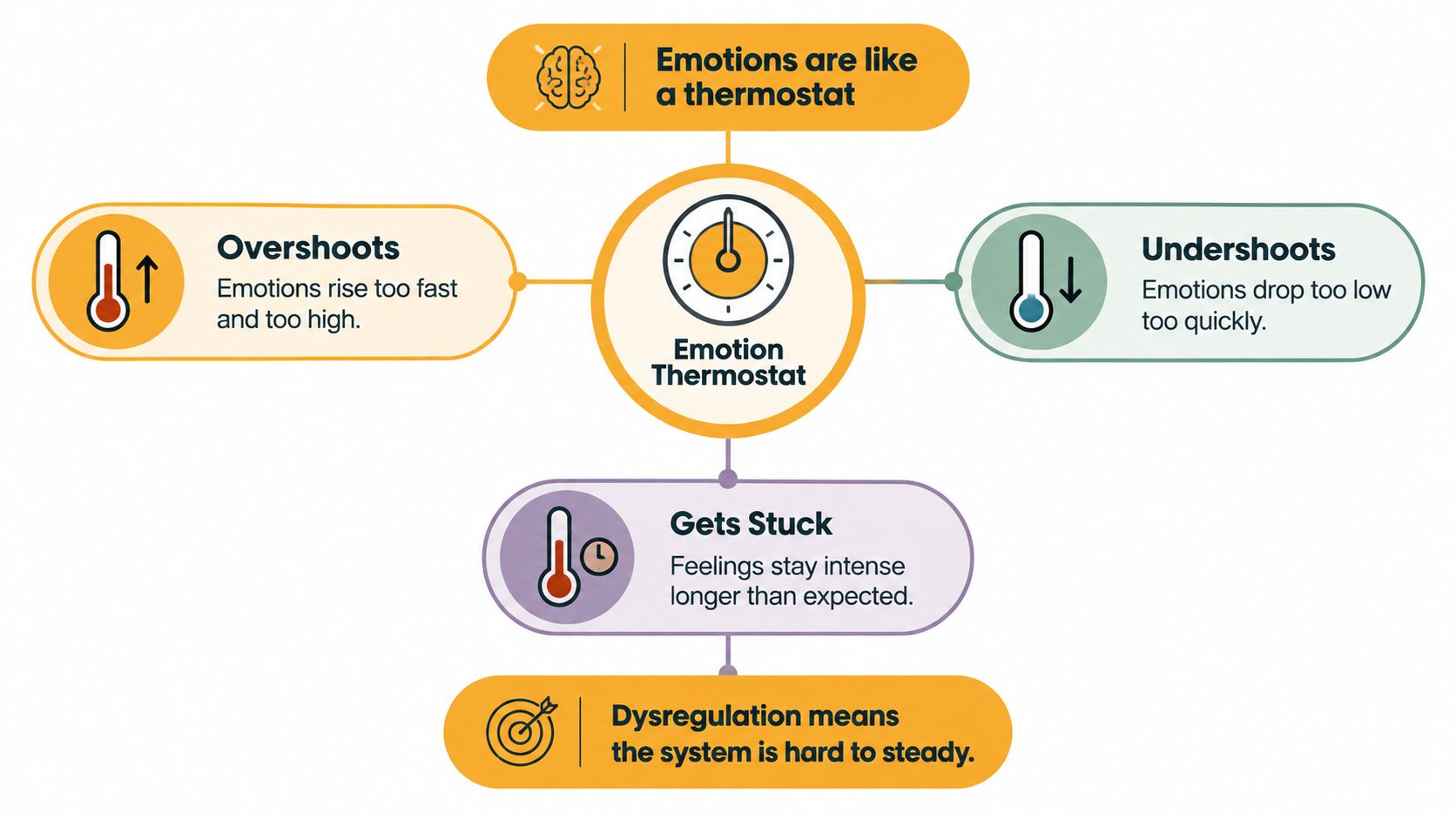
Two parts of the experience matter. Intensity is how strong an emotion feels. Strategy is what you do with it: avoid it, suppress it, accept it, rethink the situation, or take a constructive action. Treatment can work on both. It may help soften the emotional surge and build ways to respond that don't add to your distress.
The word “dysregulation” can hide several patterns:
- Rapid escalation: A critical comment quickly brings anger or panic, and it's hard to pause before responding.
- Rumination: A conversation is over, but your mind keeps replaying it and searching for what you should have said.
- Emotional numbness: You feel flat or disconnected, even when a situation would usually matter to you.
- Impulsivity: You send the message, quit the task, or make a decision before you've had time to consider the consequences.
- Difficulty identifying feelings, sometimes called alexithymia: You know something feels wrong, but struggle to tell whether it's fear, disappointment, anger, or something else.
These patterns can overlap, and they don't tell you what diagnosis, if any, applies. They're a way to describe what you notice. A person who can't name their feelings may benefit from a different first step than someone whose thoughts keep circling a worry. Naming the pattern doesn't diagnose its cause, but it can help you choose what to try and what to discuss with a clinician.
What the Evidence Says About Treatment That Works
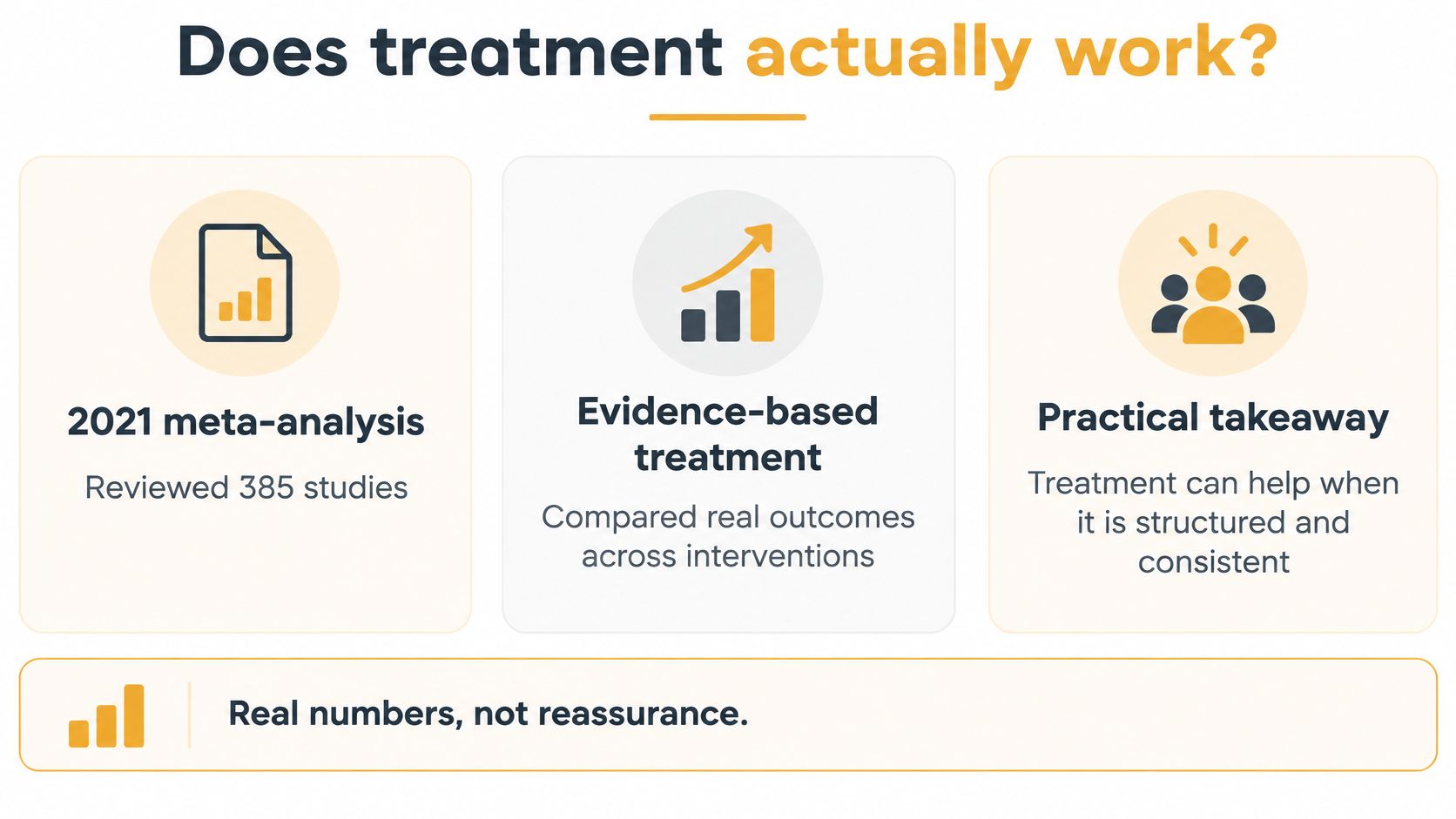
Treatment can help, but it's important to be clear about what the research tested. A 2021 meta-analysis combined 385 effect sizes from 90 randomized controlled trials involving 11,652 participants. Across the 13 studies that measured emotion dysregulation directly, psychological treatment produced a statistically significant, moderate improvement compared with control conditions, with Hedges' g = 0.54 (95% confidence interval 0.30–0.78, p < 0.001) (the meta-analysis of psychological treatments).
A moderate effect doesn't mean every person will improve by the same amount, or that treatment removes all difficult feelings. It means the difference between treatment and comparison groups was meaningful across the studies included. That's a reason for grounded hope, not a guarantee about an individual outcome.
The review also looked at the strategies people used to manage emotions. Treatment reduced disengagement-based strategies, such as avoidance or emotional suppression, with a small effect (g = 0.24 across 83 effects). It increased engagement-based strategies, such as acceptance, reappraisal, and active coping, with an effect of g = 0.26 across 82 effects.
That two-sided change matters. Treatment may address not just how intense a feeling becomes, but also how you relate to it and what you do next. The research included established approaches such as cognitive behavioral therapy, acceptance and commitment therapy, dialectical behavior therapy, and related transdiagnostic interventions.
There's an important boundary: these findings describe clinician-led psychological treatments. An app exercise inspired by a therapy method may support practice, but it isn't equivalent to assessment or therapy. Use digital tools as additions to care, not as proof that a professional isn't needed.
DBT Skills Training and the Four Modules That Target Dysregulation
Dialectical behavior therapy, or DBT, was developed as a clinical treatment that directly addresses difficulties managing intense emotions. A landmark randomized trial published in 1991 compared one year of DBT with community treatment as usual for chronically parasuicidal women with borderline personality disorder. The DBT group had fewer parasuicide incidents, less medically severe parasuicidal behavior, greater retention in individual therapy, and fewer inpatient psychiatric days across the treatment year and at most assessment points. The study didn't find between-group differences in depression, hopelessness, suicidal ideation, or reasons for living (the landmark DBT trial).
Later, DBT skills training was tested beyond that original population. In a 2014 pilot trial, 44 adults with high emotional dysregulation and anxiety and/or depression were assigned to 16 weeks of DBT skills training or an activities-based support group. The DBT group showed large advantages in reducing dysregulation (d = 1.86), increasing skills use (d = 1.02), and reducing anxiety (d = 1.37). However, 32% of DBT participants dropped out. Skills can help, but participation and appropriate clinical support matter.
Four kinds of practice
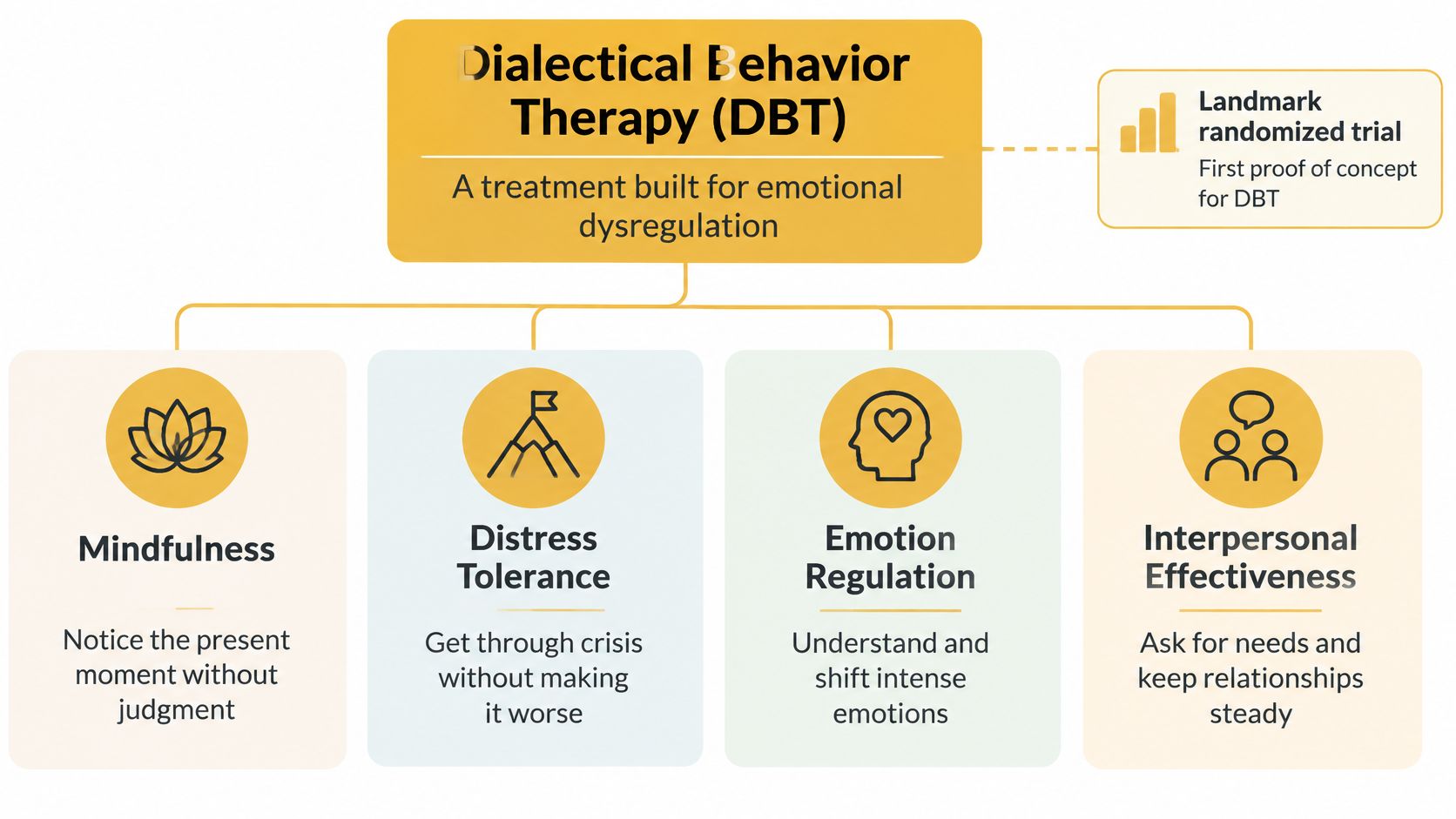
DBT skills training covers four connected areas. Each offers a different move for a difficult moment:
- Mindfulness: Notice what's happening right now, such as “My jaw is tight and I feel threatened,” without immediately judging yourself.
- Distress tolerance: Get through a surge without making it worse. If you're tempted to send an angry message, step away briefly and let the urge settle before choosing what to do.
- Emotion regulation: Identify what you're feeling and what may be contributing to it. Then consider an action that supports your longer-term needs, not just immediate relief.
- Interpersonal effectiveness: Ask clearly for what you need while respecting the other person. For example, request a pause in a tense conversation and say when you'll return to it.
These are practice ideas, not a substitute for DBT with a trained clinician. The full clinical model can include individual psychotherapy, skills training, telephone coaching, and a therapist team. A set of prompts or a journaling exercise can't reproduce that level of care, especially when someone needs monitoring or a safety plan.
CBT, Medication, and Where Each Fits
Cognitive behavioral therapy (CBT) can be useful when thoughts repeatedly intensify an emotional reaction. The National Institute of Mental Health describes CBT as addressing inaccurate or harmful automatic thoughts, examining how those thoughts affect emotions and behavior, and changing self-defeating behavior patterns (NIMH's overview of psychotherapies).
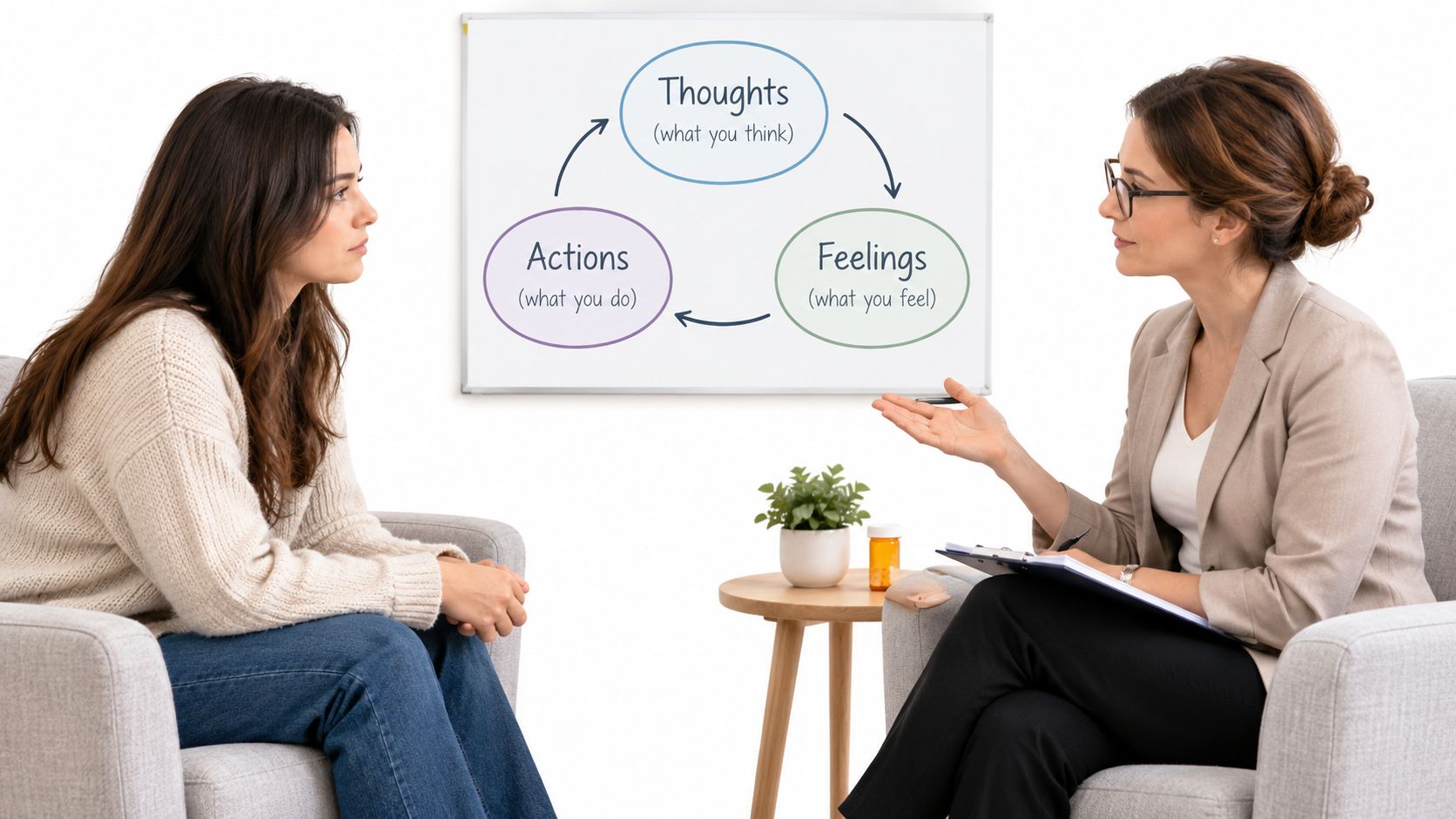
For example, imagine a friend hasn't replied to a message. The thought “They're ignoring me because they're angry” can increase anxiety or hurt, which may lead you to send more messages or withdraw. A thought record helps you notice the thought, consider what supports or challenges it, and choose a response based on what you know rather than on the first frightening interpretation.
CBT isn't a command to think positively or pretend things are fine. It's a way to look closely at the connection between thoughts, feelings, and actions. When repetitive interpretations fuel rumination, that process can offer a concrete place to start.
Treatment evidence is encouraging but not uniform. A systematic review and meta-analysis of 18 studies found moderate improvements in emotion-regulation strategies during psychological treatment, including unified protocol CBT, DBT, and mindfulness approaches. A separate systematic review of 14 DBT studies found no consistent advantage over existing psychological treatments for improving emotion-regulation difficulties, noting methodological limitations and differences among DBT programs (the review of emotion-regulation interventions and DBT). “Evidence-based” means there's research to inform care, not that one method works for everyone.
Medication is a conversation with a qualified prescriber, not a self-guided experiment. A clinician can assess your symptoms, history, and any co-occurring conditions, then discuss whether medication belongs in your care plan. CBT and other therapy methods address skills and patterns; a medication decision depends on your individual clinical picture. Neither should be treated as a guaranteed answer.
Comparing Self-Guided Apps, Therapy, and Hybrid Care
An app may help you notice whether emotions rise quickly, turn into rumination, or leave you feeling numb. Therapy can help assess what is driving those patterns and tailor care to your history and needs. Hybrid care pairs professional treatment with personal practice between sessions, like learning a skill with a coach and then rehearsing it on your own.
| Criterion | Self-Guided App | One-to-One Therapy | Hybrid Care |
|---|---|---|---|
| Clinical depth | Structured exercises, without clinical assessment | A clinician can assess concerns and tailor treatment | Professional care plus structured practice between sessions |
| Personalization | May adapt prompts to reflections and preferences | A therapist can respond to your history and changing needs | Therapist guidance can shape personal practice |
| Availability | Exercises are available for independent practice | Sessions take place with a clinician | Practice can continue between appointments |
| Access and cost | May be easier to access than appointments; features and fees vary | Access depends on finding and attending care | Requires access to therapy and time for practice |
| When it may fit | A starting point for reflection or routines | When assessment, diagnosis, or clinical treatment is needed | When you want professional guidance and between-session structure |
The right format depends partly on the pattern you want to address. If emotions escalate quickly, a therapist can help you practise pausing and choosing a response. If rumination keeps repeating, structured reflection may help you spot the loop. If numbness or impulsivity makes self-guided exercises hard to use, professional guidance can help identify a more suitable starting point.
A self-guided tool can support reflection, emotional awareness, and daily practice. It cannot diagnose a cause, provide psychotherapy, or manage an emergency. If feelings are disrupting daily life, or you're unsure what is driving them, consider speaking with a qualified professional rather than relying on an app alone.
LUNO is a self-guided mental wellness companion, not a replacement for therapy. It turns daily check-ins into a personalized plan for tomorrow, shaped by how you feel, what you need, and what has helped before. Its 10 evidence-based protocols each follow a 14-day arc that adapts to the user. They include Anxiety Relief (CBT Breathing), Grief & Loss (Narrative ACT), Burnout Recovery (Somatic Boundaries), Sleep Repair (CBT-I), Focus & ADHD (Mindfulness Structure), and a user-defined Custom Package.
LUNO may suit people looking for structured support between therapy sessions, a gentle place to start before therapy, or daily practices that adapt to real life. It can guide reflection and small steps, but it is not individualized clinical advice. AI-generated content is general self-improvement guidance. You can explore LUNO's self-guided support to see whether this format fits your needs.
When Self-Guided Skills Are Not Enough
More practice isn't always the answer. If an exercise makes you feel more ashamed, frustrated, or emotionally activated, stop and notice that response instead of forcing yourself to finish. Mindfulness isn't always the best first step, particularly if you're sleep-deprived or a trauma-related reaction is making you feel less safe. A clinician can help adapt an approach to your needs.
Emotional dysregulation can occur alongside self-harm and suicide risk. A 2026 meta-analysis of 20 studies involving 1,580 participants found a statistically significant medium reduction in nonsuicidal self-injury frequency following emotion-regulation-focused interventions (Hedges' g = 0.61, 95% confidence interval 0.40–0.83). The findings also showed high heterogeneity (I² = 85.94%), meaning results varied substantially across studies and interventions (the meta-analysis on emotion-regulation interventions for nonsuicidal self-injury). Treatment may help, but those results don't make an app a crisis service.
When to seek clinical or emergency support
Seek professional assessment if emotional difficulties involve self-harm or suicide risk, mania-like symptoms, psychosis, substance dependence, or severe functional impairment. A clinician can help assess what's happening and determine what support is appropriate. If you're in immediate danger, contact emergency services or a local crisis service. In the United States, call or text 988 for the Suicide & Crisis Lifeline.
Luno is a self-guided mental wellness companion, not a crisis service or replacement for therapy. Its app surfaces crisis resources whenever risk is detected, and users in the United States can call or text 988. That support can point people toward crisis resources, but the app can't assess or manage an emergency.
If an exercise repeatedly leaves you feeling worse, pause it and seek guidance rather than treating completion as success. Your safety and capacity matter more than keeping a streak.
Your Next Step Toward Steadier Emotions
When emotions rise quickly, try a DBT distress-tolerance skill, such as waiting before sending a message. If rumination holds your attention, write down the thought and examine what supports or challenges it. Numbness may respond to a small planned activity; impulsivity to a pause before acting. If naming feelings is difficult, note bodily sensations and consider which emotions might fit.
Choose a practice small enough to repeat. A setback doesn't erase what you've learned, and a skill that doesn't fit can be changed. Different patterns call for different tools, so notice whether the main difficulty is escalation, rumination, numbness, impulsivity, or naming emotions. If you want structure for daily reflection, LUNO is a self-guided mental wellness companion that can turn check-ins into a plan for tomorrow. It can support daily practice, but it isn't therapy or a crisis service. Find answers to common questions in the Luno: Self Care FAQ.
Steadier emotions don't mean never feeling intensely. They mean recognizing what is happening and having more ways to choose what to do next, one practice at a time.