
You settle onto the couch with a bag of chips and a movie. Somewhere between the opening scene and reaching for another handful, your fingers touch the bottom of the bag. You remember the plot, but barely remember eating. If you've been searching “mindfulness lose weight,” that missing stretch of attention is a more useful starting point than another promise about the scale.
The Moment You Eat Without Remembering
The empty bag isn't proof that you're careless or incapable of change. It's a moment worth examining: What happened before you opened it? Were you hungry, worn out, looking for comfort, or following your usual evening routine?
Those possibilities call for different responses. Hunger calls for food. Exhaustion might call for an easier dinner and an earlier bedtime. A familiar screen-and-snack routine might call for deciding how you want to eat before pressing play.
Mindfulness begins with noticing the situation, not judging the person in it.
Replace the verdict with a question
Consider the difference between these responses after eating more than you intended:
- The verdict: You tell yourself you have no discipline and promise to be stricter tomorrow.
- The investigation: You notice that you skipped lunch, arrived home tense, and ate while answering messages.
The investigation gives you something practical to work with. You could make lunch more accessible, take a transition break after work, or sit down with your snack rather than eating directly from the package.
None of those choices requires you to become a different person overnight. They require a clearer view of the moment before the behavior.
You don't need to win an argument with every craving. Start by noticing when the argument begins.
This isn't a claim that all weight concerns come from distracted eating. Your health and circumstances deserve more consideration than that. It's a narrower, more useful proposition: some eating patterns become easier to address when you can recognize them while they're happening.
A notebook, a brief daily reflection, or a structured self-care check-in can help you find recurring situations. Instead of asking only what you ate, ask what was happening around you and within you. That's a starting point you can act on.
What Mindfulness Means at the Dinner Table
A meal can pass in a blur: you eat while reading a message, planning tomorrow, or watching a show, then realize the plate is empty. Mindfulness means paying attention to your present experience with curiosity rather than reacting automatically. At dinner, that includes the food, your body's sensations, your thoughts, and anything else competing for your attention.
Attention works like a window. Work worries, notifications, and food rules can cloud the view, making it harder to notice the meal and your responses to it. Mindfulness clears some of that view. It adds awareness, not another rule about what you may eat.
Notice, pause, respond
During a meal, you might notice hunger or distraction, pause for a comfortable breath, then decide what to do next. The pause creates a moment to choose; it doesn't require you to second-guess whether you deserve food.
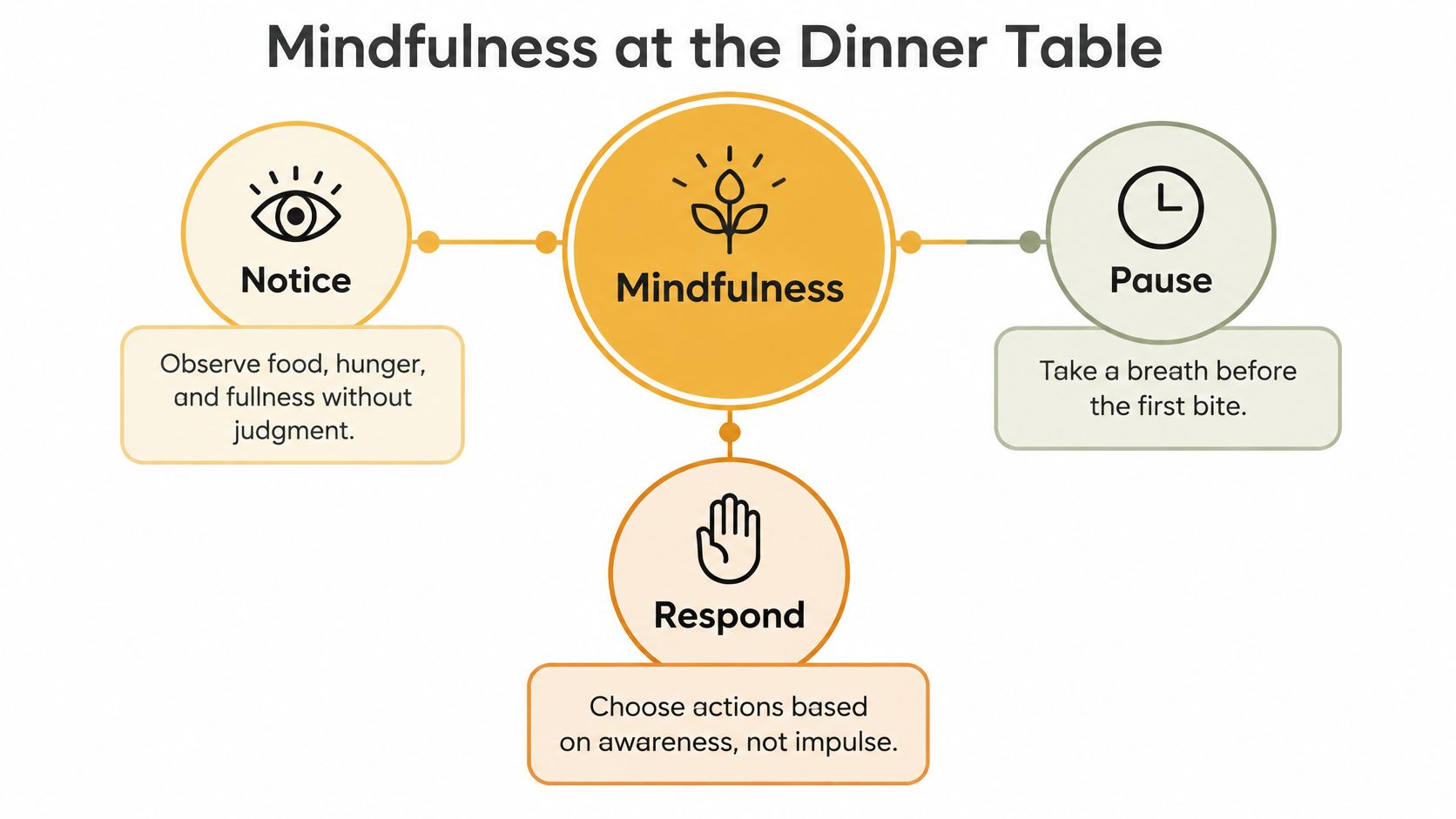
You might keep eating, serve yourself more, save some for later, or recognize that dinner is meeting a need for comfort as well as hunger. Pausing isn't a technique for denying yourself food.
Mindfulness can be practiced formally, by setting aside time to notice your breathing, or informally, by bringing attention to an everyday activity such as walking, washing dishes, or eating. Meditation doesn't have to feel relaxing to count. You may notice restlessness instead. The practice is to recognize what's present and return your attention without turning it into a struggle.
At the table, your fork and your thoughts can move at different speeds. Your hand may be reaching for the next bite while your mind rehearses tomorrow's meeting. Catching that mismatch gives you a chance to notice the bite in front of you, one small moment at a time.
What the Research Really Shows
The evidence is more encouraging for changes in eating behavior than for predictable weight loss. That distinction matters because feeling more aware around food and losing weight aren't interchangeable outcomes.
A 2018 systematic review and meta-analysis reported average losses of approximately 6.8 pounds immediately after treatment and 7.5 pounds at follow-up. Those were group averages across interventions, not a forecast for an individual practicing at home.
Where Mindfulness Has Strong vs Modest Effects
The same review provides a useful side-by-side comparison. Its pooled estimates were g = 0.70 for obesity-related eating behaviors and g = 0.42 for weight outcomes, while combined formal and informal practice had a weight-outcome estimate of g = 0.55, compared with g = 0.46 for formal practice alone (review findings).
| Outcome Area | Pooled Effect Size | Strength of Evidence |
|---|---|---|
| Obesity-related eating behaviors | Larger pooled effect in the comparison above | More encouraging for behavior change, not proof of benefit for everyone |
| Body weight | Moderate before-and-after effect | Less certain evidence of benefit beyond comparison treatments |
| Combined formal and informal practice | Larger estimate than formal practice alone | Supports practicing in daily life, without proving which component caused the difference |
Effect size is a way researchers describe the magnitude of a result. It isn't a percentage of weight lost, and before-and-after improvement doesn't automatically mean a treatment outperformed another approach.
The broader evidence remains mixed. The supplied evidence synthesis describes a meta-analysis of 12 randomized controlled trials that found improvements in impulsive eating (d = −1.13) and binge eating (d = −0.90), but no statistically significant overall weight-loss effect; the foundational systematic review likewise documents uncertainty around weight outcomes.
Evidence check: A meaningful change in eating behavior doesn't guarantee a particular change in body weight.
Your practical takeaway is to practice both away from meals and during them, while watching for changes you can observe. Treat those changes as outcomes worth understanding, not as a promise that weight loss must follow.
A Single Mindful Meal You Can Try Today
Choose an ordinary meal, not a specially prepared test of your dedication. Keep the food familiar and make the exercise small enough to fit your actual day.
The setting can be simple, as this meal illustrates.

Before the meal
Spend about two minutes arriving at the table. This is a suggested exercise length, not a research-backed dose or a requirement to delay eating.
- Check your body: Notice whether hunger feels clear, faint, urgent, or difficult to identify.
- Name your mood: Choose a plain description, such as tense, relieved, lonely, or distracted.
- Look at the food: Notice its colors, temperature, smell, and what you're looking forward to tasting.
You don't need to change anything before beginning. If you're both hungry and stressed, both observations can be true.
During and after the meal
Try the first three bites without a screen. With the first, notice flavor; with the next, texture; with the next, notice whether your attention has already wandered. These are practice prompts, not rules about chewing or portion size.
Then continue eating at a comfortable pace. You can put your fork down occasionally if that helps, but don't turn the meal into a concentration exam. If you lose track, return when you remember.
Afterward, write a short note about fullness, satisfaction, and presence. For example: “I tasted the beginning, rushed while checking messages, and noticed I wanted something sweet afterward.”
Repeat the exercise at a convenient meal over the coming week, if it feels helpful. Compare observations rather than grading yourself: Was anything easier to notice? Did a distraction recur? Boredom, wandering attention, and unclear signals are information, not failed attempts.
The Four Levers That Change Eating Behavior
You pass the office candy bowl, see a message that leaves you tense, and reach for a snack before deciding whether you want one. Several influences can meet in a single moment. Mindfulness can help you notice where the response begins, while practical changes to your surroundings can make a different choice easier.
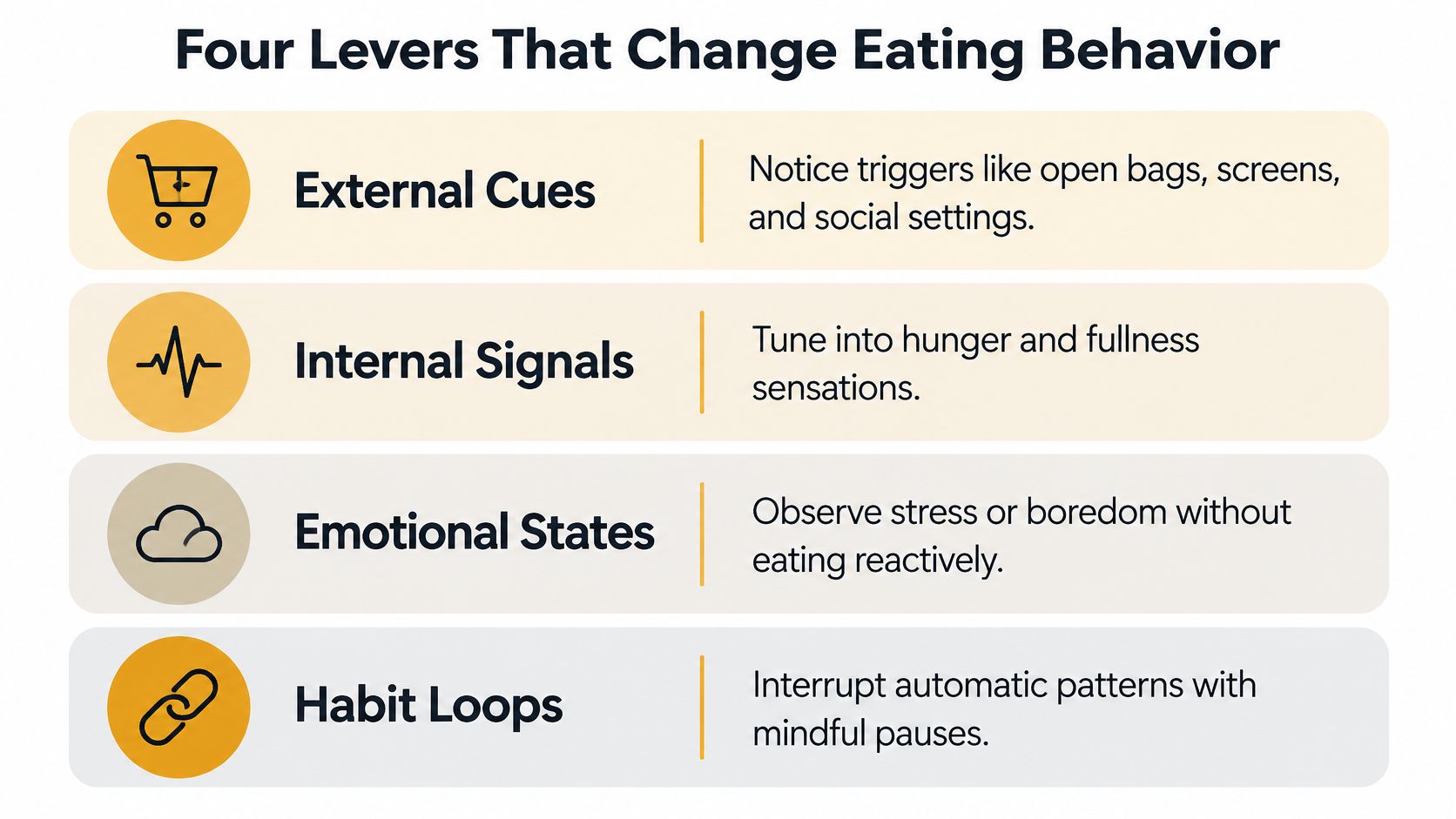
A review of 21 studies found that 86% reported improvements in targeted obesity-related behaviors, including binge eating, emotional eating, and eating in response to external cues. That figure describes the share of studies reporting improvement. It does not predict how any one person will respond.
Four useful places to look are the cues around you, your emotional state, social expectations, and the way you respond after eating. They overlap, much like several roads meeting at one intersection.
At work, passing a candy bowl may prompt an automatic reach. You could pause to decide whether you want a piece, or move the bowl or choose another route. After a difficult message, opening the cupboard may be one response to distress. Food can be part of what you need, alongside reassurance, a break, or support.
Social pressure can complicate a meal, too. If a relative offers another serving and you feel satisfied, a simple “I enjoyed it, and I'm comfortable right now” can set a boundary without inviting discussion about your body.
What happens after eating matters as well. If you eat more than you intended, describe the situation without attacking yourself. Then choose a supportive next action. That response is different from using punishment to try to regain control.
These influences often arrive together. At a family gathering, food may be readily available while fatigue, affection, and familiar routines shape what you eat. You can work with the part you can change without treating every other influence as a personal failing.
The accompanying video offers another way to explore these behavior patterns.
The useful question is whether you noticed a point where another response was possible. Sometimes the most effective change is adjusting the environment, such as making a satisfying meal easier to access, rather than relying on willpower alone.
Why the Scale Is the Wrong Scorekeeper
Two weeks of practice can change how you respond to an urge, even if the number on the scale stays the same. Weight is one narrow measure. It cannot show whether you noticed a feeling before eating, slowed down enough to enjoy a meal, or resumed your routine after a difficult day.
A randomized clinical trial of adults with obesity estimated that the mindfulness group lost 1.9 kg more at 12 months and 1.7 kg more at 18 months than the control group. Neither difference was statistically significant, so the findings do not establish that mindfulness leads to extra weight loss.
For a clearer view of your progress, track the behavior you are practicing. A few brief notes can reveal patterns that a single weigh-in misses: perhaps an urge eases after a pause, or rushed meals happen most often on busy afternoons. Keep the record simple enough to use without turning it into another source of pressure.
The visual below offers prompts for reflection. It does not show that mindfulness caused a health improvement.
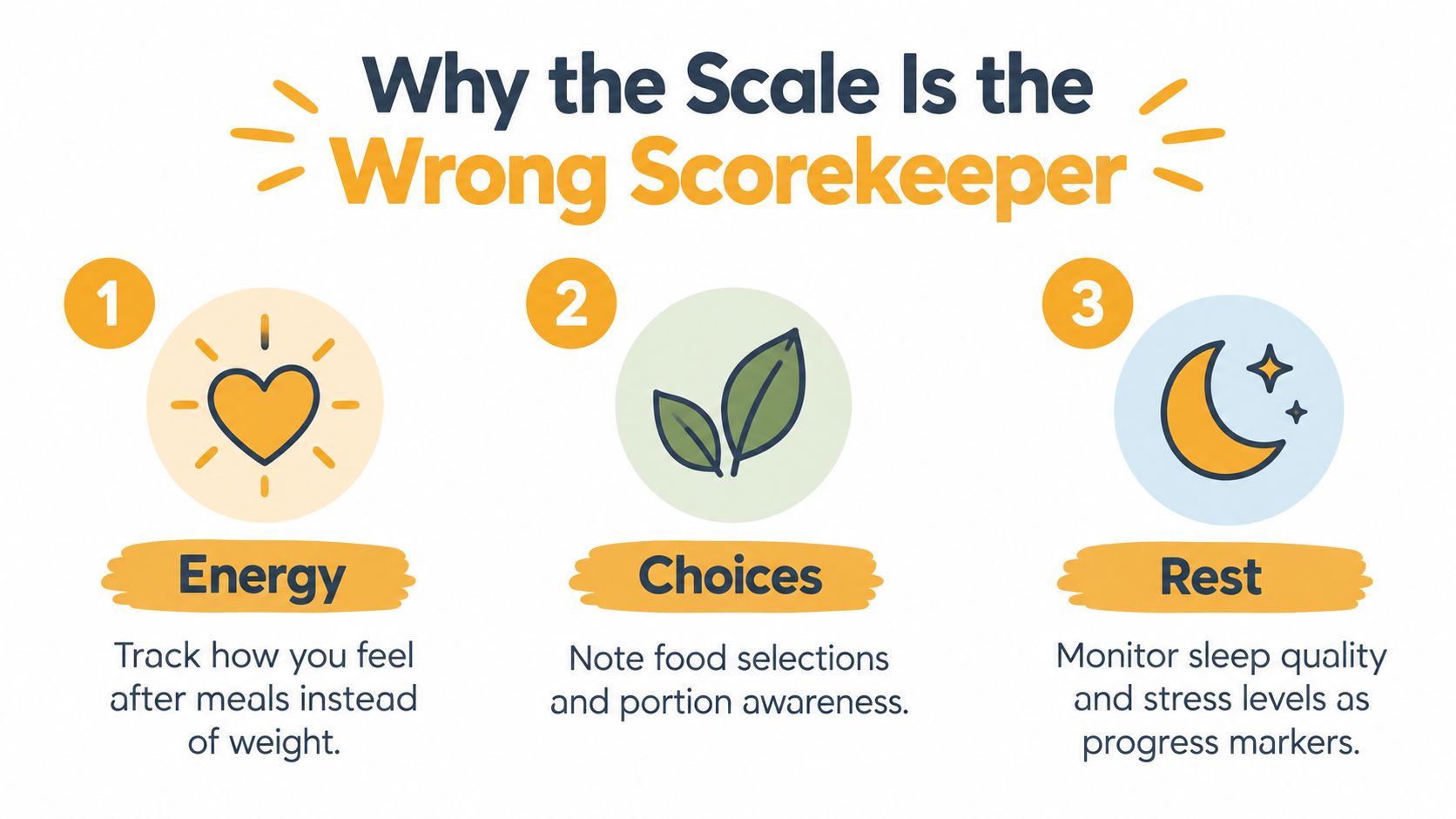
If weighing is useful and appropriate for you, discuss trends with your clinician rather than treating each reading as a verdict. You can also leave weight out of personal tracking and focus on the eating behaviors you want to understand.
Tracking should support self-understanding, not policing. If you have eating-disorder symptoms, avoid restrictive exercises, compensatory behaviors, or instructions to override hunger. Seek qualified support if recording food or body sensations increases fear, rigidity, or preoccupation. More monitoring is not automatically better care.
Where Mindfulness Fits in a Real Plan
After work, you may notice that exhaustion is driving your dinner choices. Mindfulness can help you spot that pattern, while practical support addresses the cause: keeping convenient food on hand, sharing cooking tasks, or choosing a prepared meal. Awareness helps you find the sticking point. It does not remove the need for a workable plan.
Mindfulness works alongside nutrition, movement, sleep, and appropriate medical care. A meta-analysis of 10 randomized trials found that mindful or intuitive eating was associated with greater weight loss than no intervention, with a pooled difference of −0.348 kg (P = 0.005). It did not outperform conventional diet programs (P = 0.99), and changes in BMI and waist circumference were not statistically significant.
The practical takeaway is that awareness can support behavior change, while other kinds of support address other needs. You can combine mindfulness with nutrition guidance or medical care rather than treating it as a stand-alone weight-loss treatment.
Choose support based on the barrier you face. A registered dietitian can help with individualized nutrition guidance. A notebook or calendar reminder can prompt a small action. A qualified mental health professional can help with persistent distress or loss-of-control eating, and a clinician can discuss weight-related health concerns and treatment options.
Digital tools vary in what they offer. Check whether a tool clearly distinguishes self-guided practices from therapy, explains its limits, and lets you stop or change exercises that do not suit you.
A short check-in can connect the behavior to its context: What made eating harder today? What kind of support could help tomorrow? Sleep and activity may help explain a pattern, but they do not need to become more targets to perfect. Choose one small action that addresses the actual obstacle.
Real Questions From Real Readers
How long before I notice a change?
There isn't a reliable deadline for an individual. You might notice distraction during your next meal, while responding differently to familiar situations takes repeated practice. Research findings vary across programs and follow-up periods, so a review discussing those limitations offers a better basis for expectations than a fixed transformation timeline.
Start by looking for recognition: catching a routine earlier, naming a feeling more clearly, or returning after distraction. Those observations tell you what to practice next.
What if I have a history of disordered eating?
Ask a qualified clinician whether food-focused mindfulness is appropriate for you. You may need practices that avoid hunger tests, portion monitoring, or weight goals altogether.
An outward-focused exercise, such as noticing sounds or the support of your chair, may be a more comfortable starting point. Stop an exercise that increases distress, and bring that response to your care team rather than pushing through it.
How can I practice at a family meal?
Choose something unobtrusive: notice the warmth of the plate, taste a bite, or take a comfortable breath while listening. You don't need silence, control of the menu, or an announcement about mindful eating.
If comments about your body or portions are difficult, decide on a boundary beforehand. A response such as “I'd rather talk about how your week went” can redirect the conversation without inviting a debate.
Can I combine mindfulness with another weight-management program?
Yes, provided the approach is appropriate for your health and doesn't encourage restriction or compensatory behavior that conflicts with your care. Tell your clinician or dietitian what you're practicing so the guidance fits together.
The aim isn't a perfectly quiet mind at dinner. It's a steadier relationship with food and a clearer understanding of the moments when you need nourishment, planning, comfort, or support.
Luno: Self Care offers personalized daily plans built from check-ins, with practices spanning CBT, ACT, and somatic methods, plus supported integrations that can factor in sleep and activity. It feels like therapy, but it is not therapy or a substitute for clinical treatment; you can find any topic you need through its self-care journeys and Custom Package. Visit Luno: Self Care to explore a daily reflection practice and choose a manageable next step for greater awareness around food.