You might be sitting with a compliment you brushed off an hour ago, or staring at a text from someone kind and feeling weirdly tense instead of warmed up. That reaction is common. Learning how to receive love is less about becoming a different person and more about practicing a consent-based skill that lets care land without panic, shame, or overexplaining.
Why Accepting Affection Feels So Difficult
A lot of people think the problem is that they give love more easily than they receive it. In real life, the harder part is often letting support stay visible long enough to believe it. A friend offers help, a partner says you look tired and should rest, and your first instinct is to wave it away, joke, or change the subject.
That reflex usually isn't arrogance. It's protection.
When care shows up, the nervous system can treat closeness like a risk, especially if past relationships taught you to stay self-reliant, stay alert, or expect disappointment. The body learns fast. If affection once came with pressure, inconsistency, or emotional absence, receiving warmth can feel strangely exposing instead of comforting. That's why receiving love is a wellbeing skill, not a personality trait.
The health stakes are real too. A landmark meta-analysis of 148 prospective studies with 308,849 participants followed people for an average of 7.5 years, and stronger social relationships were associated with an odds ratio for survival of 1.50, or about 50% greater likelihood of survival than weaker or insufficient relationships (PMC study). That finding wasn't just about romance. It included spouses, relatives, friends, and broader social networks, which is why receiving care from dependable people matters even when the relationship is not a partnership.
Practical rule: If your first move is to reject kindness, treat that as a signal, not a failure. The signal is usually fear, habit, or unfamiliarity.
For privacy-sensitive self-reflection, some people like to use a structured journal or check-in space such as this privacy overview while they notice the moments when they tense up around care.
Navigating Attachment Triggers and Defenses
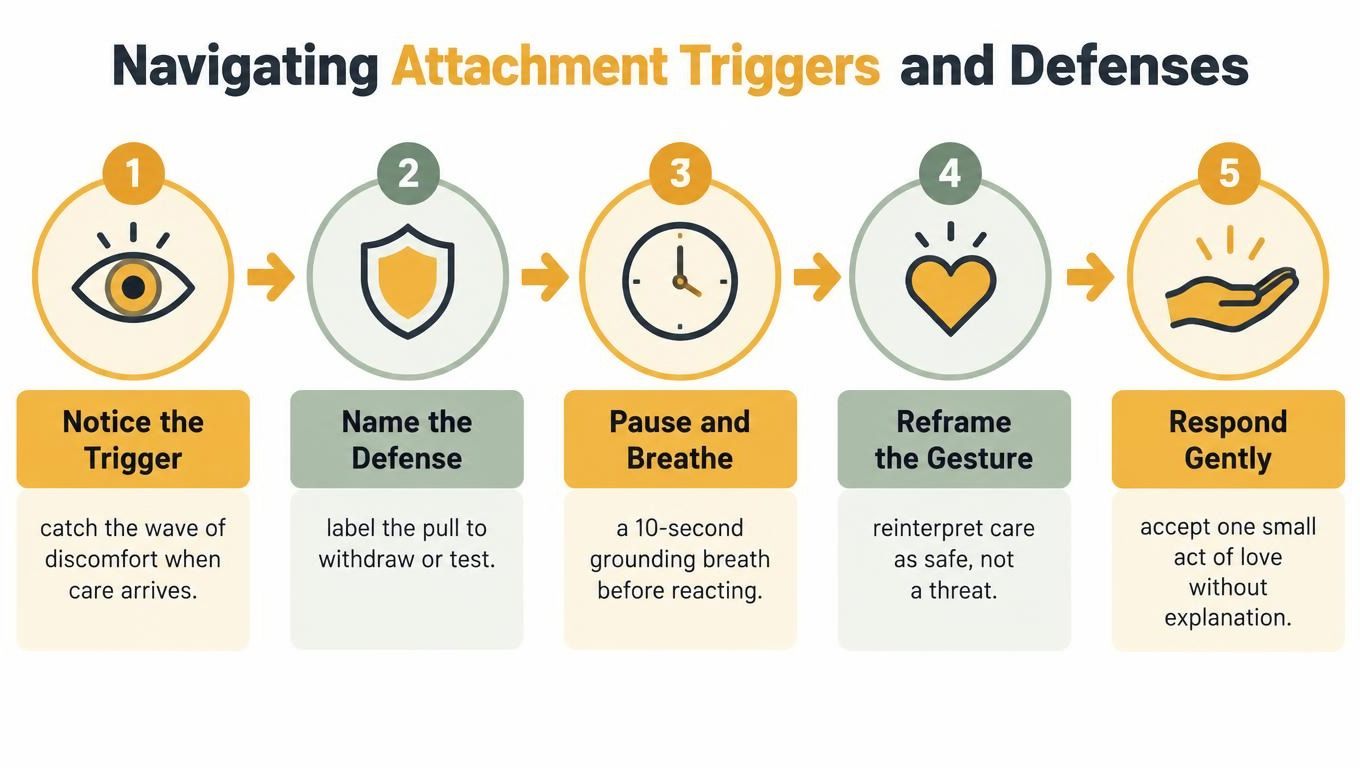
When affection feels unsafe, the defense is often faster than the thought. You may feel an urge to pull back, test the person, overexplain, or act as if you need nothing at all. Those reactions can come from avoidant or anxious attachment patterns, and they're usually trying to protect you from old pain, not from the person in front of you.
A simple protocol helps separate the old alarm from the present moment.
Notice the trigger before you decide what it means
Start by naming the moment. Was it a compliment, an offer of help, a hug, a check-in, or emotional closeness? Then rate your discomfort from 0 to 10. That number isn't a diagnosis. It's just a way to notice whether your reaction is mild, moderate, or intense.
Next, name the defense. You might feel the pull to withdraw, to make a joke, to reject the offer, or to ask for reassurance in a way that makes connection harder. Secure behavior starts with awareness, not perfection.
“This feels familiar, but familiarity isn't the same as danger.”
Pause long enough for reality to catch up
A short pause changes the moment. Slow breathing for 30 to 90 seconds can create just enough space to separate present evidence from old predictions like, “I'll owe them,” “They'll leave,” or “Closeness isn't safe.” Then accept one small, safe form of care. A simple “thank you” is enough.
That response matters because attachment research has linked insecure attachment with poorer support behavior and more negative interpretations when receiving support. One couple study found that avoidance and anxiety together explained 46.2% of variance in relationship satisfaction and 17.9% of instability, which shows how strong defensive patterns can become (APA systematic review). The point isn't to push yourself past your limits. It's to practice tolerating manageable closeness while keeping your boundaries intact.
If you want a place to track those triggers and responses, account controls and data options can matter when you're deciding what kind of self-guided support feels safe to use.
Translating Vague Needs into Clear Requests
A lot of people wait to feel “understood” before they ask for what they need. That expectation backfires. Other people can't reliably respond to hints, tests, or silence, and then you end up feeling unseen even when support is available.
The better move is to turn emotion into something observable. Instead of “I need more care,” try “listen for 10 minutes without problem-solving,” or “send one check-in message tonight.” Specific requests lower the chance of defensiveness because the other person knows what success looks like.
Use a low-blame format
A simple format helps you stay honest without sounding accusatory:
- Name the pattern. “When I'm overwhelmed, I go quiet.”
- Name the support. “What helps me feel cared for is one check-in after work.”
- Keep the request concrete. “Can you text me around 6?”
That structure also supports perceived partner responsiveness, which is the sense that someone understands, validates, and cares. In a 2024 study, perceived partner responsiveness had a large positive association with satisfaction (β = 0.87, p < 0.001), while gratitude predicted satisfaction directly (β = 0.22) and indirectly through responsiveness (β = 0.20) (study). The takeaway is practical. Clear requests make it easier for care to feel real.
Let the response be enough, even if it isn't perfect
People often sabotage good moments by grading them too harshly. Maybe the check-in was shorter than you wanted, or the hug came a little awkwardly, or the timing wasn't ideal. If the gesture was respectful, acknowledge it anyway. Then negotiate a better version next time.
Useful benchmark: requests become more specific, responses become more consistent, and recovery after bids for connection gets faster.
Avoid the traps of mind-reading, using gratitude to silence legitimate needs, or treating inconsistent behavior as affection just because it comes with warm words. Love works better when both people can name what helps.
Finding Connection Beyond Romantic Intimacy
A person can be open to care and still feel stuck if every advice column treats a partner as the main path to being loved. That framing misses people who are single, grieving, moving, caregiving, or living through a stretch when their support network is thin.
Loneliness can be situational. It can also be practical. Someone may be ready to receive care and still lack nearby safe people, enough time, mobility, money, or access to community spaces. Small connections matter because they create places for care to land.
The WHO's Commission on Social Connection reported in 2025 that about one in six people worldwide experiences loneliness, rising to roughly one in five among adolescents and young adults and nearly one in four people in low-income countries, compared with about one in nine in high-income countries (WHO commission). The same work separates loneliness from social isolation, which helps explain why a crowded room can still feel empty. Presence is one thing. Reliable care is another.

Build a wider net of care
Start with low-pressure forms of connection that do not ask one person to carry everything. A neighbor who remembers your name, a friend who sends a meme, a support group, a walking buddy, a volunteer shift, or a regular class can all help you practice receiving warmth without overloading a single relationship. The WHO also points to everyday actions such as reaching out, being fully present, joining groups, and volunteering as ways to build connection.
A wider net matters because affection does not always arrive as romance. Sometimes it arrives as being included, remembered, checked on, or accompanied. Those forms count too.
If you have been treating affection as something only couples get to access, Luno: Self Care's approach to non-romantic support is a reminder that support can be framed more widely than romance, friendship can be part of healing, and community care can be part of emotional resilience.
Using Self-Guided Tools Safely and Effectively
A journal prompt, a mood tracker, or a private reflection tool can help you notice patterns, slow reactions, and practice receiving care in smaller, safer ways. Used well, these tools act like a practice room. They let you rehearse honesty without putting all the weight on one relationship.
Warmth in a chat window still is not therapy.
A comparison summarized by the American Psychological Association found that commercially available large-language-model chatbots responded inappropriately about 20% of the time, compared with 7% for human therapists (APA practice publication). That gap matters because a tool can sound supportive and still miss risk, nuance, or clinical judgment.
Keep the scope clear
Self-guided tools can support reflection, but they need clear limits. The APA advises people not to rely on generative-AI chatbots or wellness apps for psychotherapy or psychological treatment, and it notes that crisis performance is limited and unpredictable (APA health advisory). These tools can help you name trust, vulnerability, or the feeling of not wanting to receive love. They cannot replace a clinician when trauma, severe depression, self-harm thoughts, abuse, or other high-risk concerns are present.
The escalation line should stay simple. If someone has thoughts of harming themselves or another person, urges to self-harm, sees or hears things others do not, or has strong distressing beliefs that others do not share, they need live human help right away. In the United States, that means 911, the 988 Suicide & Crisis Lifeline, or the nearest emergency department (APA guide).
Luno: Self Care's safety and scope guidance explains that the app is self-guided support, not a crisis service.
For less urgent needs, human therapy remains available. In England, people can self-refer to NHS talking therapies for common problems like anxiety and depression, and those services are delivered by trained professionals in person, by video, by phone, or online (NHS talking therapies).
Building a Daily Practice of Letting Love In
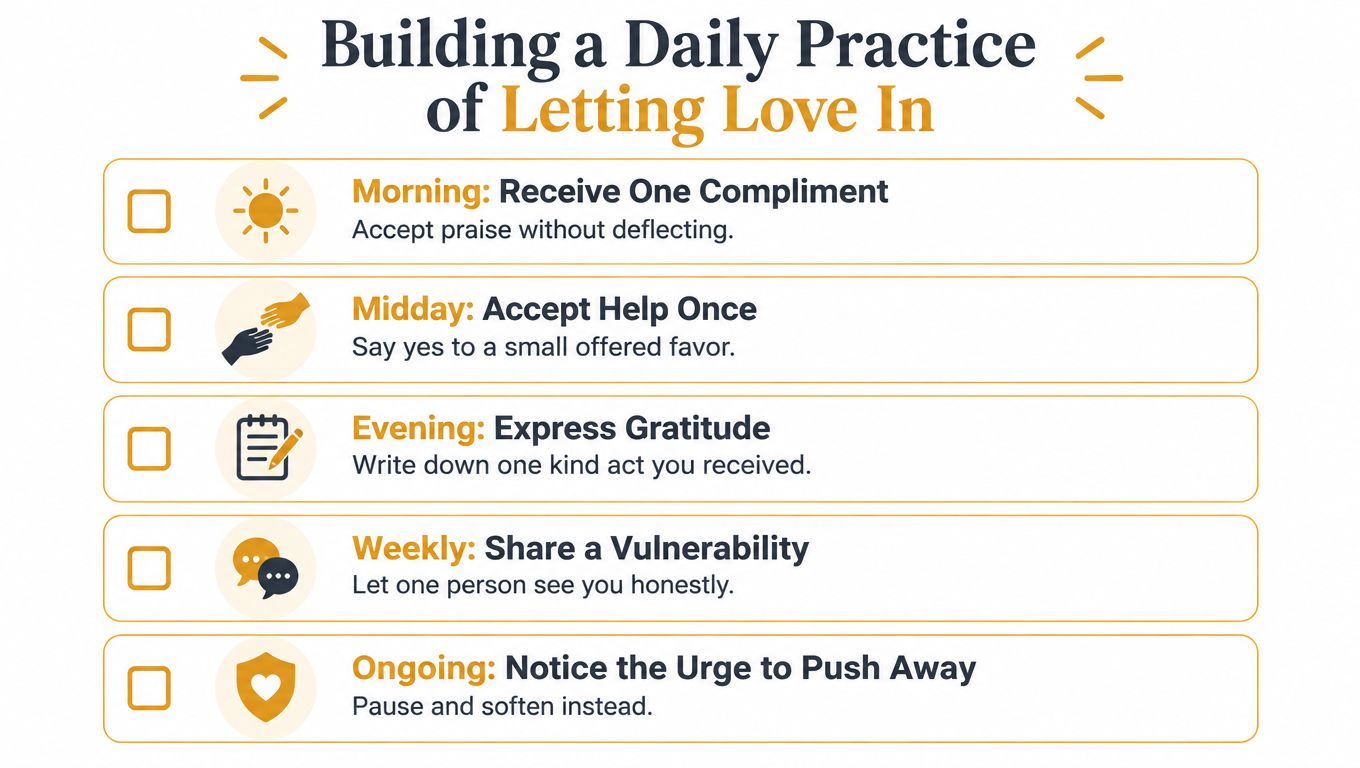
Receiving love gets easier when it becomes ordinary. Not dramatic. Not perfect. Just repeated. The goal is to practice one small act of openness often enough that your body stops treating care as a surprise.
A simple daily routine can help:
- Morning, receive one compliment. Don't deflect it. Say “thank you” and move on.
- Midday, accept one small favor. Let someone hold the door, carry something, or answer a quick question.
- Evening, name one kind act you received. Write it down in a sentence.
- Once a week, share one honest feeling. Let one trusted person see you clearly.
- Any time you feel the urge to push away, pause. Soften by one degree before you respond.
Those small moments matter more than grand gestures because they retrain your baseline. They also give you evidence that care can arrive without trapping you.
Track the wins you usually ignore
A lot of people only notice when they “fail” to receive love. Flip that habit. Watch for the times you stayed present, said thank you, asked clearly, or let someone help without apologizing for existing. Those are signs of growth.
If you want a structured, self-guided place to practice these habits, review the FAQ and see how Luno: Self Care supports daily reflection, relationship-pattern awareness, and gentle next-step planning while staying firmly outside clinical therapy.
Luno: Self Care helps you turn emotional insight into daily practice, so you can notice triggers, accept small acts of care, and build steadier connection over time. If you want a private companion for that kind of self-guided work, visit Luno: Self Care and explore whether it fits the way you want to practice receiving love.