
You're about to speak, walk into an interview, sit down for an exam, or wait for a first date, and your stomach flips before your mind has even caught up. That sudden churn can feel like a warning, but most of the time it's your body gearing up for a moment that matters. The fastest way to get control is to stop treating the sensation like a mystery and start responding to what it is, a stress reaction you can calm, redirect, and, when needed, respect.
Why Stomach Butterflies Happen Before Important Moments
I've seen this pattern over and over, especially right before someone has to perform while being watched. A client will say, “My stomach's in knots, so something must be wrong,” and the more likely explanation is a threat-response system that has switched on in advance. Anxiety can trigger sympathetic arousal, which pushes attention toward possible danger and can bring on abdominal fluttering, nausea, muscle tension, and a faster heartbeat, even when nothing physically dangerous is happening (Frontiers review).
What normal butterflies look like
Public-speaking anxiety shows how ordinary this reaction is. A review reports that roughly 63% of people experience some level of public-speaking anxiety, and about 61% of college students describe it as a major fear. In an impromptu-speech study, 57% of participants reported high anxiety, 20% moderate anxiety, and 22% low anxiety.
Practical rule: brief, trigger-linked fluttering that settles after the event usually points to anticipatory stress, not illness.
The trap is that the sensation can feed on itself. Once someone reads a normal stress response as danger, the alarm often gets louder. The better question is simple, “What is my body preparing me for?” and, “Does this ease once the moment passes?”
When it stops being ordinary
There is a line you should not blur. Persistent or severe abdominal symptoms, symptoms that do not line up with an identifiable stressor, or symptoms that come with bleeding, repeated vomiting, fainting, significant weight loss, or difficulty swallowing deserve medical evaluation. The same review points to those warning signs as reasons to stop assuming the problem is only anxiety.
That distinction protects you in both directions. It keeps you from spiraling over a normal stress signal, and it keeps you from labeling everything as nerves when the body may be pointing to something else.
How to Slow Your Breathing to Reduce Nervous Arousal
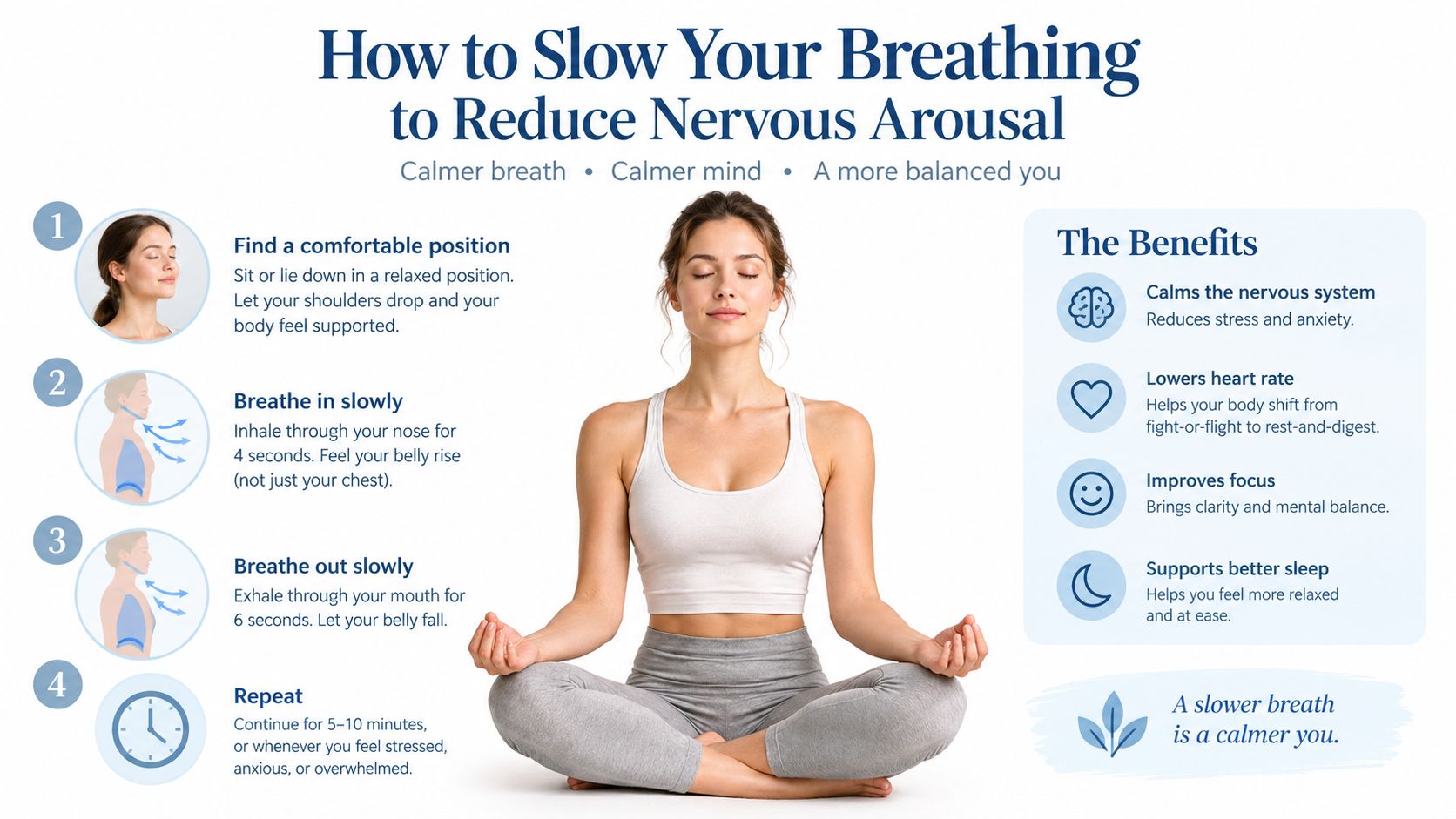
Breathing is usually the first tool I use when someone wants to know how to get rid of butterflies in stomach fast. It does not erase nerves, but it can change the body state underneath them. Slow, controlled breathing is one of the more reliable short-term ways to lower arousal, especially when the goal is to stay steady enough to think, speak, or move through the moment without feeling rushed.
Use a simple nasal pattern
Breathe gently through your nose. Let your abdomen expand as you inhale, then make the exhalation a little longer than the inhalation. Keep the pace easy and repeat it for several minutes before the moment starts.
That pattern matters because forceful over-breathing can backfire and leave people feeling worse. The goal is a smaller physiological spike, not perfect calm. A breathing review found that many studied breathing interventions reduced stress or anxiety, and slow, diaphragmatic, deep, or otherwise controlled breathing showed the clearest practical value in the settings it examined (Breathing review).
Best use: breathing works best as a short-term regulator, not as a promise that nervousness will vanish on command.
What this means in practice
Use breathing as the first move, then stop. If you spend ten minutes searching for the perfect technique, you often feed the anxiety loop. Pick one pattern, practice it before the event, and return to it when your stomach tightens again.
That restraint matters because breathing is a coping tool, not a cure-all. If anxiety stays severe, panic keeps showing up, or avoidance starts running your schedule, you need more support than self-guided calming alone can provide.
Quick Grounding Techniques to Regain Focus Before Performing
Your stomach can feel louder when your attention keeps dropping into it. I often ask people to stop trying to “fix” the sensation for a minute and instead give the brain a few firm, boring anchors in the outside world. That shift reduces the loop of scanning, predicting, and catastrophizing.
Try a three-step reset
Look around and name three visible details, either aloud or just in your head. Feel both feet on the floor, or press your fingers lightly against the edge of a chair. Then relax your jaw and shoulders on purpose, because tension in those areas often tracks the same arousal that's hitting your gut.
If you're standing, shift your weight slowly from one foot to the other. If you're seated, notice the contact points under your thighs and back. The job here is not to meditate your way into a new personality. It's to move attention away from internal alarm signals long enough to function.
Bring the mind back to the room, not the stomach.
I like grounding because it interrupts the habit of checking the body every few seconds. The more often someone asks, “How bad is it now?” the more dramatic the feeling becomes. A short external cue cuts that feedback loop without requiring perfect calm.
Keep it short enough to use under pressure
Use one sequence before the event, and reuse the same sequence when you feel the wave returning. Don't add five extra steps because that usually turns grounding into another performance.
When the situation is high stakes, simple beats thorough. The goal is steadier attention, not a perfect emotional state.
When to Stop Suppressing Nerves and Start Using Them
Not every burst of nerves needs to disappear. Mild arousal can sharpen focus, increase readiness, and help you step into a hard moment with more energy than you had ten minutes earlier. The mistake is assuming that any stomach flip means you should immediately fight it.

Reframe the sensation
A useful question is, “What if this is readiness, not danger?” That one shift changes how the body feels to the mind. The flutter is still there, but it stops looking like a stop sign.
Lots of people backfire at this point. They try to eliminate every trace of nerves, then become more tense because they're measuring themselves against an impossible standard. In performance moments, a little activation is normal preparation fuel.
Use the energy instead of wrestling it
Speak a little more slowly. Walk with purpose. Put the energy into the task rather than into monitoring your stomach.
That doesn't mean ignoring a real problem. If the sensation is severe, persistent, or paired with symptoms that don't fit a stress-linked pattern, use the warning signs already covered and get checked. But if this is the familiar pre-event surge, the goal is not zero nerves, it's usable nerves.
How to Track Triggers and Prevent Recurring Butterflies
When the same stomach response keeps showing up, the fastest fix isn't usually more suppression. It's pattern recognition. The gut responds bidirectionally to emotion, so anxiety, sadness, and excitement can all shift gastrointestinal movement, and gut discomfort can feed the emotional reaction right back (Harvard Health).
Write down what happened before, during, and after
Track the event itself, the prediction you made, your sleep, caffeine or stimulant intake, bowel symptoms, and what changed after the moment passed. If the sensation shows up only before presentations but not on ordinary mornings, that's a different pattern than discomfort that appears at rest or after certain foods.
That record helps you test one small adjustment at a time. You might change your pre-event meal, practice breathing earlier, or prepare the night before instead of in a rush. The point is to learn what actually moves the needle for your body.
Use structured self-care when you need more consistency
A self-guided tool can help people stay with the pattern instead of abandoning it after one bad day. Luno: Self Care turns daily check-ins into personalized next-day plans, and its Anxiety Relief program includes CBT and breathing tools that can support calmer preparation before stressful moments. It can feel supportive and therapy-like, but it is self-guided support, not psychotherapy, diagnosis, crisis care, or a replacement for a qualified clinician.
People can use it for the topic they need, then return to the same record the next day and notice what changed. That continuity matters more than any single calming exercise. Recurring butterflies usually fade when you stop guessing and start tracking the trigger, the interpretation, and the result.
Useful habit: keep the log brief enough that you'll actually use it before the next event.
Warning Signs That Mean You Should Seek Professional Help
A brief flutter before a presentation or interview can be a normal stress response. Help is warranted when the feeling stops matching the situation, lingers, or starts interfering with work, school, relationships, or daily routines. According to the Office on Women's Health, generalized anxiety disorder involves excessive anxiety that is hard to control, lasts at least six months, and disrupts daily life.
Know the red flags
Watch for symptoms that are new, severe, recurrent, or hard to manage. The NHS lists faster or irregular heartbeat, dizziness, chest pain, nausea, stomach cramps, sweating, breathlessness, and shaking as possible anxiety symptoms, and says to seek help when anxiety, fear, or panic is difficult to control or self-help is not helping.
WHO notes that structured psychological self-help can support people with lower-intensity needs, but that does not replace clinical assessment when symptoms are severe, medically unexplained, or connected to crisis risk.
Keep the boundary clear
Temporary butterflies usually rise before a clear trigger and settle once the moment passes. Medical warning signs deserve a different response. If you notice bleeding, repeated vomiting, fainting, significant weight loss, or difficulty swallowing outside a clear stress trigger, seek same-day medical evaluation rather than trying to monitor it on your own.
Mayo Clinic also recommends contacting a healthcare professional when worry interferes with work, relationships, or other parts of life, and advises immediate emergency treatment for suicidal thoughts or behaviors (Mayo Clinic).
Anxiety is common. It is not the only explanation for what starts in your stomach.