
The popular advice to open a journal and pour out your deepest feelings skips an important question: Will that help you feel more able to live your day, or leave you overwhelmed? Your first page doesn't need to contain your hardest memory. It can contain an emotion, an immediate need, and a manageable next step.
Learning how to start journaling for mental health means learning how to pace yourself, not how to produce a dramatic breakthrough. Small pages count. So does switching to a lighter prompt, closing the notebook, or deciding that you need a person rather than another page.
A Two-Week Starter You Can Trust
Two-week mental health journaling starter
| Phase | Time | Cadence | What to write | Stop rule |
|---|---|---|---|---|
| Days 1 to 3 | 5-15 min | Every 1-3 days | What am I feeling, and what would help tomorrow? | Stop if distress climbs |
| Later expressive block | 15-20 min | 4 close days | One upsetting experience, thoughts and feelings, then one reframe | Not the opener if trauma symptoms spike |
| Anxiety focus | 10-20 min | Repeated specific topic | Trigger, body sensation, coping response, one action | Track 0-10 before and after |
| Low-capacity day | 5 min | As tolerated | One emotion, one need, one small step | Switch to grounding if you loop |
| Week-two review | 10 min | Once | Patterns in ratings and one next action | Pause if sleep or functioning drops |
Treat this as a suggested practice schedule, not a treatment prescription or a challenge you must finish. Choose the row that fits your capacity tonight. You don't have to graduate to harder writing.
A 2022 systematic review and meta-analysis in Family Medicine and Community Health found an average 5% reduction in mental-health measure scores compared with controls, with subgroup improvements of approximately 9% for anxiety, 6% for PTSD, and 2% for depression. Those are group averages on symptom measures, not your personal odds of recovery. They support modest hope, not a promise that journaling will treat a condition.
Start with the easiest workable row
During the opening days, stay with present-day observations. You might write that you feel stretched thin after work and that preparing breakfast tonight would make tomorrow less demanding. That's a complete, useful entry without an explanation of your whole history.
The later expressive block is optional. Longer writing about upsetting experiences isn't a more advanced achievement, especially if it leaves you unsettled. Leave that row alone when you need gentler structure.
For anxiety, keep the topic specific: an unanswered message, tension in your stomach, checking your phone, and the decision to put it aside while you eat. The low-capacity version is smaller still: tired, need food, make toast.
Starting rule: Choose a goal you can notice in ordinary life, such as recognizing a trigger or making tomorrow morning easier.
Review usefulness, not effort
During week two, look at the before-and-after ratings alongside what happened afterward. Could you settle into the evening? Did you sleep reasonably? Were ordinary responsibilities manageable the next day?
A page that feels profound but repeatedly disrupts your evening isn't automatically helpful. A plain entry that helps you take a needed break may be worth keeping.
Circle the easiest row and put its window on your calendar. You're making room for a check-in, not signing up to become a different person by the end of the fortnight.
Handwritten Typed or Voice Notes
Pick one primary format and one backup, then stop shopping. You need a private place you'll use, not the perfect notebook, app, microphone, or template.
Handwritten, typed, and voice journaling
| Format | Best when | Privacy watch-out | Typical time | Main risk |
|---|---|---|---|---|
| Handwritten | You spiral on a keyboard or want an offline page | Notebook in a shared drawer | 10-20 min | Hard to search or replace if lost |
| Typed | You want search, backup, or a short phone note | Cloud sync and shared devices | 5-15 min | Editing until the feeling disappears |
| Voice | Blank page, fatigue, or hands are busy | People nearby can hear; store the summary, delete raw audio | 5-10 min | Oversharing sound in a public place |
These time windows are practical suggestions, not evidence that a format requires a particular session length. Let privacy and ease decide.
Choose for your actual surroundings
Handwriting is worth trying if typing turns into rapid, repetitive paragraphs. You can leave your phone elsewhere and work offline. The trade-off is physical: paper can be misplaced, read by someone else, or difficult to search when you want to find a recurring theme.
Typing suits brief entries and searchable records. Use a locked note rather than an open document on a shared tablet. Resist polishing your wording until it sounds reasonable enough to show someone, because you're recording your experience, not preparing a statement.
Voice can help when words come more easily aloud. Record in a private room, and use headphones for playback. If your purpose is reflection rather than keeping an audio archive, make a short written summary and delete the raw recording, including any recently deleted copy.
For app-based options, you can visit Luno: Self Care. Decide what you're comfortable recording before you enter sensitive details anywhere.
Keep a primary format and a quiet backup
A sensible default is a notebook at home and a locked typed note when you're away. Keep voice as an alternative when neither feels workable. Stay with that arrangement for the trial period unless privacy or accessibility requires a change.
Say Maya writes three short lines in a pocket notebook after lunch: what happened, what she feels, and what she needs. On a crowded train, she types those same prompts behind a passcode rather than speaking them aloud. She changes the medium, not the whole practice.
A private ten minutes can mean paper. A shared space can mean typed and locked, provided nobody can read over your shoulder.
You don't need matching entries across devices. You need a usable record and a comfortable way to return.
How to Run Your First Journal Session
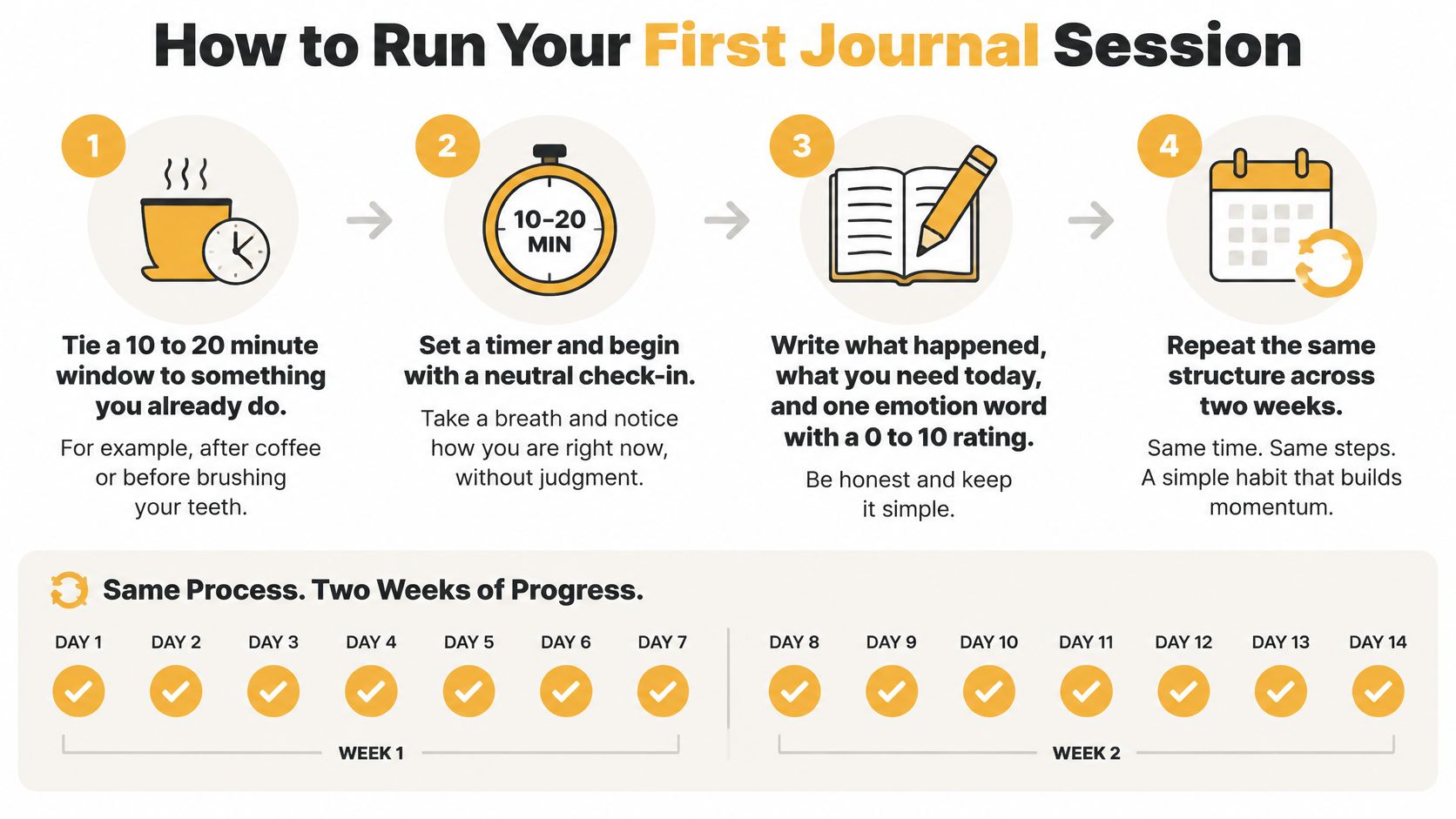
A first journal entry does not need to reveal your deepest pain. Give it a beginning, a middle, and a clear ending. You are practicing a contained check-in, not trying to solve everything before you stand up.
Make each move small enough to follow
Attach the session to something familiar. Set aside a suggested 10-20-minute window after coffee or before brushing your teeth. Leave room to settle afterward instead of filling every available minute with writing.
Set a short timer. Begin with 5-15 minutes, choosing the shorter end if you're unsure. A defined ending can keep one unfinished thought from pulling you into a longer session.
Check your starting distress. Rate it from 0 to 10, with zero meaning no distress and ten meaning the most distress you can imagine. Treat the number as a personal comparison, not a diagnosis or a score you must improve.
Choose one specific moment. Describe what happened, what you thought and felt, and what you noticed in your body. A tense conversation at lunch is a workable topic. Every relationship you've ever had is too large for an opening session.
Leave the writing unpolished. Fragments, repeated words, and spelling mistakes are fine. If you can understand the entry, it has done its job.
End with an action or a kinder interpretation. You might plan to ask for clarification tomorrow rather than assume someone is angry. Or you might note that tiredness made the conversation harder without blaming yourself for having feelings.
Close the journal and ground yourself. Take a two-minute transition: feel your feet on the floor, name five things you can see, and notice the room around you. Wait until afterward to check your phone.
Check the aftermath. Rate distress again, then note how you sleep and function the next day. You don't need to reread the story to make this check.
Understand the method without copying its intensity
The historical starting point was more emotionally demanding. In Advances in Psychiatric Treatment, James Pennebaker and Sandra Beall's 1986 experiment asked college students to write for 15 minutes on four consecutive days about traumatic or upsetting experiences. Those who disclosed their deepest thoughts and feelings made fewer health-center visits four months later. That finding doesn't mean severe trauma is the right first assignment.
Choose milder material and keep your ending intact. Several contained sittings may feel more manageable than one marathon emotional dump, but no particular number of sessions guarantees a benefit. Journaling can support reflection alongside clinical care; it does not replace it.
If an example would help you settle into the routine, watch before opening your own page.
For questions about how LUNO works, visit the LUNO Self Care FAQ. Keep your own definition of done simple: the timer ended, your closing action is written, and the book is closed.
Prompts That Match Your Capacity
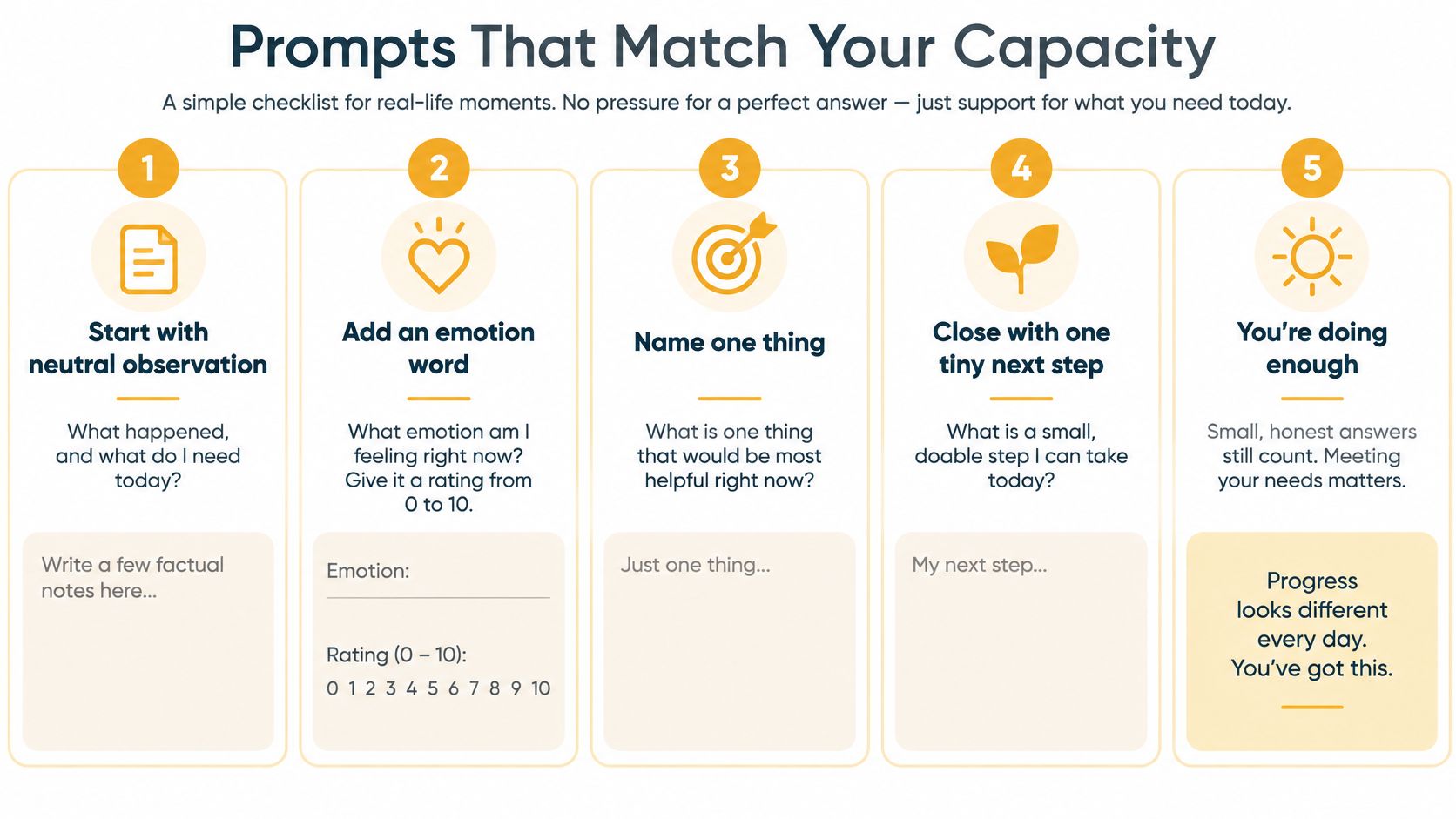
Choose a prompt for the amount of emotion you can comfortably stay present with today, not the depth you think an honest person should reach. Being able to stop or change direction is a journaling skill.
Start with a gentle progression:
- Observe the present. Describe what happened and what you need today, without explaining why you've always felt this way.
- Name the feeling. Add an emotion word and an intensity rating.
- Find a controllable part. Separate what you can do from another person's choices.
- Record support. End with an action that makes the next part of your day more manageable.
Keep this checklist nearby when choosing a question.
Use balanced writing without forcing positivity
A systematic review and meta-analysis of 24 randomized trials involving 1,558 participants found that positive writing produced more favorable mood and cognitive outcomes than expressive writing in general-population samples, while expressive writing involved greater negative emotion during the intervention. A heavier prompt isn't a badge of honesty.
Balanced writing doesn't require gratitude for something painful. You can acknowledge that a day was difficult and also identify what supported you.
Try a set that matches your day:
- A hard morning. What feels loud in my body? Which task could I make smaller? If the task is getting ready, the smaller version might be washing your face before deciding what comes next.
- An anxious evening. What set this off? What did I do afterward? What helped even a little? Describe the helpful response without demanding that it eliminate anxiety.
- A flat day. What did I do anyway? Which demand can I drop? Eating something or answering an essential message can count without turning the entry into a productivity review.
Reserve detailed trauma narratives for clinician-guided work rather than escalating alone when a prompt feels destabilizing.
Plan for the feeling after the page
The U.S. Department of Veterans Affairs therapeutic-journaling guide notes that writing about difficult experiences can temporarily increase physiological arousal, blood pressure, and negative mood, while summarizing associations with fewer health-center visits during the following six months. Immediate discomfort and longer-term usefulness aren't the same measure, but discomfort also isn't proof that an exercise is helping.
As a suggested starting rhythm, try three tolerable sessions during the opening week, separated by a day or more, then a short weekly review. Track sessions completed, time spent, distress, and next-day functioning rather than literary quality.
Review our safety information before using self-guided support for difficult material. If writing leaves you less able to sleep or manage the day, lighten the question or pause. Write tomorrow's gentle prompt on the next blank line so you don't have to choose while upset.
Privacy Stop Rules and Fixing Stalls
If you have suicidal thoughts or urges to hurt yourself, stop journaling and get immediate human help. In the United States, the National Institute of Mental Health's help guide advises calling or texting 988 for the 24-hour Suicide & Crisis Lifeline; in life-threatening situations, call 911 or go to an emergency department. Outside the United States, contact your local crisis or emergency service.
A journal isn't therapy, and a self-guided wellness app isn't a crisis service. Don't make completing an entry a condition for reaching someone who can help.
Put your stop plan on the first page
Write down the person or service you'll contact if you become overwhelmed. Add a grounding action you can do without making another decision, such as putting both feet on the floor and describing the objects around you.
Make your stop plan specific enough to follow when concentration is poor:
- When distress rises. Put down the pen or stop the recording. You don't owe the page a conclusion.
- When you feel disconnected. Turn toward your surroundings, name where you are, and contact support if you can't settle.
- When the same fear loops. Leave the story alone and move to a concrete activity, such as getting water or sitting with someone you trust.
- When safety is uncertain. Contact trained human help rather than choosing a more intense prompt.
Permission to stop: Protecting your capacity is a successful use of the tool, not a failure to be honest.
You don't need a particular distress number before you're allowed to stop. Your sense that the exercise is becoming too much is enough.
Keep private writing genuinely private
Before your first sensitive entry, check where it will live. A notebook in a shared drawer isn't private just because its cover says journal. Store it somewhere others won't casually encounter it, especially if discovery could put you at risk.
For digital entries, use a device passcode and a separate note lock where available. Check cloud synchronization, shared accounts, notification previews, and which devices can open the same file. Decide what you'd do if the phone were lost, including how you'd secure the account or remotely lock the device.
Use initials or relationship labels instead of other people's full names. You can describe a difficult conversation without preserving identifying details that don't help your reflection.
Our privacy policy is available to review before sharing personal information. No journaling format removes the need to think about access, storage, and what you choose to record.
Match a stall to a smaller adjustment
A missed session and worsening symptoms need different responses. Don't treat every difficulty as a motivation problem.
Journaling stalls and the fix
| What you notice | What is usually going on | Try this |
|---|---|---|
| Blank page | Prompt is too large or perfectionism | One sentence and a 5-minute timer |
| Same fear rewritten | Rumination, not insight | One pass, close the book, then move |
| Worse mood right after | Short-term activation from hard topics | Three lighter or balanced prompts |
| Missed several days | All-or-nothing restart | One line about the gap, then continue |
| No time | Window does not exist in real life | Five minutes tied to an existing cue |
| Symptoms for 2 weeks or more | Beyond a self-guided page | Pause and seek qualified professional help |
These are possible explanations, not diagnoses. If the adjustment doesn't help, you don't have to keep repeating it.
A 2025 systematic review of positive expressive writing found potential well-being benefits but variable effects across interventions and participants. That variability matters: a technique can be useful to someone else and still be a poor fit for you.
Distinguish reflection from rumination by what you're doing, not how much you write. Reflection might identify a need or a possible response. Rumination can look like repeatedly prosecuting the same case against yourself without discovering anything usable.
Don't repeatedly reread a distressing entry unless you have a clear purpose, such as extracting a question for a therapist. You can bring a short summary instead of revisiting every detail.
Know when a habit adjustment isn't enough
Stop self-directed emotional writing if you develop dissociation, intrusive memories, escalating distress, or worsening functioning. Don't assume these experiences mean you need to push through to a breakthrough.
The National Institute of Mental Health recommends seeking professional help when severe or distressing symptoms last two weeks or more, including sleep difficulties, appetite or unplanned-weight changes, trouble getting out of bed because of mood, concentration problems, lost interest, or inability to complete normal tasks. You can seek help sooner, particularly when symptoms are worsening or safety is a concern.
Bring a simple summary to the appointment: what you've noticed, what writing seems to change, and what has become harder. You don't need a polished journal or an explanation for why a self-help tool didn't work.
Turn Yesterday's Page Into Tomorrow's Care
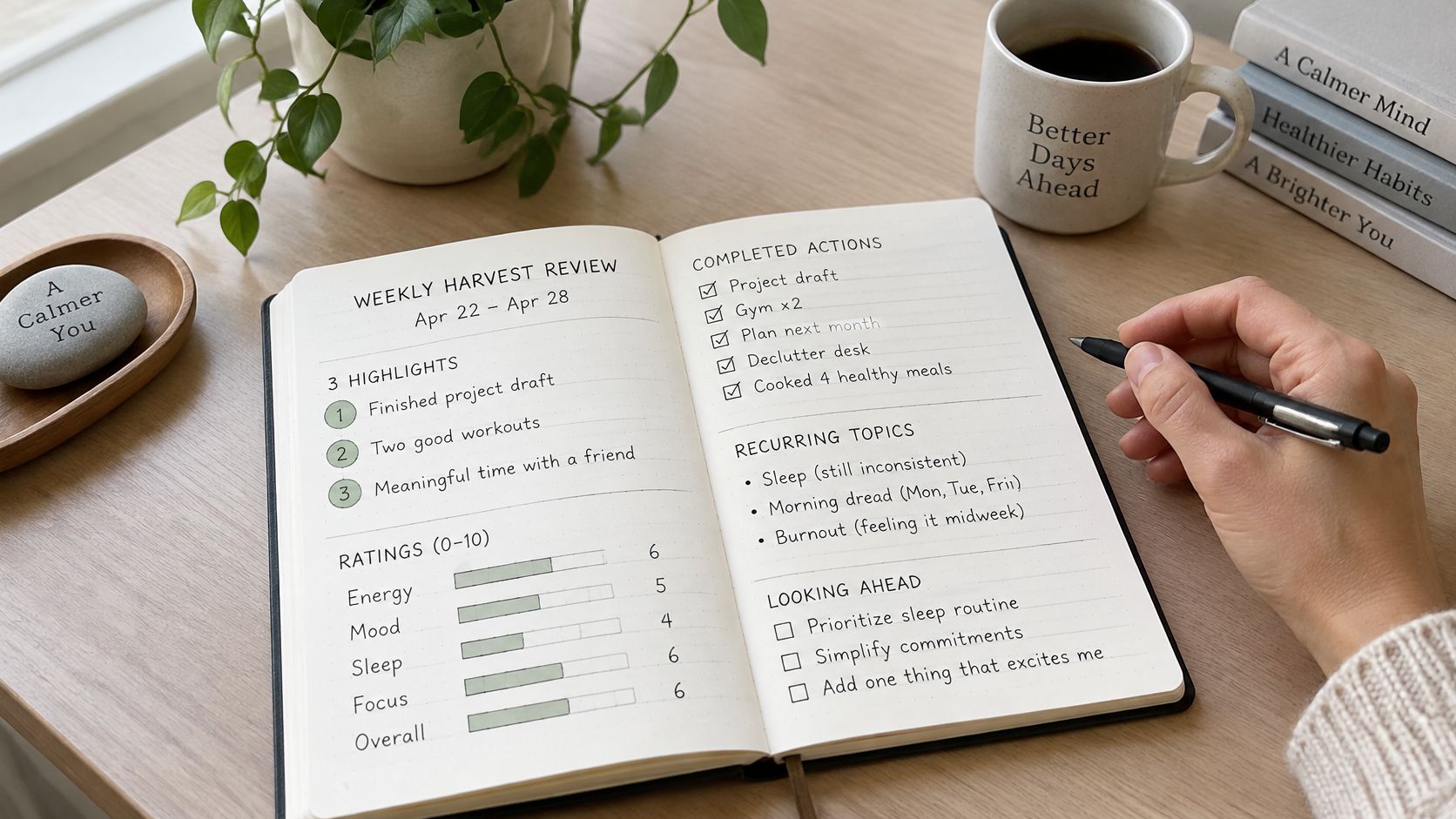
Once a week, look for ratings, actions you took, and recurring topics. Skip a full reread if it pulls you back into distress. You're looking for information you can use, not a verdict on your progress.
A simple review can stay focused on these marks.
Make tomorrow's move smaller than the feeling
If broken nights repeat, choose a manageable wind-down. If you keep describing exhaustion after the same commitment, consider a boundary. If starting the day feels impossible, identify the smallest necessary task rather than writing a demanding recovery plan.
Our AI mental wellness companion, Luno, turns daily check-ins into a personalized plan for tomorrow, shaped by how you feel, what you need, and what has helped before. Luno can feel like therapy because it maintains continuity, recalls helpful patterns, and picks up after gaps, but it is not therapy.
You can find any topic you need through our 10 evidence-based protocols, each organized into an adaptive 14-day arc: Anxiety Relief, Grief & Loss, Burnout Recovery, Sleep Repair, Self-Esteem, Trauma Processing, Relationship, Depression Lift, Focus & ADHD, and a user-defined Custom Package. These offer structured reflection and daily practice, not a substitute for clinical assessment or treatment.
Use a next-day plan as support for an ordinary action, not as a personal clinical prescription.
Our AI guidance is general self-improvement support, and Luno isn't a crisis service. If your trial stayed tolerable, keep the window that worked and choose tomorrow's small action. If writing kept making life smaller, pause and speak with a qualified professional.
Luno: Self Care offers daily check-ins, mood tracking, and adaptive next-day plans to help you turn a few honest lines into manageable daily practice. Visit Luno: Self Care to explore a self-guided journaling routine that fits your capacity, with clear limits and room to begin again.