
You're standing in the hallway for the third time. The water cup has been refilled, the stuffed animal has been chosen, and now your toddler needs to talk about toes, shadows, and a totally urgent problem that could not wait until morning. By the time the light goes out again, you're tired, annoyed, and wondering whether you're doing bedtime wrong.
You're probably not. Toddler bedtime resistance is common, and it usually grows out of a mix of normal autonomy-seeking, night waking, and routines that accidentally teach a child to keep stalling. The hard part is that a plan only starts working when it stays the same long enough for your child's brain to catch up, which is why the first few nights can feel worse before they feel better.
Why Bedtime Feels Like a Battle Right Now
A toddler who keeps getting out of bed is often doing two things at once. They're testing boundaries because that's developmentally normal, and they're also reacting to what has worked before. If asking for one more book, one more drink, or one more cuddle sometimes changes the outcome, the child learns that bedtime is negotiable.
That doesn't mean your toddler is manipulative in some dramatic way. It means they're a toddler. They want connection, they hate stopping something enjoyable, and their ability to tolerate frustration is still small.
The behavior is common, not a verdict on your parenting
Bedtime resistance and night waking affect about 20% of children aged 1 to 3 years (PubMed review). That matters because it puts the problem back in the category of a known sleep issue, not a family failure. Many parents feel embarrassed when their child won't settle, but the pattern is common enough that it deserves a calm, structured response.
Practical rule: if your child's bedtime routine changes every night, your child is being trained by inconsistency, not by your intentions.
The other piece is time. Sleep changes aren't usually visible after one rough evening. A toddler may protest harder on the first few nights of a new plan, especially if the old pattern involved extra attention after lights out. That pushback can look like failure when it's resistance to a new rule.
What's really happening after lights out
Night arousals are normal. Children briefly wake between sleep cycles, and if falling asleep required rocking, lying with a parent, or a long sequence of negotiation, they often ask for that same help again when they wake in the night. That's why a plan for how to get your toddler to sleep has to include both bedtime and what happens after sleep starts.
Consistency is what changes the pattern. A predictable routine lowers the amount of decision-making your toddler gets to do at the hardest time of day. It also lowers the chance that you'll end up trading sleep for short-term peace.
Building the Wind-Down Routine That Actually Works
A toddler bedtime routine works best when it is short, repeatable, and boring in the right way. The sweet spot is usually 20 to 45 minutes with three to five quiet activities (American Psychological Association). Think of the routine as a cue sequence, not entertainment. The point is to move the body and brain toward sleep, not to squeeze in one last exciting interaction.

A useful order is bath, pajamas, brushing teeth, one or two short books, then lights out. Screens should be off at least 60 minutes before bed (AAFP). Keep the tone quiet and the choices limited. Too many choices, too much talk, or too much stimulation makes the transition harder, not easier.
Make the schedule predictable across the whole week
Consistency has to include wake time, not just bedtime. A child who wakes at wildly different times on weekdays and weekends gets mixed signals about when night starts and ends. Choose fixed anchors for both, then protect them as best you can.
Putting your toddler down awake matters too. If they fall asleep in your arms, in the car, or while being rocked, they may look for that same setup when they wake between sleep cycles. The sleep location should match the wake-up location as closely as possible.
Use the routine as a cue, not a negotiation
Once the routine starts, it should move forward. That doesn't mean cold or rushed. It means calm and finite. If your child asks for another story after lights out, the answer stays the same every night.
Keep the last steps identical. Same order, same phrasing, same end point. Toddlers settle faster when bedtime feels familiar.
A simple checklist you can tape inside a closet door:
- Turn screens off early: Stop them at least 60 minutes before bed.
- Keep it brief: Aim for 20 to 45 minutes total.
- Use quiet steps: Bath, pajamas, teeth, books, bed.
- Set one sleep location: Put your toddler down where they'll sleep.
- Stay consistent: Same bedtime and wake time across the week.
- End awake: Let your child drift off in bed, not in your arms.
Graduated Extinction vs Bedtime Fading
Parents often want a straight answer: should bedtime be gentle, or should it be firmer? Both approaches can work, but they ask different things of you. The better choice is usually the one you can repeat on a hard night without changing course.
Graduated extinction is the more structured option. You put your toddler in bed awake, leave the room, and return on a planned schedule of brief checks. Those checks stay calm, short, and boring. You do not restart the routine, play, feed, or pick the child up unless there is a real safety or medical reason.
Bedtime fading takes a different route. Instead of asking a child to lie awake for a bedtime that feels too early, you temporarily set bedtime close to the time your toddler naturally falls asleep. Once settling improves, you move bedtime earlier in steps of about 30 minutes (American Thoracic Society resource). It often feels gentler for children who get highly activated by repeated protest or who seem wired at the usual bedtime.
What each method costs the family
Graduated extinction asks for emotional steadiness. The hard part is hearing protest without stepping in too quickly. Bedtime fading asks for schedule patience, because you are temporarily allowing a later bedtime in order to rebuild sleep pressure.
Both methods can be tiring. The strain lands in different places. With graduated extinction, the strain is usually the crying. With bedtime fading, the strain is the temporary lateness and the discipline of shifting bedtime gradually instead of forcing a fix overnight.
A randomized trial by Gradisar and colleagues compared graduated extinction, bedtime fading, and sleep education in infants aged 6 to 16 months. Behavioral approaches improved sleep in that study, and later reviews have reached the same general conclusion: these methods can help children fall asleep more independently, resist bedtime less, and wake less often at night (PubMed review). That still does not make one plan the right fit for every toddler.
A simple decision rule
Choose the method you can hold steadily long enough to matter. For most families, that means giving one approach about two weeks before deciding whether it is working. Switching tactics after one rough night often keeps the problem alive longer than it needs to.
If your child is sensitive, easily revved up, or has a hard time calming once upset, bedtime fading may be easier to live with at first. If your toddler is drawn out by repeated reassurance and checks make the evening stretch longer, graduated extinction may work better. Parents of neurodivergent toddlers often need to weigh more than crying versus no crying. They also need to think about sensory load, bedtime predictability, and how much protest their child can handle without becoming more dysregulated.
| Dimension | Graduated Extinction | Bedtime Fading |
|---|---|---|
| Parent effort | Short, repeated checks, emotionally demanding | Later bedtime at first, requires patience |
| Best fit | Families who can tolerate brief protest | Toddlers who fight early bedtime hard |
| Core move | Put down awake, return at fixed intervals | Align bedtime with natural sleep onset |
| Main risk | Inconsistency and over-rescuing | Letting bedtime drift late for too long |
Reading the Nap Question Without Guessing
Nap trouble can make bedtime look like a behavioral problem when it's really a schedule problem. One skipped nap, one short nap, or one unusually late nap doesn't tell you much on its own. What matters is the pattern across several days.
The practical question is not just, “Did my toddler nap?” It's, “What does the full day look like?” Use nap timing, nap length, bedtime resistance, night waking, and morning mood together. That gives you a better read on whether your child is undertired, overtired, or ready to change the nap.
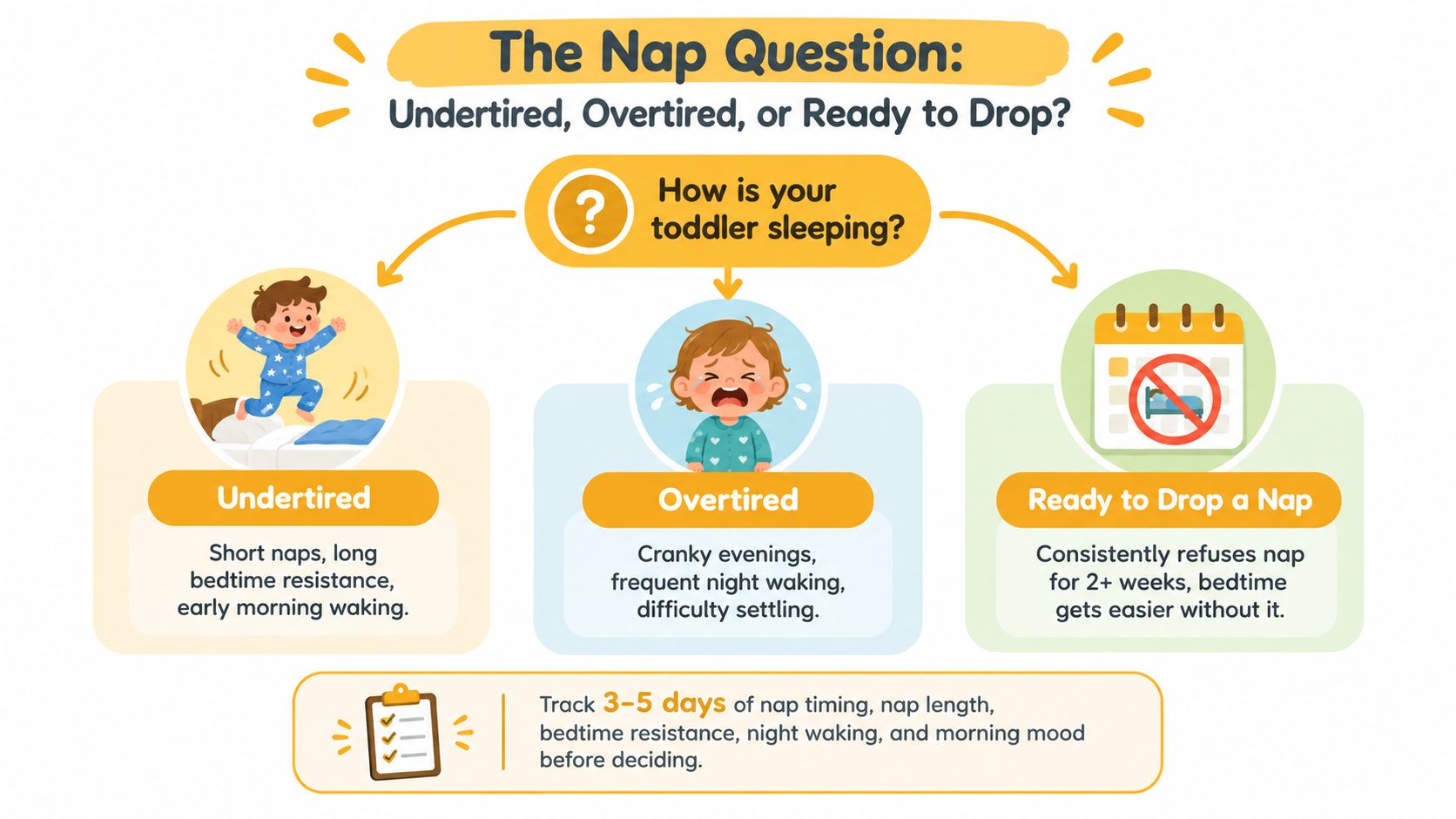
Use several days of data, not one difficult afternoon
Toddlers usually transition from two naps to one between about 12 and 18 months, while the morning nap may disappear around 10 to 15 months and the final nap can fade anywhere from roughly 2 to 4 years (BBC Tiny Happy People). That wide range is exactly why guessing often goes wrong. A child who refuses one nap for three days may still need it.
The cleaner rule is to protect the child's total sleep opportunity across 24 hours. For ages 1 to 2, the benchmark is 11 to 14 hours including naps (AASM consensus). If bedtime gets harder after a nap change, the first question is often whether the child has been pushed too far, too fast.
What usually goes wrong
Cutting a nap too early often backfires. A toddler who is overtired may look energetic for a while, then melt down, resist bedtime, wake more at night, or wake earlier in the morning. On the other hand, a toddler with too much daytime sleep may not have enough sleep pressure to settle at night.
The safer way to test change is gradual. Shift nap timing slowly, protect age-appropriate total sleep, and give the new pattern several days before you call it successful or unsuccessful. A single awful bedtime is a data point, not a conclusion.
If your child still seems tired, wakes cranky, or fights sleep harder after nap reduction, you probably removed the nap too soon.
When Standard Advice Does Not Fit Your Toddler
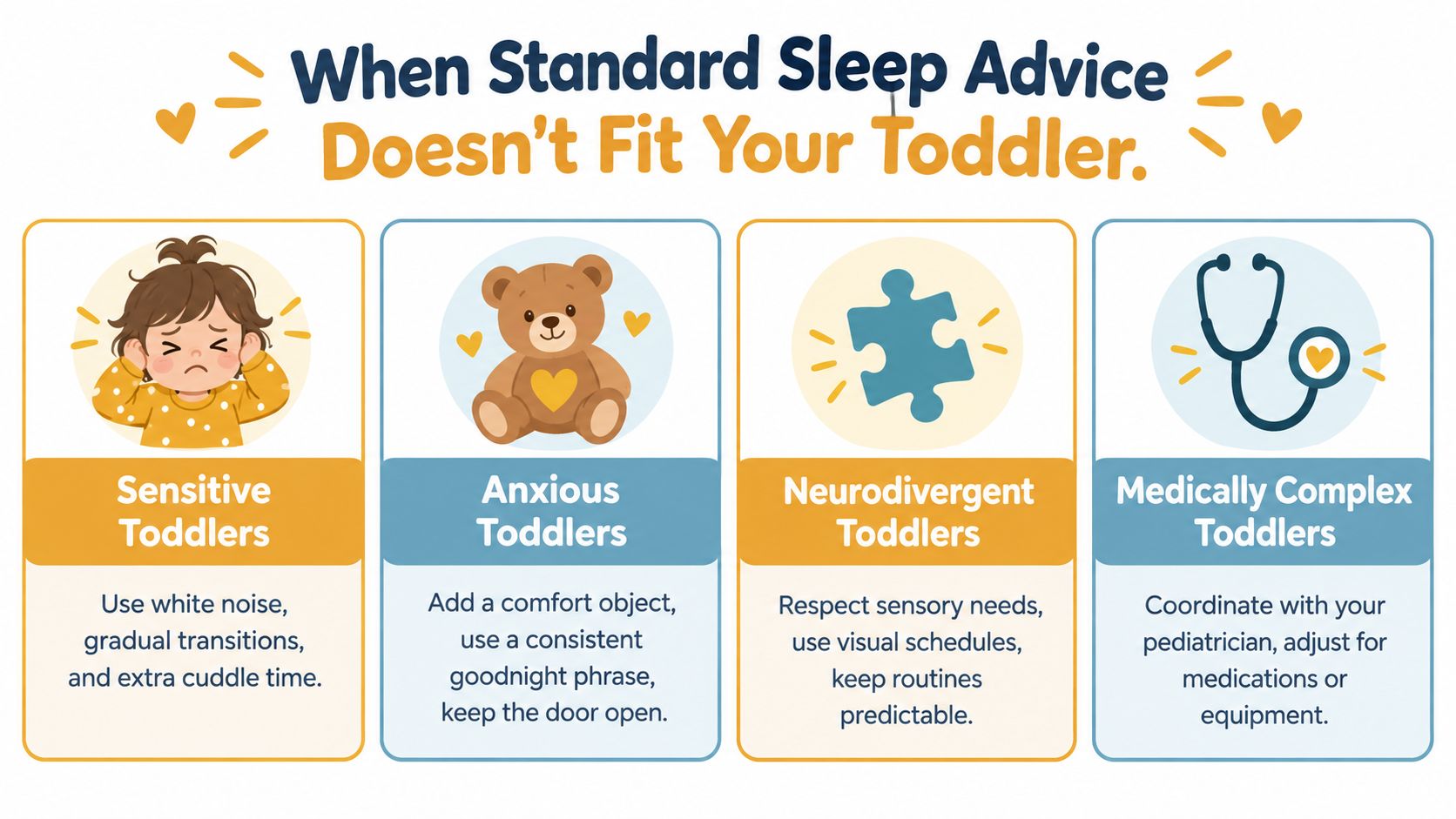
Some toddlers need more than a standard bedtime script. Sensitive, anxious, neurodivergent, and medically complex children often do better with slower changes, more predictability, and, in some cases, a medical check before any sleep method gets stricter.
Adapt the environment before you push the method
Small supports can lower the strain at bedtime. White noise, gradual transitions, picture schedules, a comfort object, a familiar phrase, and extra cuddle time often make the routine easier to tolerate. The goal is a calmer runway into sleep.
A perfect sensory setup matters less than lowering avoidable stress before the routine even starts. If your toddler is already overloaded by the time pajamas go on, a rigid plan usually creates more resistance.
Check for the cause before assuming it's behavioral
Snoring, gasping, breathing pauses, unusual movements, pain, major daytime impairment, or possible medication effects deserve pediatric attention. A child who seems impossible to settle may be uncomfortable, anxious, or dealing with something medical that sleep training alone will not fix.
Behavioral sleep support also has limits. In healthy children, a systematic review found only about 10.5 additional minutes of sleep per night on average (Journal of Pediatric Psychology). In neurodevelopmental and medical conditions, outcomes vary, and there is no single response that works for every child. That makes matching the method to the child more useful than forcing one script.
When to slow down, not push harder
If your toddler has anxiety, sensory sensitivity, developmental differences, or a medical condition, favor methods that protect safety and trust. Picture support, a slower fade, or a pediatrician's input before any extinction-based approach may fit better than an abrupt change.
Rule of thumb: when sleep problems come with snoring, breathing changes, pain, or clear daytime impairment, the next step is clinical evaluation, not stronger discipline at the bedroom door.
Your First Two Weeks of Better Nights
The best plans start small and stay boring enough to repeat. For the first 3 days, do nothing except observe. Track bedtime, sleep-onset latency, night waking, out-of-bed episodes, nap timing, and how you respond. You're looking for the pattern, not proving a theory.
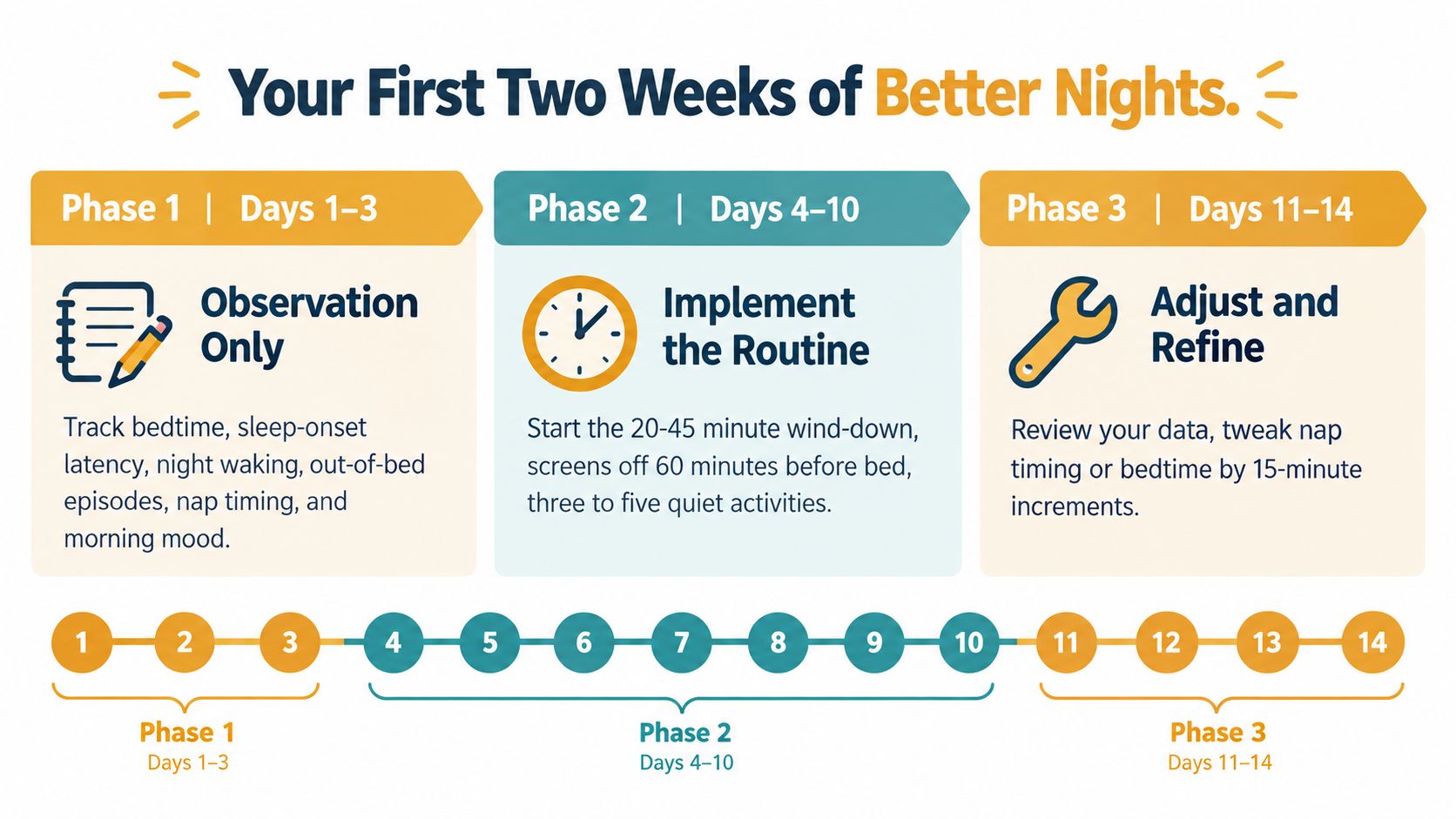
For days 4 through 7, stabilize the routine. Keep screens off for the hour before bed, use your 20 to 45 minute wind-down, and hold your wake and bedtime anchors steady across the week. Right now you stop feeding bedtime chaos without yet trying to solve every wake-up.
Days 8 to 14 are for one chosen method
Pick either graduated extinction or bedtime fading, then stick with it for the full window. Don't change course after one hard night. If you're using checks, keep them brief and calm. If you're using fading, move bedtime earlier only after sleep starts reliably within about 30 minutes of lights out.
Working usually looks like settling in about 30 minutes, fewer middle-of-the-night calls, and easier mornings. Not working looks like persistent distress, worsening wake-ups, or bedtime resistance that improves only when you change the schedule, nap timing, or environment.
The biggest mistake is treating every bad night as a reason to switch. A better response is to ask whether the child needs more sleep pressure, a different routine, or a medical check. That keeps you from cycling through three strategies in five nights and calling the result failure.
Keeping Perspective and Knowing When to Call Someone
Bedtime resistance and night waking are common at this age, and they don't mean you've broken your child's sleep. They usually mean the current pattern needs clearer boundaries, a better schedule, or a more careful look at what your toddler's body is asking for. You do not need to fix everything tonight.
Call your pediatric clinician if you hear loud persistent snoring, breathing pauses, unusual nighttime movements, significant daytime impairment, or pain. Those are not signs to be more patient. They're signs to check for a medical explanation before you keep adjusting sleep tactics at home.
Structured self-guided support can help parents stay calm and consistent between visits, especially when the problem is behavioral and the family needs a paced plan. It's still not a substitute for clinical care when the sleep issue feels medical, persistent, or beyond what routine changes can solve.
If you want a structured way to protect bedtime, track what's happening, and build a calmer evening routine without guesswork, visit Luno: Self Care. It offers self-guided, evidence-based support that can help you stay consistent while you work on better nights for your family.