
You're hovering over the meeting link, thinking of another reason not to join. You've skipped it for weeks. Or perhaps you're rereading a short message, trying to work out whether someone's annoyed with you. Nothing definite has happened, but you already feel exposed.
Learning how to deal with insecurity doesn't mean convincing yourself that everyone likes you. It means noticing what you predict, checking what happens, and choosing a response that protects your well-being without shrinking your life.
Tell Ordinary Insecurity From a Pattern That Needs Help
Skipping a meeting can bring immediate relief. When you keep skipping because you expect humiliation, though, insecurity is affecting what you can do. That distinction matters more than whether you seem confident to other people.
The World Health Organization's anxiety-disorders fact sheet estimates that 470 million people worldwide lived with an anxiety disorder in 2023, about 5.8% of the global population. That isn't a count of people experiencing insecurity. It does establish that anxiety is common, including social anxiety involving intense fear of rejection, embarrassment, or negative evaluation.
Insecurity isn't itself a diagnosis. Look at its persistence, intensity, and effect on daily life rather than trying to diagnose yourself from a difficult afternoon.
Ordinary insecurity versus patterns that need professional assessment
| Signal | Usually ordinary insecurity | Warrants professional assessment |
|---|---|---|
| Duration | Flares around specific events and fades within a few days | Persists for weeks or months and keeps escalating |
| Avoidance | Skips one optional event, then goes back | Consistently avoids work, school, friends, or relationships |
| Physical response | Nerves before a presentation that settle once it starts | Panic attacks or dread that starts on waking and lasts most of the day |
| Mood | Low after a setback, recovers within days | Persistent low mood, hopelessness, or loss of interest in usual activities |
| Safety | No risk to self or others | Thoughts of self-harm or suicide, or inability to stay safe |
Use this as a reflection guide, not a diagnostic test. Try keeping a two-week log, noting which column best describes each day and what you couldn't do because of the distress. You don't need to finish the log before asking for help.
When insecurity is persistent, escalating, or disruptive, talk to a clinician.
If most entries sit in the right-hand column, self-guided exercises shouldn't be your main approach. Any thoughts of self-harm or suicide call for urgent support now, not after completing an exercise. If you can't stay safe, contact emergency services; location-specific options appear under the final heading.
For now, write down your most frequent difficult situation and the signal that worries you most. Choose something concrete, such as avoiding the team update, rather than a global judgment about your personality.
Catch the Prediction Behind Your Insecurity
A situation happens. You make an automatic prediction. Your body reacts, and you do something to prevent the feared outcome. That action brings relief, but you may never discover whether the prediction was accurate.
In cognitive behavioral therapy, or CBT, some protective actions are called safety behaviors. Excessive rehearsal, repeated apologies, checking reactions, and reassurance-seeking can serve this role. The question isn't whether preparation is bad. It's whether you believe you can cope only when you perform the protective ritual.
Make a brief thought record
Try this routine in under ten minutes. You're collecting information, not building a case against yourself.
- Write the trigger. Describe what happened in a sentence, without guessing anyone's intentions.
- Name the prediction. Replace a broad feeling of inadequacy with a testable expectation, such as expecting colleagues to criticize your answer.
- Rate your belief from 0 to 100. Record how convincing it feels at that moment.
- Note the body signal. Tight shoulders, a hot face, or a dropping sensation in your stomach are useful observations.
- Identify your safety behavior. What did you do to prevent rejection, hide discomfort, or get certainty?
These are hypothetical entries, with illustrative ratings and outcomes. Your own record may include mixed reactions or an outcome you still can't interpret.
| Trigger | Automatic prediction | Belief (0–100) | Safety behavior | What actually happened |
|---|---|---|---|---|
| Asked to share a team update | Everyone will see I have no idea what I am doing | 80 | Rehearsed three times and spoke only in bullet points | Two colleagues asked follow-up questions and thanked me |
| Friend replied to a text with one word | They are annoyed with me | 75 | Sent three apology texts | Friend replied an hour later saying the day had been busy |
| Posted a photo online | People will judge how I look | 60 | Checked the post every ten minutes | Eight comments, all neutral or positive |
| Quiet stretch at a dinner party | I am boring and they wish I would leave | 70 | Stayed near the kitchen and avoided eye contact | The host said she had hoped to hear more about my trip |
Notice that observable outcomes aren't mind-reading. Follow-up questions are observable. Concluding that everyone secretly disliked you isn't.
A belief rating tracks how convincing a prediction feels. It isn't a score for being right, reasonable, or good at self-help.
As a practice schedule, aim for three entries a week for two weeks. Keep them short enough that recording the moment doesn't become another perfectionist task.
Calm Your Body Before You Run an Experiment
Your heart is racing before you speak. Or your chest tightens after a delayed reply. Trying to debate your thoughts while you're highly activated can feel like doing paperwork during a fire alarm.
You don't have to become completely calm. Give yourself enough space to choose what to do rather than reacting automatically.
A short settling routine
- Name the sensation. Use a plain word such as hot, tight, shaky, or fast. Describe what you notice without deciding that it means danger.
- Try gentle, slower breathing. For example, breathe in for four seconds and out for six, for two minutes. Don't force a deep breath or hold your breath; return to comfortable breathing if you feel dizzy or more distressed.
- Orient to your surroundings. Try a five-four-three-two-one check: notice five things you can see, four you can touch, three you can hear, two you can smell, and one you can taste. Skip anything unavailable or uncomfortable.
- Recheck the prediction. Rate your belief again and note whether it changed. An unchanged rating doesn't mean you failed.
These timings are a suggested practice, not a clinical threshold or a promise of relief. You can shorten the routine if counting makes you more self-conscious.
Use calm as a bridge
After settling, take the manageable action you planned. That might mean keeping your microphone on and asking your question while your hands still feel shaky.
If you repeatedly postpone the action until every uncomfortable sensation disappears, calming can become another condition you believe you must meet before participating. The aim is workable discomfort, not perfect composure.
Breathing exercises, preparation for stressful situations, and speaking with a health professional can belong in a broader support plan. Frequent panic attacks or dread lasting most of the day deserve professional assessment rather than an increasingly elaborate breathing routine.
How to Run a Graded Social Experiment
A meta-analysis of 55 CBT trials for social anxiety found large pooled post-treatment effects, with g = 0.87. A realistic benchmark is a meaningful response to treatment, not the complete elimination of fear, and a self-guided exercise isn't equivalent to a course of CBT.
A graded experiment is a manageable opportunity to test a prediction. It isn't a test of your courage, and it shouldn't involve tolerating unsafe situations.
This flowchart outlines the process.
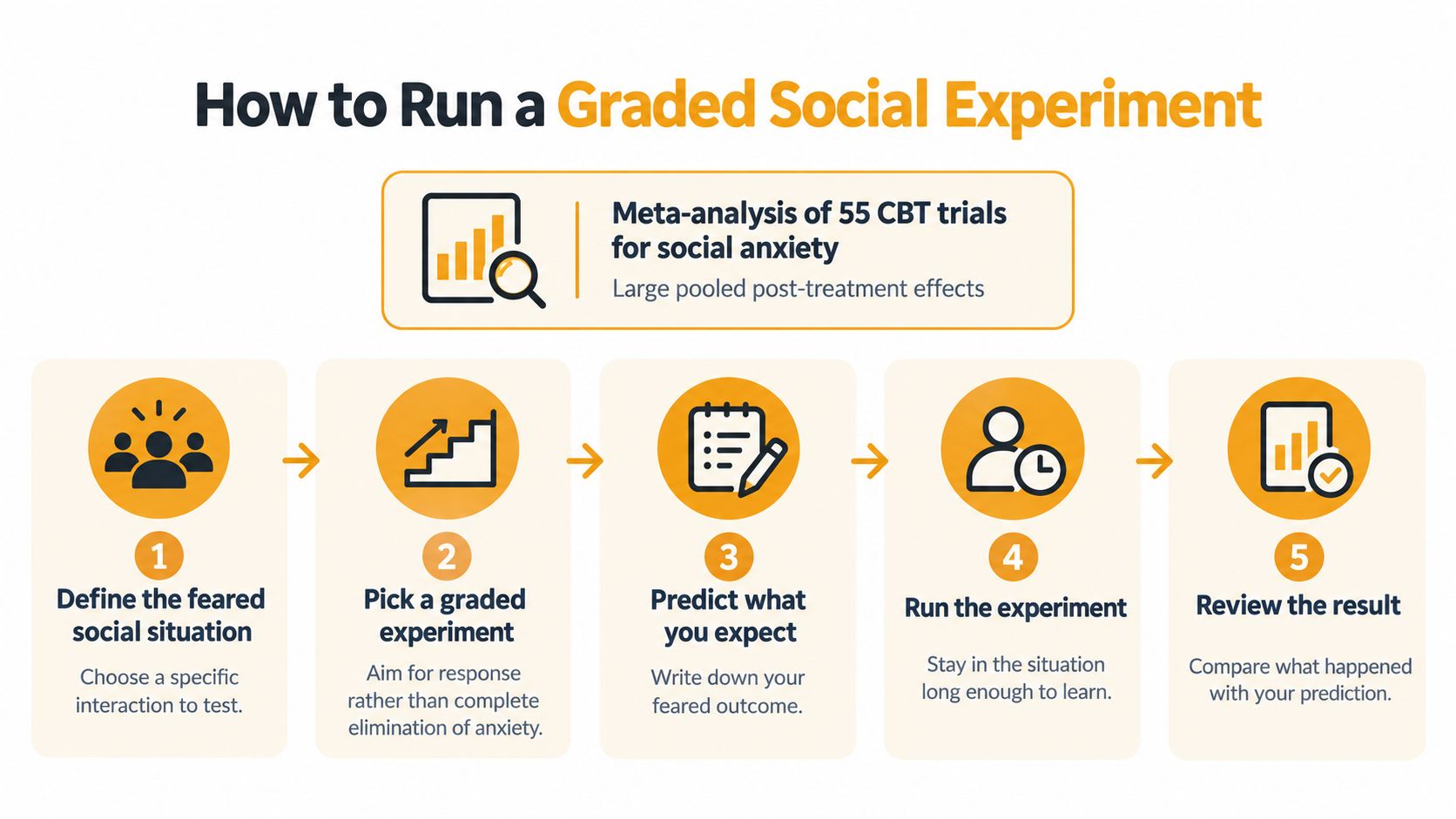
Choose an action that can teach you something
- Pick a low-stakes situation. As an illustrative target, choose something around 30 to 40 on your personal fear scale. Asking a question in a small meeting may be more workable than volunteering for a major presentation.
- Write the feared outcome and rate your belief. Make it observable: expecting someone to dismiss your question gives you something clearer to assess than expecting to feel inadequate.
- Drop a safety behavior while participating. Ask without scripting every word, for example. Keep ordinary preparation and any accommodations you need.
- Record what people said and did. Include inconvenient evidence as well as reassuring evidence. If someone disagreed, note whether they challenged your idea, insulted you, or offered another view.
- Repeat, then increase the challenge gradually. You might ask a follow-up question or contribute an opinion. Reduce another protective ritual when the task feels manageable enough to repeat.
Stay long enough to observe the interaction, rather than leaving immediately after speaking. You don't need to remain until your anxiety disappears.
Watch for these pitfalls
- An experiment that's too easy. Saying hello to someone you never fear won't test your prediction about contributing at work.
- Measuring only anxiety. Feeling nervous afterward doesn't erase the fact that you participated and gathered evidence.
- Hidden reassurance-seeking. Asking several colleagues whether you sounded foolish can replace the ritual you intended to drop.
An awkward outcome can still produce useful learning. Perhaps your question wasn't clear and someone asked you to rephrase it. That supports a specific adjustment, not a conclusion that you don't belong.
Measure success by the behavior you completed and what you learned, not by whether you felt confident.
Use a Self-Compassion Sequence When Your Inner Critic Takes Over
Your presentation ends with a rushed conclusion. Before you've closed the slides, you're telling yourself that you always ruin things. A specific problem has become a verdict about your whole character.
Self-compassion means responding to that moment with honesty and care. It doesn't mean pretending the presentation went perfectly.
Use this visual as a reminder of the sequence.
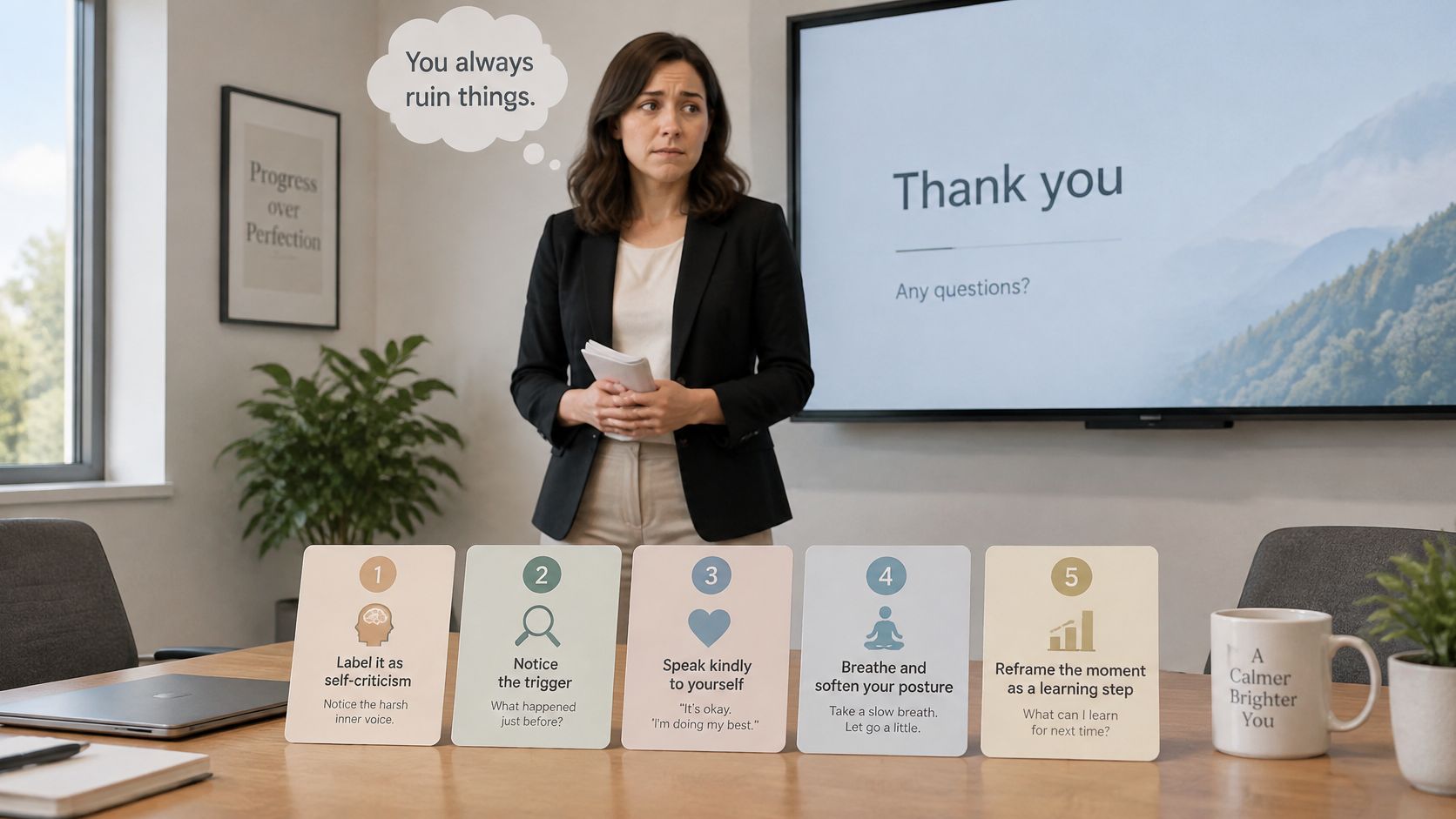
Replace the verdict with a repair
- Label what's happening. Identify self-criticism or threat activation rather than treating every harsh thought as a reliable assessment.
- Write the exact judgment and the standard behind it. In this example, the judgment is that you ruin everything. The hidden standard may be that you must never make a mistake.
- Give a balanced response. Acknowledge that the ending was rushed and that you can prepare differently next time. Don't excuse harm if you interrupted, misled, or mistreated someone.
- Choose a corrective action within the next day. Send a clear summary, correct an error, or rehearse a shorter conclusion.
- Repeat after setbacks. Briefly track self-compassion, rumination, anxiety, and mood using the same simple scale each time. Personal ratings can help reflection, but they aren't a diagnosis.
A meta-analysis of 27 randomized controlled trials found medium improvements from self-compassion interventions in self-compassion, stress, depression, and mindfulness. These are group-average results, not guaranteed outcomes for an individual.
Keep kindness practical
Compassionate language doesn't need to sound uplifting. It needs to be accurate enough that you can use it while disappointed. You can acknowledge poor preparation without insulting yourself into preparing better.
For another way to engage with this topic, you can watch the video below.
Don't assume that a kinder response will resolve every worry. Predictions about rejection still need real-world testing, and practical mistakes still need repair. Affirmations alone can change your wording without changing what you do.
Practical rule: Pair compassion with a specific action you can complete and review.
What to Do When Kindness Toward Yourself Feels Unsafe
Being kind to yourself can feel fake, undeserved, or threatening. You might become tense when someone offers care, or feel ashamed after trying a compassionate exercise. That reaction deserves attention, not another demand to be more positive.
A 2025 meta-analysis covering 46 studies and 17,650 participants found that self-compassion was negatively associated with attachment anxiety (r = -0.42) and attachment avoidance (r = -0.32). These associations don't establish causation or diagnose your attachment style. They do challenge the assumption that accepting care is straightforward for everyone.
Identify what feels dangerous
Different concerns call for different responses:
- Self-criticism. You fear you'll stop trying unless you stay harsh. Pair a neutral response with a clear responsibility or task.
- Shame. You feel undeserving. Begin with basic care rather than statements about being wonderful.
- Fear of dependence. Support feels like surrendering control. Choose a limited request with a clear endpoint.
- Fear of receiving care. Kindness makes you feel visible or exposed. Decide how much you want to share and with whom.
These are possibilities to explore, not labels you have to accept. You may recognize several, or none.
Start with something emotionally neutral
For a suggested two-week practice, use a statement such as acknowledging that the situation is difficult and that you can pause. You don't have to believe anything grand about yourself.
Then accept a small, bounded form of support. For example, arrange a ten-minute call with a trusted friend and say whether you want listening or practical help. Add a concrete act of care, such as eating a meal or taking a walk, and notice your bodily response without demanding gratitude or relief.
Finding compassion hard doesn't prove it's ineffective. It also doesn't mean you should push through overwhelming distress. If self-harm or severe distress is present, involve a qualified professional before continuing emotionally intense exercises.
You're allowed to approach kindness slowly. Neutrality and basic care are legitimate starting points.
Set Boundaries When Insecurity Is About a Relationship
Relationship uncertainty deserves attention alongside your internal reactions. In a 2025 survey of 276 partnered adults, attachment anxiety and avoidance both predicted lower commitment through greater relationship uncertainty, with a stronger effect for anxiety (β = -0.21) than avoidance (β = -0.07).
That doesn't tell you what's happening in your relationship. It does suggest why trying to feel more confident may miss the issue. Sometimes you need emotional regulation; sometimes you need clearer agreements; sometimes you need protection from unacceptable behavior.
Three relationship signals and the right response to each
| Signal | What it looks like | Response |
|---|---|---|
| Internal trigger | Abandonment fear spikes in any quiet phase, even when the partner has been consistent | Name the fear, check the observable facts, and self-soothe before reacting |
| Communication ambiguity | Unclear plans or mixed messages about commitment | Make a specific request and agree on expectations out loud or in writing |
| Repeated boundary violation | Deception, coercion, contempt, or pressure you've objected to more than once | Set a firm limit and seek support from a counselor or trusted person, rather than reframing it as your confidence |
These categories can overlap. Being anxious doesn't make your observations false, and a partner's reassuring explanation doesn't automatically settle a repeated problem.
Add relationship facts to your existing record
Use the same thought record rather than creating a competing system. Extend the outcome column to include the request, the partner's response, and what happens afterward:
- Trigger and observable facts. Record the changed plan or missed agreement without guessing motives.
- Interpretation. Note what you think it means and how strongly you believe it.
- Request and response. Write what you asked for and what your partner said or did.
- Repeated pattern. Notice whether behavior changes over the following weeks.
For a recurring planning problem, you might explain that when plans change at the last minute, you need a text by noon so you can organize your evening. Add what you'll do if you haven't heard, such as making your own plans. A boundary states your limit and your action, not just what someone else must do.
An internal trigger may appear across unrelated situations. A communication gap may improve after a clear agreement. Repeated deception, coercion, contempt, or disregard for boundaries shouldn't be treated as a confidence exercise.
The survey findings are cross-sectional. Use your record to notice patterns, not to diagnose attachment style or assign blame. If setting a limit could put you at risk, seek confidential support before confronting your partner.
Pick One Experiment This Week and Set a Check-In
Choose a task small enough to schedule and meaningful enough to teach you something. You don't need a complete personality transformation before taking part in your life. One honest data point beats a week of good intentions.
Use a journal or calendar to make the commitment visible.
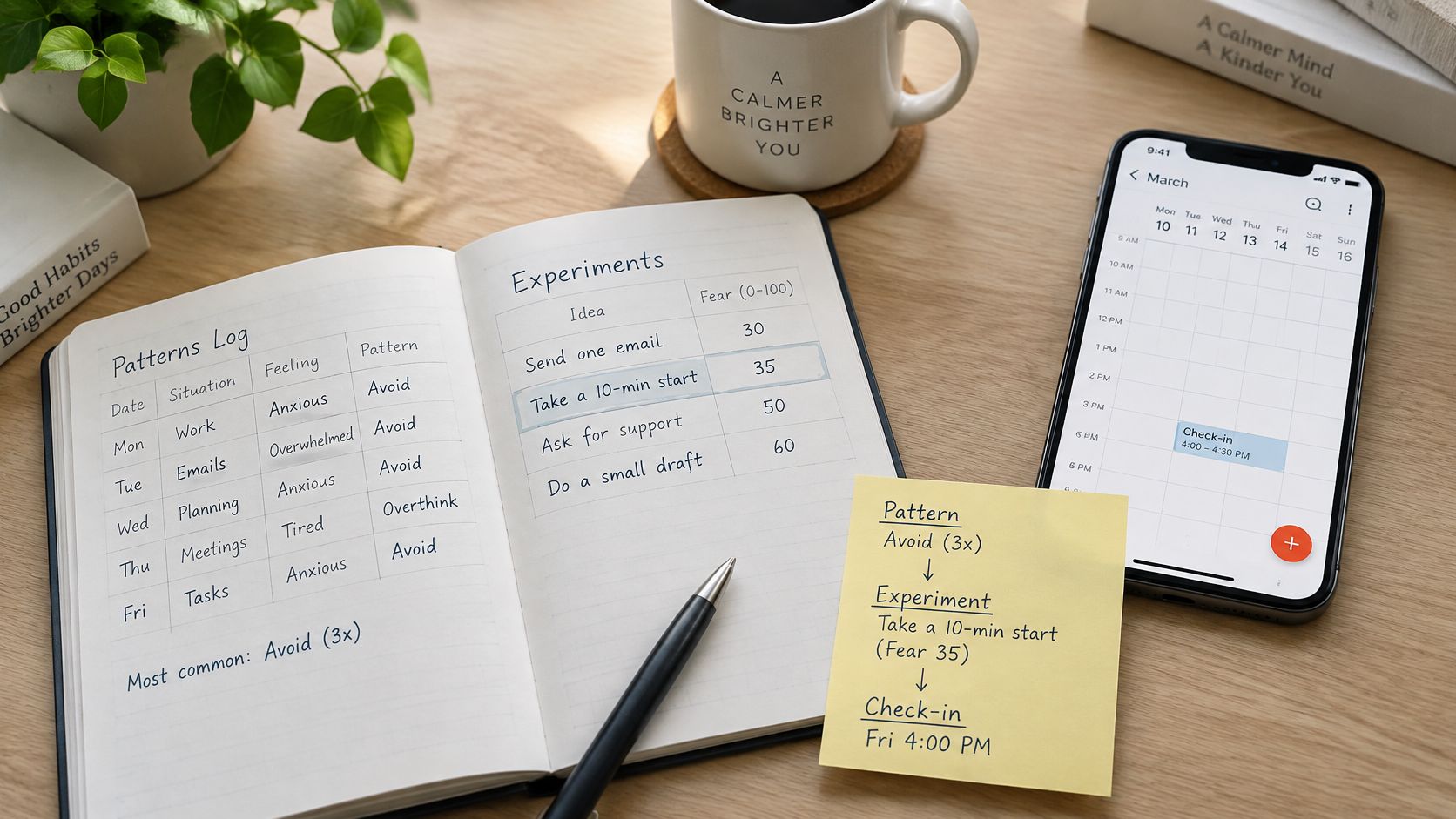
Make a manageable plan
- Choose a recurring pattern. Pick something that appeared at least twice in your log.
- Select a manageable experiment. Aim for roughly 30 to 40 on your personal fear scale, challenging without being overwhelming.
- Schedule it within the next 48 hours. Write the situation, prediction, and safety behavior you'll reduce.
- Put check-ins on days 7 and 14 in your calendar. Use the same ratings and review participation, avoidance, and daily functioning alongside your mood.
If your log shows you stayed silent in two meetings, a fitting experiment might be asking one question early in the next one, before your inner critic talks you out of it. Small enough to schedule. Real enough to test a prediction.
Structured tools can hold this plan between check-ins. Luno: Self Care is a self-guided mental wellness companion, not therapy, a clinician, or a crisis service. You share your story, choose from 10 evidence-based packages or build your own, receive a Day 1 plan written specifically for you, and report through daily check-ins so each day's plan adapts overnight. Its AI-generated guidance supports reflection, emotional awareness, and daily practice rather than individualized clinical advice, and it can sit alongside treatment rather than replace it. The WHO's self-care guidance likewise positions self-care as a complement to health services, not a replacement.
Know when to get more support
According to NHS urgent mental-health guidance, call emergency services or go to an emergency department immediately if someone's life is at risk, serious self-harm or an overdose has occurred, or you can't keep yourself or someone else safe; in England, call 111 and select the mental-health option for urgent but non-emergency needs.
For ongoing impairment, speak with a GP or a qualified mental-health professional. The NHS guide to accessing mental-health services explains that talking therapies in England can also be accessed through self-referral without first seeing a GP.
If self-guided work fits your situation, write down your experiment and your check-in dates now. Make the next action clear enough that you won't have to renegotiate it when you feel nervous.
Luno: Self Care turns daily check-ins into a personalized plan for tomorrow, shaped by how you feel and what has helped before. If you'd like structured support for noticing predictions, recording what happens, and choosing your next small step alongside any care you need, you can download the app from the App Store or Google Play.