
You've opened the email, typed a sentence, and deleted it again. You know what needs saying, but your mind keeps asking whether you'll sound difficult, get it wrong, or regret pressing send. You don't need to feel unstoppable. You need enough trust in yourself to take one useful step.
Self belief meditation can be a way to practice that smaller, more believable kind of trust. Instead of trying to talk yourself into a new personality, you settle your attention, choose a line you can support with evidence, and rehearse an action you can take.
What Self Belief Meditation Actually Changes
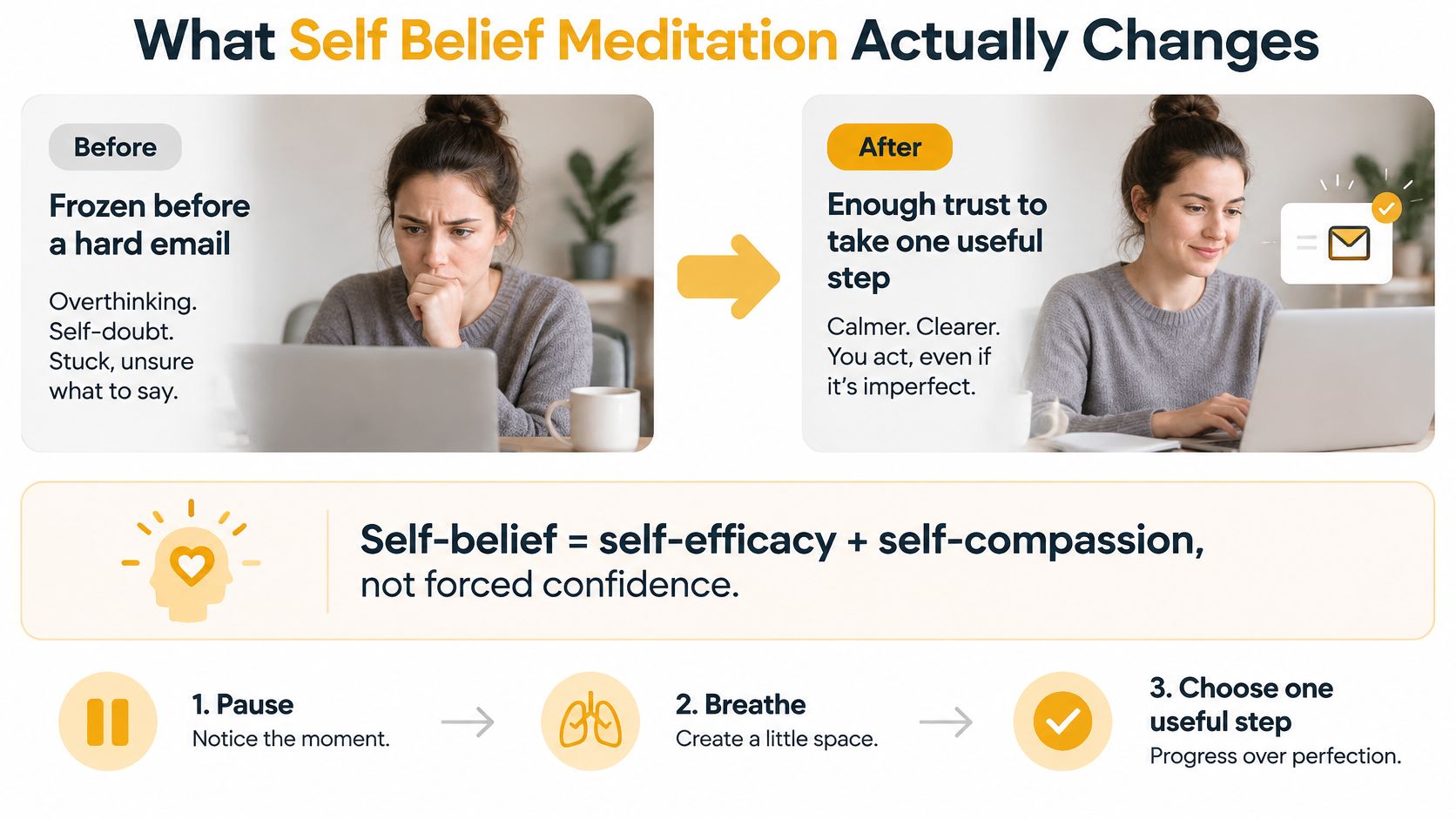
Self-belief isn't the conviction that everything will work out. It's the willingness to act without that guarantee. Before the difficult email, that might mean writing a clear request rather than waiting until you feel completely confident.
For this practice, a useful working definition is self-efficacy plus self-compassion. Self-efficacy means believing you can manage a challenge. Self-compassion means responding to difficulty without turning it into a verdict on your worth. Together, they leave room for both responsibility and kindness.
Trust your capacity, not a perfect outcome
A 2015 systematic review and meta-analysis of meditative interventions reported a self-efficacy effect size of 0.86, with a 95% confidence interval of 0.50 to 1.23, assessed on average approximately eight weeks after interventions began; effects for depression, anxiety, and stress were 0.49, 0.53, and 0.49, respectively.
Those findings concern caregiver and health-professional contexts, not everyone trying a meditation at home. The relatively wide confidence interval also leaves uncertainty about the exact average benefit. This supports a measured expectation: meditation may strengthen perceived coping capacity, but a particular script or short practice isn't guaranteed to produce the same result.
The practical change to look for is less dramatic than a confidence makeover:
- Before practice: You treat doubt as a reason to delay.
- During practice: You notice doubt without having to settle every objection.
- After practice: You choose a manageable behavior despite some remaining uncertainty.
This diagram captures the distinction between feeling certain and becoming able to act.
Keep the promise small and honest
A structured sit can feel therapy-like because you're working with attention, thoughts, and reflection. But a self-guided exercise doesn't establish a clinician relationship, provide a diagnosis, or replace treatment.
You can choose a concern that matters today, such as self-worth, stress, anxious anticipation, or low mood. That flexibility doesn't mean the same exercise treats every condition. It means you can rehearse a useful response to the situation in front of you.
For the email, success might be drafting the request while your stomach still feels tight. The action doesn't have to wait for the feeling to disappear. That's the standard to bring to a short sit: not a transformed identity, but a more workable next move.
Run a Fourteen Day Self Belief Sit
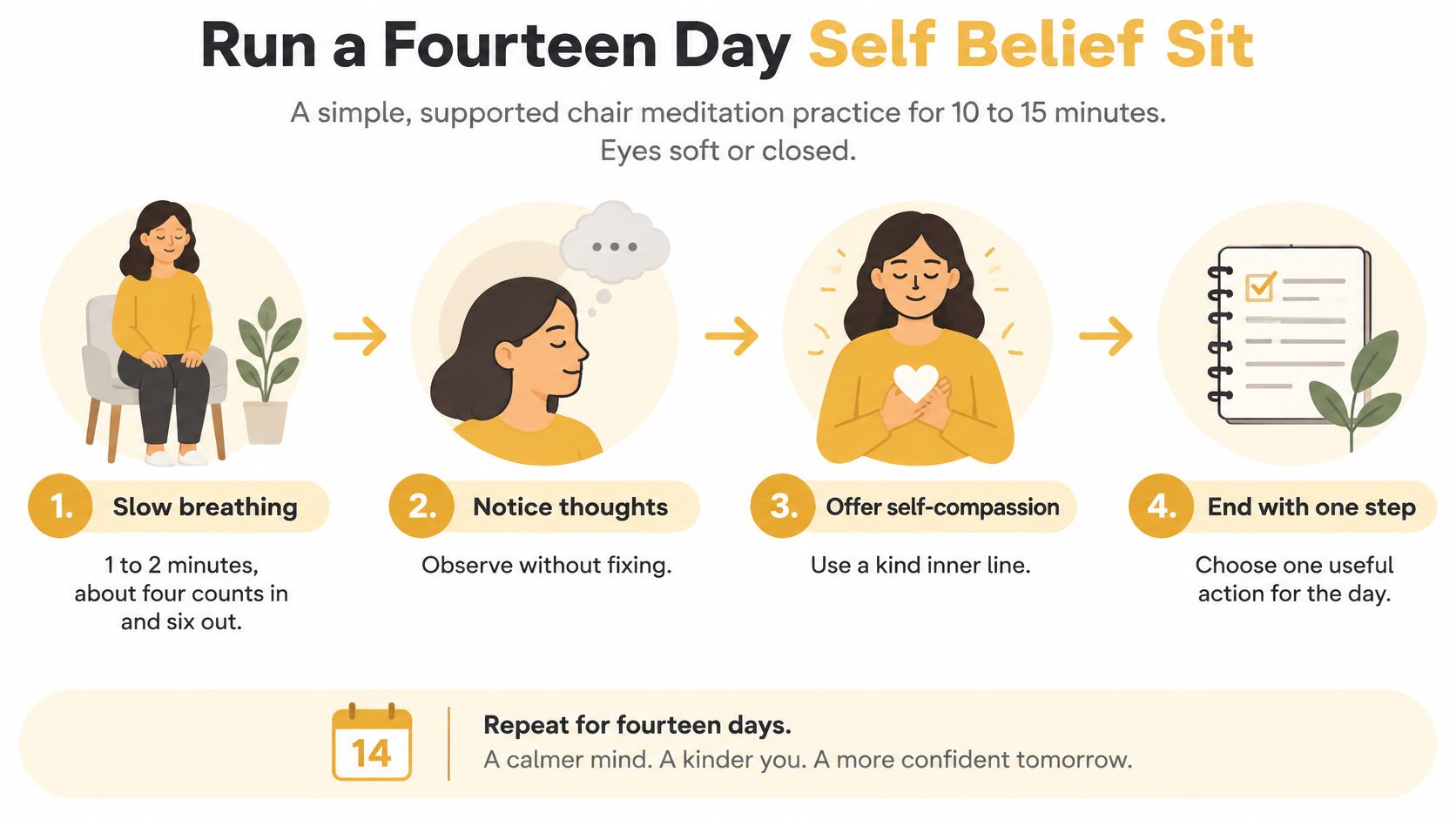
Use this as a 10 to 15 minute practice repeated over 14 days, not a test of how well you can meditate. Sit in a supported chair with your eyes softly open or closed. Keep a notebook within reach so finishing doesn't require opening your phone.
Before beginning, feel your feet on the floor and name a sound in the room. If inward attention feels uncomfortable, keep your eyes open and let the room remain part of your awareness.
The visual offers a compact reminder of the practice's main movements.
Follow the six moves
These timings are practical pacing suggestions, not a scientifically established optimal dose.
| Move | Suggested time | What you're practicing |
|---|---|---|
| Settle with breathing | 1 to 2 minutes | Returning attention |
| Choose a controllable belief | About 1 minute | Narrowing the task |
| Notice the critic | 2 to 3 minutes | Allowing thoughts without debate |
| Offer an evidence-linked line | About 2 minutes | Credible self-support |
| Rehearse the smallest behavior | 2 to 3 minutes | Preparing for a real situation |
| Write the if-then and finish | About 2 minutes | Connecting reflection to action |
Steady your attention with breathing. Try about four counts in and six out, without straining or holding your breath. If counting creates tension, breathe naturally instead. The point is to give attention somewhere simple to return, not to achieve perfect calm.
Name a belief you can influence today. Use a statement such as I can take one useful step despite uncertainty. Avoid choosing someone else's response as your target. You can practice making a request, but you can't guarantee that another person will welcome it.
Notice the self-critical thought. Label it doubt or old story. Let it be present without building a case against it. You're practicing not obeying every thought, rather than proving the critic wrong.
Offer a credible replacement. Recall something you did this week: answered an awkward message, asked for clarification, or returned to an unfinished task. Build your line around that evidence. A modest fact is more useful here than an impressive sentence you don't believe.
Rehearse a near-term situation. Choose something likely to happen within the next day. Picture the smallest successful behavior, such as opening the draft and writing its first clear sentence. Skip the fantasy of universal approval and rehearse what your hands or voice will do.
Write an implementation intention. Use the form If X happens, I will do Y. Rate your belief from 0 to 10, then plan to rate it again after the action, not immediately after meditating. Finish by opening your eyes, feeling your feet, and stopping.
Leave out the unnecessary work
Skip a lengthy body scan, perfect posture, and attempts to force the critic away. Don't repeat a sentence you find unbelievable, substitute distant fantasy wins for rehearsal, or treat a calm feeling as proof of progress.
The emphasis is self-compassionate cognitive rehearsal, not hype. Evidence summarized in a review of meditation and self-compassion includes a mindfulness-program effect of g = 0.60, with a 95% confidence interval of 0.41 to 0.80, and a loving-kindness and compassion meditation effect of d = 0.56 across 31 randomized trials involving 2,823 participants. Those standardized effects aren't percentages of people who succeed.
For optional beginning-and-ending records, use the Self-Compassion Scale and General Self-Efficacy Scale, alongside a separate tally of completed actions. A notebook is enough; Luno's website is another place to explore self-guided support.
If you prefer a guided format, you can preview this video before choosing whether to include it in your routine.
Feeling better at the end of a sit is welcome. It isn't the same as durable belief or a change in what you do.
Lines You Can Say Without Wincing
The best line isn't the most uplifting one. It's the one you can say without immediately producing a mental list of exceptions.
Say you're preparing for a difficult conversation. You don't need to persuade yourself that you're fearless. You need language that helps you begin while leaving room for nerves.
Before a difficult conversation
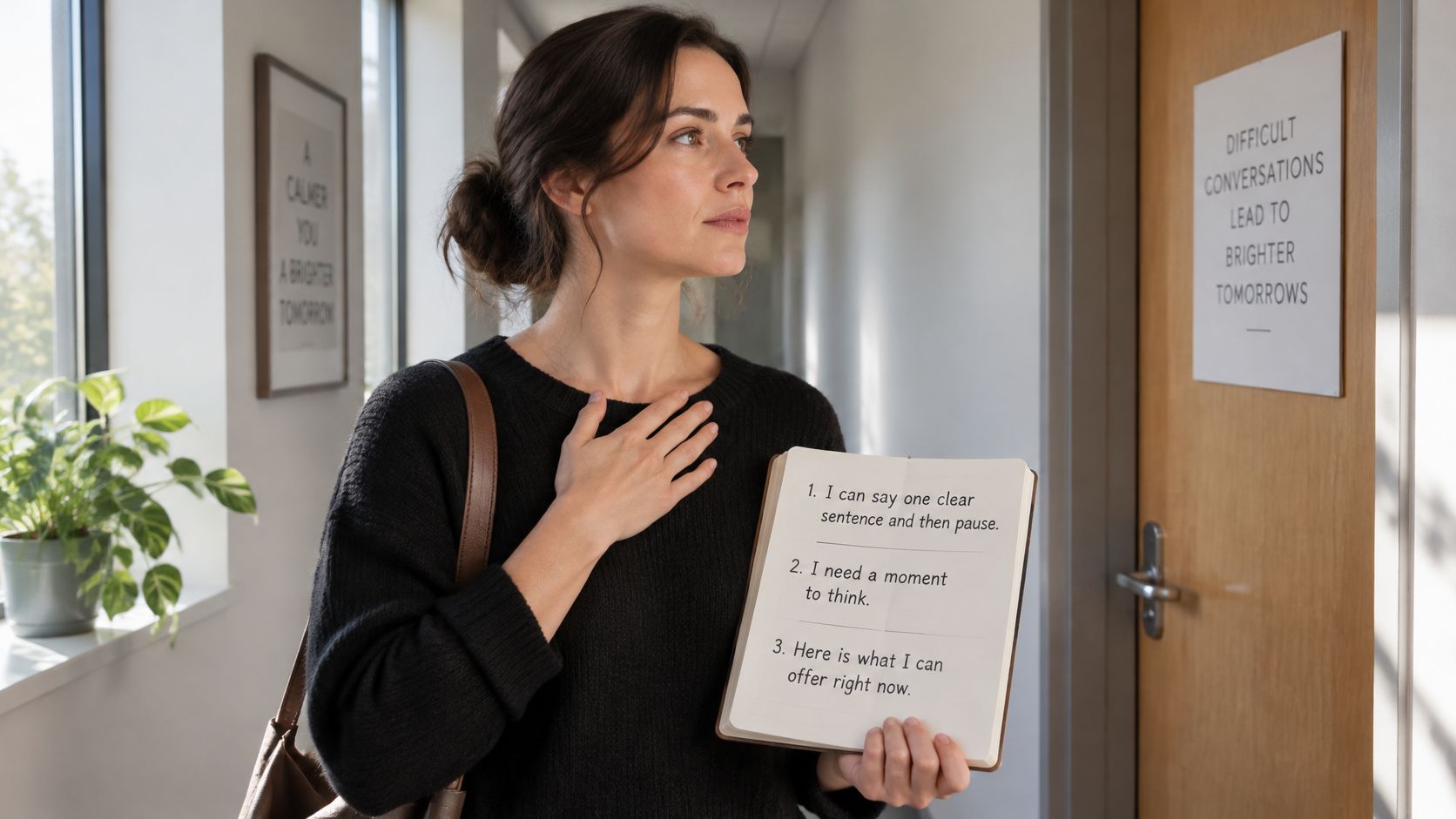
Take a comfortable breath, then use this line: I can say one clear sentence and then pause. Rehearse the actual sentence, perhaps a direct request to clarify a deadline or discuss an uncomfortable boundary.
Its unbelievable twin is I am fearless. If you're visibly anxious, that claim asks you to ignore your experience. A narrower line lets fear and useful behavior coexist.
After a mistake at work
You notice the familiar accusation that you always mess things up. Label it old story, then try: I can repair one piece today. Picture sending the corrected attachment, acknowledging the error, or asking what needs fixing first.
The hollow alternative is I never fail. Your mind can immediately find counterevidence. Repair is a more trustworthy target than pretending mistakes don't happen.
When starting an avoided task
Use I can open it for ten minutes, paired with If I sit at the desk, I will set a ten-minute timer. This is a practical starting commitment, not a claim that ten minutes is a therapeutic threshold.
Compare that with I am unstoppable. You may still feel tired or distracted, and you're allowed to stop when the timer ends. The believable line makes beginning possible without demanding endless momentum.
One true past action, one small next action.
Add evidence before each working line. You might remember that you clarified an awkward request earlier this week, corrected a previous mistake, or opened a document despite reluctance. Don't embellish the memory to make it impressive.
A notebook gives you somewhere to keep statements you can support rather than collecting slogans.
Aim for steadiness rather than a confidence spike
The mindfulness and self-compassion evidence includes a 2012 meta-analysis of 39 studies in nonclinical adults with an overall effect of r = 0.27; a 2013 Mindful Self-Compassion trial comparing 25 intervention participants with 27 wait-list controls, alongside a 21-person community pilot, found gains in self-compassion, mindfulness, and well-being maintained at six months and one year; and a 2014 study assigning 98 women to three weeks of meditation and 130 to a wait-list found greater reductions in body shame and appearance-based contingent self-worth, with benefits maintained at three months.
These findings support modest expectations and a compassionate direction. They don't establish that the exact scripts above were tested or that repeating them guarantees lasting change.
Choose a personal line and rewrite it using something you did this week. If the evidence feels ordinary, keep it. Ordinary evidence is still evidence.
A Daily Slot That Survives a Busy Week
A meeting runs late, breakfast gets rushed, and the morning you planned disappears. Set a default slot and a backup before the week begins, so the practice has a cue even when the day shifts.
A 10 to 15 minute sit can fit before a demanding task, at midday, or in the evening. Choose a time you can protect without turning the practice into another demand. If anticipatory doubt tends to surface before work, try sitting before the first hard task. If mornings are crowded, choose an evening when you'll still be alert.
Match the practice to your actual day
Where to place a 10 to 15 minute sit
| Moment | Minutes | Emphasis | Use when |
|---|---|---|---|
| Before the first hard task | 10 | Breath, one credible belief, and an if-then for that task | Dread shows up early |
| Midday reset | 12 | Label the critic and revisit one credible line | A meeting or message shook you |
| Evening review | 15 | Rehearse tomorrow's smallest step and write the if-then | The day was messy and you're still alert |
| Same-day repair | 10 | Name the setback, choose one next action, and rerate belief afterward | You sat, then stumbled |
| Short travel version | 8 | Use audio or text for breath, one line, and one if-then | You have no private seat for a full sit |
The eight-minute option is a fallback, not a compressed version you must complete perfectly. Keep the main routine numbered: settle with a few breaths, name one belief you can support, then choose a specific if-then action. For example: “If I hesitate before opening the draft, then I'll write one rough sentence.” A credible line paired with a doable response gives the sit a practical endpoint.
Give the slot a physical cue
Sketch the coming week before it starts. Keep the default slot on ordinary days, and assign the backup to the days most likely to disrupt it.
- Pair it with an existing action: Sit after putting your breakfast plate away or closing your work laptop.
- Prepare the space: Leave the notebook and a comfortable chair ready.
- Make the response visible: Put your if-then beside the kettle or on the closed laptop.
- Handle app questions separately: Read the Luno FAQ outside your protected practice time.
An extended session to repay missed minutes can make the next sit harder to begin. Before bed, choose tomorrow's cue and backup, then leave the written plan somewhere you'll see it.
Missed Days Doubt and Distress
People quit practices that initially seem manageable. In a 14-session online meditation trial, 115 participants withdrew and 169 completed, a reported 40.5% dropout rate, with significantly greater attrition in movement-meditation assignments than sitting assignments; dose conditions didn't differ significantly in outcomes or dropout, while regular practice had only weak associations with improvements in well-being and mindfulness.
That doesn't mean sitting is always better for every person. It does mean there's little reason to make this particular routine elaborate or to assume extra minutes will solve a difficult day.
Continue instead of repaying missed practice
Keep your default brief and seated. Choose audio when reading feels effortful, or text when a voice feels distracting. Use the same basic practice rather than searching for a new method whenever enthusiasm drops.
If you miss a day, continue at the next available slot. If several days pass, return to the last useful belief and choose a current if-then rather than restarting as punishment. You haven't failed a challenge; you've discovered where the routine needs a smaller demand or a better cue.
Recovery rule: Resume with a manageable action, not a longer session.
A line that feels fake also needs adjustment, not more repetition. Shrink I can handle this conversation to I can write down my opening sentence. Rate conviction before acting and after completing that observable step.
Don't add time to force a feeling. If you finish with doubt still present but know what you'll do next, the sit can end.
Know when to stop
Begin with contact with the room: feet on the floor, eyes open if preferred, a sound you can identify. End deliberately by opening your eyes, feeling your feet, and stopping. You don't have to stay inwardly focused to demonstrate commitment.
This is optional self-guided support, not emergency care, diagnosis, therapy, or medication. Stop the exercise and seek qualified help if distress escalates, traumatic experiences become activated, your mood or behavior becomes unusually heightened or agitated in a mania-like way, or there's any risk of self-harm.
- For urgent emotional support in the United States: The National Institute of Mental Health help guide advises calling or texting 988 for suicidal crisis or emotional distress, with free, confidential support available 24 hours a day, seven days a week; in a life-threatening situation, call 911 or go to the nearest emergency room.
- For assessment and ongoing care: A primary-care clinician can provide an initial screening and referral to a mental-health professional.
- For app scope and boundaries: Review Luno's safety information, but don't use an app as a substitute for urgent help.
You don't need to diagnose yourself before asking for support. If the practice consistently leaves you less grounded or less able to function, pause it and discuss what's happening with a qualified clinician.
For ordinary follow-through, track completed small actions rather than a perfect streak. A repaired mistake, an opened document, or a clear request tells you more about practical self-trust than an unbroken calendar does.
Begin the Next Fourteen Days
Before bed, make three decisions: the belief you'll practice tomorrow, the slot you'll use, and the if-then you'll leave in sight. Write them plainly enough that your tired morning self won't need to interpret them.
Day-one success is completing the sit and attempting the small action. You don't have to feel transformed, and you don't have to use today's belief forever. Let what happens influence tomorrow's choice.
Choose support that leaves room for real life
Luno: Self Care is a self-guided mental wellness companion that turns daily check-ins into a personalized next-day plan. You can find the topic you need rather than forcing every concern into self belief meditation. Its 10 evidence-based healing protocols, each organized into an adaptive 14-day arc, are:
- Anxiety Relief: CBT Breathing.
- Grief & Loss: Narrative ACT.
- Burnout Recovery: Somatic Boundaries.
- Sleep Repair: CBT-I.
- Self-Esteem: Schema IFS.
- Trauma Processing: Trauma-informed CBT.
- Relationship: DBT Attachment.
- Depression Lift: Behavioral Activation.
- Focus & ADHD: Mindfulness Structure.
- Custom Package: User-defined support.
The structure can feel personal. Lena M., who used Self-Esteem for 14 days and reported confidence improving from 4 to 8, described it this way:
“It felt like therapy homework that someone actually designed for me.”
That's an individual account, not a prediction of your results. Luno feels therapy-like in structure and experience, but it is not therapy.
Keep your judgment in the process
The National Institute of Mental Health's psychotherapy overview describes psychotherapy as treatment to help people identify and change troubling emotions, thoughts, and behaviors, usually with a licensed mental-health professional. Luno doesn't establish that clinician relationship, diagnose conditions, provide crisis care, or replace professional assessment or treatment.
Treat AI-generated guidance as general self-improvement support, not individualized clinical advice. You remain responsible for judging whether a suggestion fits your circumstances, especially when health or safety is involved. If distress is acute, stop and use qualified or crisis support rather than an app.
Sit once tonight if it feels appropriate, write your if-then, and leave it somewhere visible. Tomorrow, record what happened without grading your worth. Choose the next step from that reality.
Luno: Self Care offers daily check-ins, reflection, and adaptive plans to help you connect self-belief practice with manageable actions. Visit Luno: Self Care to choose the topic you need and begin a self-guided routine that can adjust as you go.