
You're awake again, staring at the dark ceiling while your mind runs the same movie on repeat. Your body feels tired, but your thoughts won't let you rest, and the question keeps returning in a sharper form each time: what happens when I die, what happens to the people I love, and why does this feel so huge at 3am?
That kind of fear isn't a character flaw. It's often a learnable pattern, and when you treat it like a pattern, you can work with it instead of wrestling it all night.

What the Fear Actually Feels Like at 3am
At 3am, death fear usually doesn't arrive as a calm philosophical question. It shows up as a jolt, a racing heart, a tightening chest, and a sudden need to figure everything out right now. You may lie there mentally rehearsing death, illness, collapse, or the loss of someone you love, then try to push the thought away, only to have it come back stronger.
That loop matters. Brief reassurance can feel helpful for a moment, but if you keep using it to shut the thought down, the brain learns that the thought was dangerous and needed escape. That's why generic advice like “just live in the present” or “accept it” often fails, because it doesn't tell you what to do when the fear is fused with your body, sleep, and checking habits.
A few signs usually show up together:
- Catastrophic prediction, such as “If I think about death, I'll lose control.”
- Body checking, like scanning your breathing, pulse, or sensations.
- Late-night searching, especially health searches that spiral into more fear.
- Ritualized reassurance, including repeated prayer, checking on loved ones, or mental reviewing.
- Compulsive planning, where you try to solve every possible future at once.
Practical rule: if the thought keeps pulling you into checking, avoiding, or searching for certainty, the problem is no longer just existential. It has become a loop you can interrupt.
The point isn't to silence every mortal thought forever. The more realistic target is to reduce avoidance, checking, and the ways the fear starts shaping your day. If you can describe your pattern in one or two sentences, you've already done the first useful job, because clear naming makes the next step much easier. If you want a simple starting point, the Luno FAQ can help you see how structured self-guided support is organized.
Naming the Specific Fear You Are Carrying
Not all death fear feels the same. One person is mainly afraid of the dying process itself, another is haunted by nonexistence, and another gets stuck on leaving family behind. When you name the exact shape of the fear, you stop treating it like one giant fog and start treating it like a specific problem.
The five common flavors
Fear of the dying process sounds like, “I'm scared of pain, confusion, or suffering before the end.” People with this version often picture hospitals, breathlessness, or a loss of dignity.
Fear of nonexistence is different. The thought is less about pain and more about, “I won't be there anymore,” which can feel unreal, blank, or impossible to absorb.
Fear of separation from loved ones often sounds like grief before the loss has even happened. The fear is not only death, but the absence that follows.
Fear of unfinished responsibilities shows up as panic about what you won't complete, repair, or pass on. It's common in people carrying work stress, parenting stress, or old regret.
Fear of losing control often has the strongest body charge. The mind keeps circling around collapse, panic, illness, or “what if I can't handle it.”
A simple self-reflection prompt can help: What part of death feels worst to me, the process, the absence, the separation, the unfinished business, or the loss of control? You don't need a perfect answer. Many carry two or three of these at once, and one usually gets louder at night while another shows up during the day.
Why this naming matters
The response changes depending on the flavor. Meaning work can help when the fear is about purpose or unfinished business. Graded exposure is often more useful when the fear is about control and uncertainty. If the fear is tied to sleep or health checking, the fix needs to address that loop directly rather than offering broad reassurance.
Say the fear in plain language before you try to solve it. A named fear is easier to work with than a global dread.
Graded Exposure That Actually Reduces the Fear
The strongest practical tool here is graded CBT exposure, done carefully and regularly. The idea is simple: instead of trying to suppress death thoughts, you gradually face safe reminders of mortality while staying with the discomfort long enough for your brain to learn that you can tolerate the thought without rituals, reassurance, or escape.
How the method works
The mechanism is called inhibitory learning. In plain language, the win is not that fear disappears instantly. The win is that your mind learns, over time, that the thought is survivable, uncertainty is bearable, and catastrophe does not need a safety ritual every time.
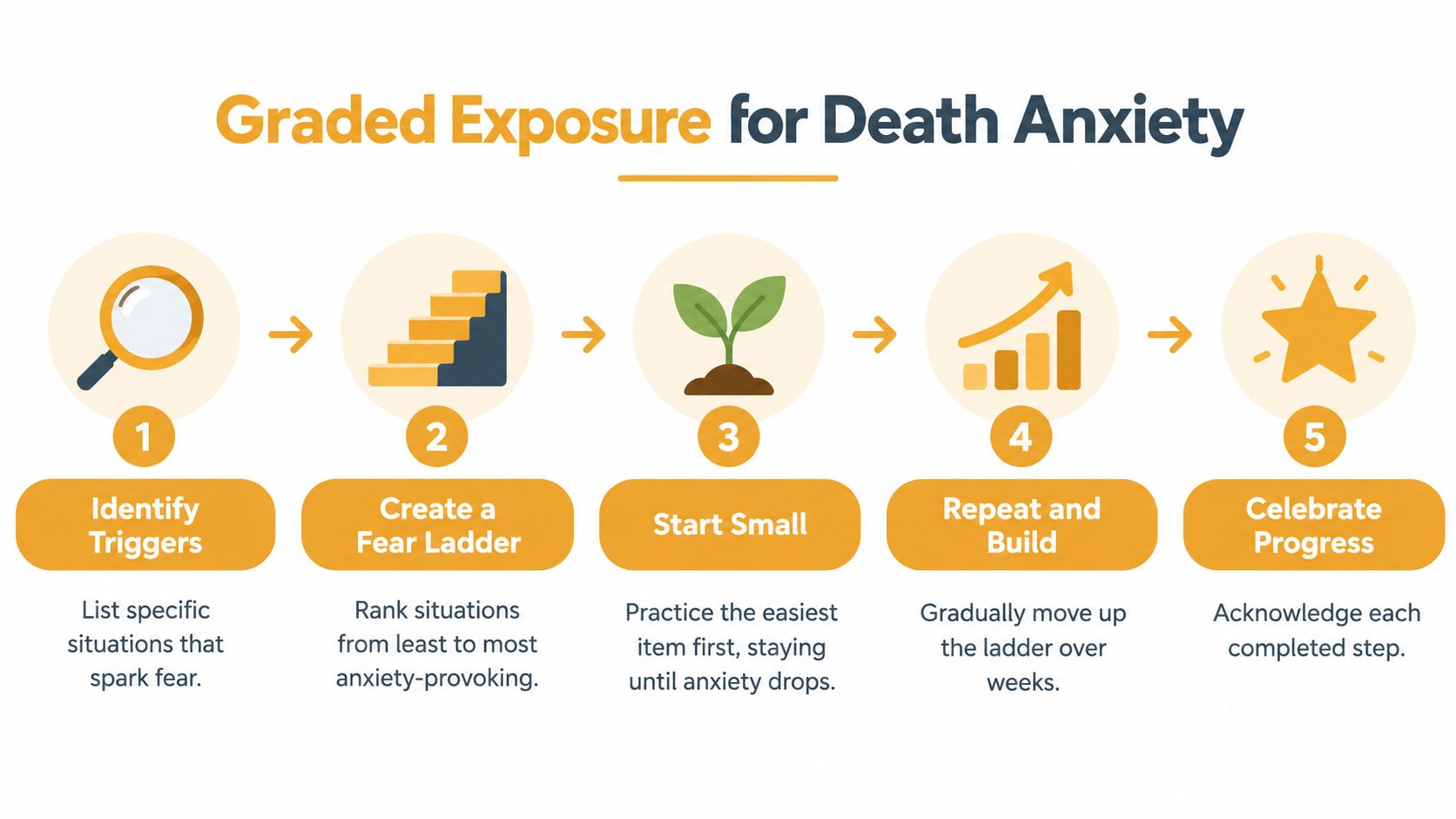
A workable sequence looks like this:
- Identify the trigger and prediction. Write the trigger and the feared outcome, such as “If I think about death, I'll panic and lose control.”
- Rate distress from 0 to 100. This gives you a baseline instead of relying on vague feelings.
- Build a hierarchy. Start with a mild prompt, such as writing the word “death,” then move toward safer but harder prompts like reading about mortality or discussing personal values.
- Stay with the prompt. Don't add reassurance, checking, distraction, or compulsive avoidance while you're practicing.
- Repeat and progress gradually. Return to the same level until it's manageable, then move up.
- Record what you feared and what happened. That comparison is the learning.
A simple example might look like this for someone afraid of losing control: writing the word “death” on Monday, reading a short article about end-of-life planning later in the week, discussing a value such as family or faith with a trusted friend, then spending a few minutes imagining a hard but safe scenario without rushing to neutralize it.
Video guidance can also be useful when you're learning the rhythm of exposure.
Four common mistakes
- Rushing up the ladder. Stay at each rung until it feels workable, not until it feels perfect.
- Using exposure as reassurance. If you're secretly checking whether you “feel better,” the exercise turns into a safety behavior.
- Stopping at peak anxiety. Let the body settle enough to learn something new.
- Practicing alone when trauma, panic, obsessive-compulsive symptoms, or suicidal thoughts are part of the picture. In those cases, a licensed clinician should design and monitor exposure.
The most important measure of success is not calmness, it's flexibility. If you can face the thought without collapsing into rituals, the fear is already changing. Persistent trauma reactions, severe panic, or any suicidal thinking call for a licensed clinician, not self-guided practice.
Translating What Matters Into One Weekly Act
Exposure helps with fear, but values keep people practicing when the work feels uncomfortable. If death fear is tied to unfinished business, regret, or the sense that life is slipping by, then the next move is to turn a value into one concrete action you can do this week.
From a value to a behavior
Start with one sentence about what matters most. It could be “I want to be present for my kids,” “I want to repair what I can,” or “I want to live with more courage.” Then translate that into one observable weekly behavior that is small enough to happen even on a bad week.
If the value is presence, the behavior might be a Sunday morning phone call with no devices nearby. If the value is repair, it might be sending one honest message. If the value is legacy, it might be spending 20 quiet minutes on a small project that matters to you.
The key is to schedule the action with a specific time and place. Afterward, ask one question: did this increase connection, purpose, or agency? If the answer is partly yes, that counts. If the week fell apart, the plan gets revised, not abandoned.
Useful test: if your “meaning” practice makes you feel pressured to be grateful, positive, or spiritually polished, it's probably too harsh. Fear and sadness can stay in the room while you act on what matters.
Meaning-focused work doesn't erase mortality thoughts. It gives those thoughts less power to define your identity and your calendar. Research on people facing life-threatening illness suggests that meaning, self-esteem, and attachment security can act as psychological buffers, but effects vary, so the honest target is better functioning, more connection, and more willingness to live your values, not a guarantee that fear vanishes.
Breaking the Nighttime Loop of Checking and Searching
A 3am spiral often looks less like a single fear and more like a loop. A sensation appears, the mind jumps to “something is wrong,” the body gets checked, a search begins, sleep breaks apart, and the next day the brain is even faster to treat every sensation as danger. That pattern can make death fear feel urgent and physical, even when the actual problem is a mix of health anxiety and sleep loss.
A simple nighttime protocol
Start by putting the fear into one plain sentence. “I'm afraid this sensation means something bad is happening.” That helps you separate the thought from the alarm it triggers.
Then delay checking or searching for a fixed window. A delay interrupts the reflex and gives the urge room to fade. If the thought still feels sticky, write it down for a planned worry appointment earlier in the day, then stay off your phone and return to bed.
Sleep also gets easier when you remove some of the triggers that keep the loop active. Cut back on caffeine later in the day, and limit late news if it keeps your system keyed up. A brief defusion phrase can help too. Say, “I'm having the thought that something is wrong,” and let that sentence sit without arguing with it.
If you want a self-guided companion for these steps, Luno: Self Care can organize check-ins and next-day plans, but it is still self-guided support, not therapy or crisis care. For a full picture of how data is handled, the privacy page explains what is collected and how it is protected. The account deletion page is another data-control option if you want to understand how access and deletion work.
When to escalate
Seek clinical help if illness-related fear keeps returning, if severe insomnia lasts more than a few weeks, or if checking starts interfering with work, relationships, or daily routines. If the fear is narrowing your life, or if you cannot sleep without repeated reassurance, that is the point to bring in professional care.
The goal is to stop letting the thought run your nights, not to eliminate every mortal thought.
Acceptance as a Daily Practice You Can Build
Acceptance gets misunderstood all the time. It does not mean you're okay with death, it does not require a particular belief system, and it does not arrive as one big breakthrough. In practice, acceptance is the willingness to carry the thought and still live by your values.
A small daily protocol
Try this in the morning or evening, for five to ten minutes:
- Body scan. Notice where fear lives in the body without trying to fix it.
- Name the thought. Use one sentence, such as “I'm afraid of disappearing” or “I'm afraid I won't be there for my family.”
- Name a value. Use one sentence about what matters today.
- Take one small action. Do one thing that points toward that value.
That's enough. Acceptance is a practice, not a mood. It becomes stronger through repetition, especially on ordinary days when the fear is present but not overwhelming.
If you use a structured app for this kind of work, keep the boundary clear. It can help you organize reflections, practise evidence-based exercises, and prepare questions for a clinician, but it isn't therapy, a diagnostic tool, or a crisis service. The point is support, not replacement.
| Self-Guided Practice vs Professional Care | What you notice | Try this first | Escalate when |
|---|---|---|---|
| Mild, understandable death fear | You can still sleep, work, and function | Use the daily acceptance protocol and a graded exposure rung | It starts to disrupt daily life |
| Nighttime checking and searching | You keep reaching for reassurance | Use the delay, worry appointment, and phone-off bedtime routine | Severe insomnia persists or daily life suffers |
| Fear tied to values or unfinished business | You feel stuck, but not unsafe | Translate one value into one weekly action | Depression, trauma symptoms, or impairment show up |
| Thoughts of self-harm | You feel unsafe | Skip self-help and contact emergency or crisis services | Immediate danger is present |
For privacy and scope boundaries, the safety page is the right place to review how a self-guided companion sets limits.
Bringing the Practices Together This Week
Start with a simple weekly shape. In the morning, do one exposure rung and repeat it until it feels more manageable. In the middle of the week, choose one values-based action, such as a call, repair, or small project. In the evening, do a brief acceptance check-in and keep the no-search rule at bedtime. If fear spikes, ask whether you are facing a control problem, a meaning problem, or a sleep-and-checking problem.
A realistic outcome looks like less avoidance, better sleep, more values-aligned action, and a kinder relationship with the thought itself. That target is steadier than chasing a day with no death thoughts, and it gives you something you can practice.
Setbacks belong in the process. A rough night usually points to the rung that still needs work or the loop that still needs interrupting. Death fear rarely disappears because you dislike it, but it does become more workable when you meet it with skill instead of panic.
If you want a self-guided place to organize that work, Luno: Self Care offers daily check-ins, personalized next-day plans, and evidence-based support for anxiety, sleep, and related habits. Its privacy details explain how the app handles your information. Visit Luno: Self Care to see whether that kind of structure would help you practice these steps more consistently.