
Maya is standing in her hallway with one shoe on and her blazer half-buttoned, rehearsing the same greeting she plans to use at the work party door. She's said it three times already, and her chest still feels tight. That loop, the script, the pause, the urge to turn back, is what shyness feels like in real life.

Shyness isn't a character flaw. It's a common response to uncertainty, and for many people it shows up as a faster heartbeat, a blank mind, or the urge to scan for exits before a conversation even starts. The goal isn't to become loud or fearless. It's to feel safer in your own skin.
The night before the work party
Maya keeps checking the mirror, not because she thinks she looks bad, but because she wants one less thing to worry about once she walks in. Inside the apartment, her roommate laughs at something a friend says, and that sound makes the party feel even more real. Maya isn't broken. She's doing what shy people often do, which is rehearse, monitor, and brace.
A lot of people know this exact feeling. The mind starts drafting the first sentence, then the second, then the imagined awkward pause that might follow. Your body joins in with a tight chest, a dry mouth, and a strong wish to just stay home.
Practical rule: the presence of nerves doesn't mean the plan is failing, it means your brain thinks the situation matters.
The path forward has three parts. First, get clear on whether you're dealing with ordinary shyness or something closer to social anxiety. Second, build a graded exposure ladder so you're not forcing yourself into the hardest room first. Third, run prediction experiments on real moments so your confidence comes from evidence, not hype.
That matters because social anxiety is often about fear and avoidance, not just quietness, and it can become clinically significant when it causes distress or gets in the way of school, work, relationships, or daily life as described by the National Institute of Mental Health. If you're only mildly shy, you can usually work with small, repeatable practice. If your fear is persistent and disabling, professional assessment makes sense.
The goal is not to become loud, it is to feel safer in your own skin.
Shy, introverted, or socially anxious
These words get mixed up all the time, but they point to different experiences. Shyness usually means tension in certain social situations. Introversion means you prefer less stimulation and more alone time. Social anxiety is a pattern of fear and avoidance that can interfere with living your life.
A useful clue is how much the discomfort changes your behavior. If you still go to the event, speak up sometimes, and recover afterward, you may be dealing with shyness. If you routinely avoid invitations, stay silent even when you want to speak, or spend hours worrying before and after, the issue may be bigger.
A quick self-check
Ask yourself three things. How often do you avoid situations you actually want to join? How intense are the physical symptoms, like shaking, sweating, or going blank? How much does it interfere with work, friendships, dating, or ordinary errands?
Clinical evidence draws a line between mild social hesitation and a disorder defined by persistent fear, avoidance, and impairment. The distinction matters because the right next step is different. One person needs gentle practice. Another person needs evaluation and possibly treatment.
| Marker | Situational shyness | Introversion | Social anxiety |
|---|---|---|---|
| Social energy | Drained in some settings | Drained by too much stimulation | Drained by fear of judgment |
| Main feeling | Self-consciousness | Preference for calm | Anxiety and avoidance |
| Typical pattern | Comes and goes | Fairly steady | Persistent and impairing |
| What helps | Practice and familiarity | Respecting pacing | Structured exposure and support |
A nationally representative U.S. survey found that about 50% of adolescents described themselves as shy, while only 12% of those shy adolescents met criteria for social phobia at some point in their lives, and about 5% of adolescents who did not identify as shy still met criteria for social phobia according to the National Institute of Mental Health. That's a good reminder that quietness and diagnosis are not the same thing.
If you want a privacy-focused place to keep your own notes while sorting out these patterns, you can review Luno's privacy information.
Build a graded exposure ladder
A graded exposure ladder works because it gives your nervous system proof that you can survive social discomfort. Instead of leaping from silence to the hardest event on your calendar, you move in steps. Each step stays small enough to be doable and large enough to matter.
Start by listing social situations that make you uneasy. Then rate each one on a 0 to 10 SUDS scale, where 0 feels calm and 10 feels overwhelming. Sort them into low, medium, and high tiers, then choose a first rung below 4 for week one.
A simple way to build it
- Brainstorm the situations. Write everything from making eye contact with a cashier to introducing yourself at a gathering.
- Rate the discomfort. Give each item a 0 to 10 score based on how it feels before you do it.
- Order the list. Put the easiest tasks at the top and the hardest tasks at the bottom.
- Pick one starting rung. Choose a task you can repeat several times without flooding yourself.
Rule of thumb: stay on a rung until it feels familiar, not until it feels perfect.
| Rung | Situation | SUDS (0-10) | Tier |
|---|---|---|---|
| 1 | Make eye contact and smile at a barista | 2 | Low |
| 2 | Ask a coworker one question in the break room | 3 | Low |
| 3 | Say hello and use someone's name | 3 | Low |
| 4 | Introduce yourself to a new person | 4 | Medium |
| 5 | Stay in a small group for five minutes | 5 | Medium |
| 6 | Ask one follow-up question at lunch | 5 | Medium |
| 7 | Join a work-party conversation for a few minutes | 6 | High |
| 8 | Share one short opinion in a group | 6 | High |
| 9 | Start a conversation with someone you don't know well | 7 | High |
| 10 | Keep talking after the first awkward pause | 7 | High |
The most common mistake is skipping rungs. People see the top of the ladder and try to jump straight there, then conclude they “can't do it” when their anxiety spikes. Slow climbing works better than heroic leaps.
If you want a structured place to keep the ladder visible, Luno's FAQ page can help you understand how a self-guided routine is organized.
Run prediction experiments on real moments
An anxious mind treats its predictions like facts. A prediction experiment turns those thoughts into testable guesses. That shift matters because fear often overstates what will happen and under-notices neutral or ordinary outcomes.
Start small. Before a low-stakes interaction, write the situation, the feared outcome, and how likely it feels. Then do the moment anyway, and record what happened after it's over. Keeping the notes until afterward helps you stay observational instead of getting stuck in self-monitoring.
A worked example
Maya walks into a coffee shop and decides to ask the barista a question. Before speaking, she writes, “I'll stumble over my words and look weird.” She rates her anxiety as 7 out of 10 and the likelihood of awkwardness as 70%.
She asks the question, pauses once, and the barista answers normally. No one reacts badly. The moment feels uncomfortable, but it passes. That's the kind of data anxious brains usually miss when they're only scanning for threat.
Copy this template into a journal or app:
- Date
- Situation
- Predicted outcome
- Anxiety rating before
- Likelihood estimate
- What I noticed instead
- What I learned
Write the prediction before the moment, then write the result after. Don't do both at once.
Repeat the same kind of experiment several times, ideally 5 to 10 reps, so your brain has enough evidence to update its expectations. You're not trying to make anxiety vanish. You're training yourself to trust what happens more than what fear predicts.
Drop the safety crutches that keep you stuck
Safety behaviors look harmless because they reduce discomfort in the moment. You rehearse every sentence. You keep your phone in your hand. You stay near the exit. You answer softly so nobody notices you. The problem is that these shields teach your brain that you needed the shield to survive.
That's why they backfire. They stop the feared outcome from being properly tested. If you only felt okay because you never made eye contact, your mind gets to say the avoidance was the reason nothing went wrong.
Pick one shield for the week, not all of them at once. Notice when it shows up, then replace it with a gentler behavior that still keeps you engaged.
| Safety behavior | Replacement |
|---|---|
| Rehearsing every sentence | Say the first sentence once, then continue naturally |
| Avoiding eye contact | Hold eye contact long enough to finish one thought |
| Speaking very softly | Use a clear, ordinary voice |
| Staying near the exit | Move one step farther into the room |
| Checking the phone | Keep the phone away for the first few minutes |
| Nodding instead of answering | Give one short spoken response |
When anxiety spikes mid-conversation, do this: label the feeling, slow your exhale so it lasts longer than the inhale, plant both feet on the floor, and keep speaking for about 20 more seconds without reaching for the shield. That's not a performance test. It's a practice rep.
A helpful digital companion can support that kind of between-moment reflection. Luno: Self Care offers self-guided check-ins and next-day plans built from evidence-based methods, but it's not therapy and it isn't a replacement for a clinician. It can still be useful as structure between real-life reps.
For account and data questions, Luno's safety and account options are worth reviewing before you start logging personal notes.
When you stumble, getting back on track
A reader freezes at a work party, goes quiet, and spends the rest of the night replaying the moment. The next day, they cancel the follow-up invite and tell themselves they're just shy. That story feels convincing, but it's usually bigger than the event itself.
Four moves that reset the pattern
- Timestamp and label it. Write the date, the situation, what happened, and the feeling, without judging it.
- Separate event from story. “I paused for three seconds” is an event. “Everyone thinks I'm awkward” is a story.
- Audit the story. Ask what supports it and what contradicts it.
- Plan the smallest next rep. Choose something easier than the stumble and do it within 48 hours.
The point is to keep the learning active. If you wait too long, your brain turns the lapse into a verdict instead of a data point. A small comeback, done soon, tells your nervous system that one rough moment didn't change the world.
One awkward night doesn't define you. The next return matters more.
If embarrassment makes you want to disappear, keep the next step tiny. Reply to one text. Say hello to one familiar person. Show up for ten minutes and leave. The win is returning, not proving you're polished.
If you want a place to revisit your notes later, account deletion and data controls matter too, especially when you're choosing any app for personal reflection.
A two-week starter plan and where Luno fits
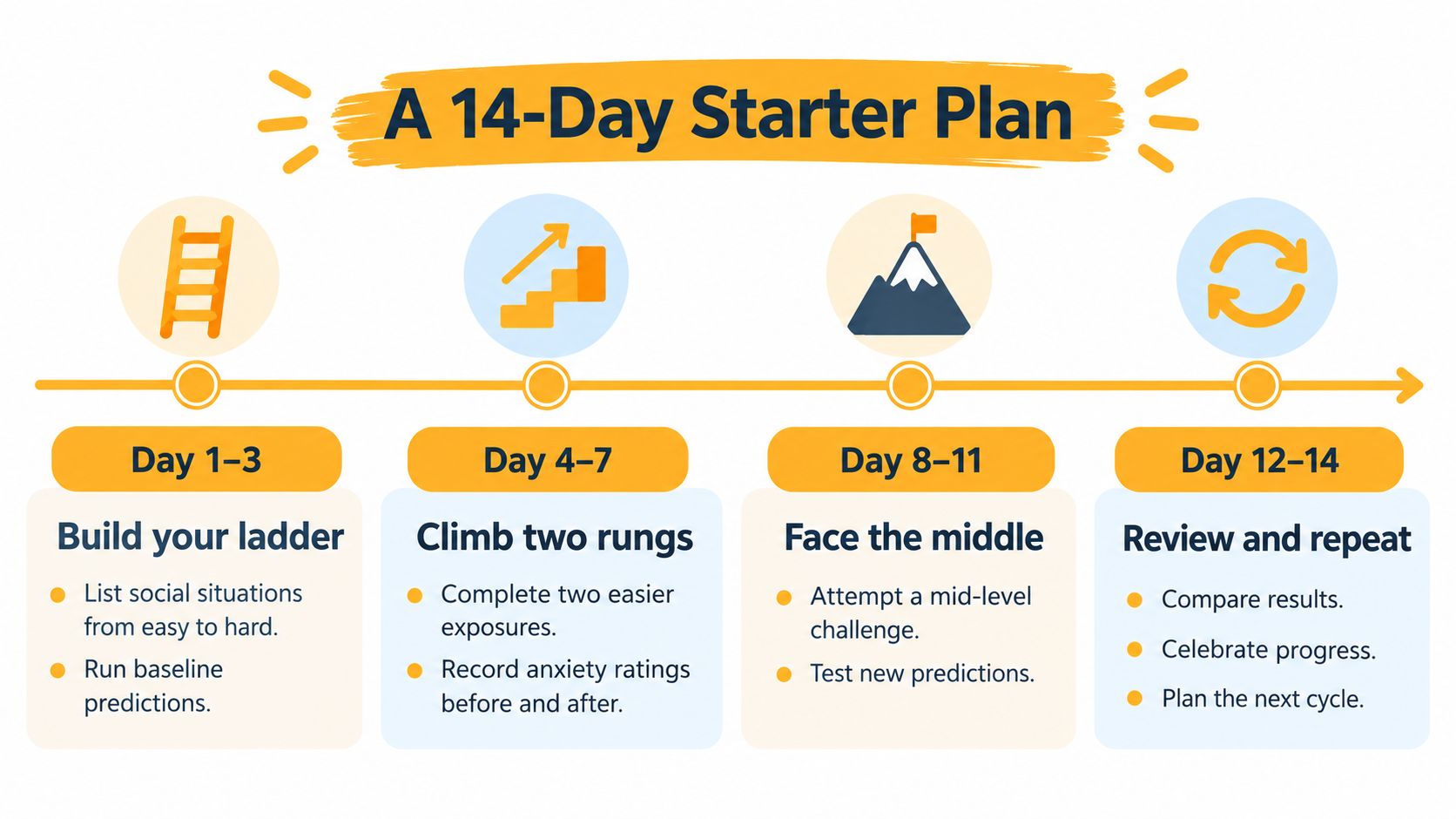
A good starter plan feels small enough to start on a weekday. It also feels structured enough that you don't have to invent the process every morning. This kind of routine works best when each day has one action and one reflection.
Days 1 to 3
Build your ladder, then choose two low-rung situations. Write a prediction for each one before you do anything. Keep the tasks short enough that you can finish them in about 10 to 20 minutes.
Days 4 to 7
Climb two rungs and drop one safety behavior. Record your anxiety before and after each attempt, plus what happened. If one task feels too big, move it down a rung rather than abandoning the plan.
Days 8 to 11
Test a prediction in a real conversation. Ask a question, make one comment, or stay in the exchange a little longer than you usually would. Then compare the feared outcome with the actual result.
Days 12 to 14
Review your notes, celebrate the reps you completed, and choose the next harder step. Set up a monthly maintenance loop so practice doesn't stop just because one week went well.
A short video can help make the rhythm feel more concrete.
If you want a self-guided companion for daily reflection, Luno can sit in that between-session space. It turns check-ins into next-day plans, which can be useful for tracking patterns, keeping a streak going, and organizing practice around anxiety or self-esteem goals. It complements therapy, but it doesn't replace clinical care.
If avoidance keeps growing, if panic-level symptoms are showing up often, or if you're also dealing with depression, substance use, self-harm risk, or persistent impairment at school, work, or in relationships, get professional support. A quiet life is one thing. A life shaped by fear is another.
If you want a calm, structured way to practice being less shy, visit Luno: Self Care and use it for daily reflection, small exposure steps, and between-session support. It's built for people who want something practical to return to each day, especially when confidence feels far away.