
You read the message again while riding home, even though you already know every word. The promotion went to someone else. Your manager's explanation sounded polite, but your mind keeps returning to the one sentence that felt unfair. By the time you reach your stop, the conversation has followed you through the train, past the unopened messages on your phone, and into the next task waiting at home.
Your lunch was half-eaten. Your shoulders stayed tight. Three thoughts kept circling: Why does this always happen to me? Nobody understands how hard I try. What's the point of making an effort? You aren't choosing to be dramatic. You're tired, hurt, and caught in a mental loop that makes the rest of the day look gray.
Feeling sorry for yourself can be a normal response to disappointment and prolonged stress. It can also become a pattern that keeps you focused on unfairness while making action feel unreachable. Understanding the difference helps you respond with something more useful than forced positivity or harsh self-criticism.
When You Can't Stop Feeling Sorry for Yourself
At first, the feeling may seem like a reasonable pause. Something went wrong, and you need time to absorb it. You replay the conversation because your brain is trying to make sense of what happened, not because you secretly want to ruin your evening.
Then the replay starts taking up more room. You leave a friend's message unanswered because explaining yourself feels exhausting. You open your laptop but read the same paragraph without taking it in. You tell yourself you'll go for a walk after dinner, then stay on the sofa because moving would mean admitting that the day is continuing.
The loop often has a familiar texture:
- A narrow story: The same interpretation returns, even when new information appears.
- A shrinking world: Ordinary tasks, conversations, and pleasures feel distant or irritating.
- A heavy body: Your chest may feel tight, your face warm, or your limbs unusually slow.
- A fading sense of choice: You can name what hurt you, but not what you might do next.
None of this means the original disappointment was small. A rejection, betrayal, financial worry, conflict, or repeated lack of recognition can hurt intensely. The problem isn't that you feel pain. The problem begins when the mind turns pain into a fixed identity and keeps presenting the same conclusion: I am powerless, and nothing I do will matter.
Start with safety, not self-judgment
If your thoughts feel overwhelming, or you're worried about what you might do, move toward immediate human support rather than trying to manage the moment alone. You can review Luno's safety guidance, contact someone you trust, or reach a local crisis service or emergency service appropriate to where you live.
For a less urgent episode, try to postpone the demand to “fix” yourself. Put both feet on the floor. Drink some water. Notice whether you've eaten, slept, or been alone with the same thoughts for too long. These small observations won't erase the setback, but they can reveal that the emotional intensity is being carried by a stressed body as well as by the story in your head.
A useful first question is not “How do I stop feeling sorry for myself?” It is “What is this feeling telling me about what hurts, what I believe I can't control, and what support I need?”
What Feeling Sorry for Yourself Actually Means
Feeling sorry for yourself, or self-pity, is an emotional response in which you experience heartfelt sorrow for your own situation and become absorbed in the sense that life has treated you unfairly. That definition doesn't make the response shameful. It gives it a shape.
The phrase itself is much older than modern self-help language. Major dictionary definitions describe “feel sorry for yourself” as pitying yourself because life seems unfair or harmful, while the core word sorry can be traced to Old English sārig, meaning pained or distressed, as described in the Oxford Learner's Dictionaries entry for “sorry”. The emotional root is ordinary and ancient. People have long needed language for the experience of hurting and turning that hurt inward.
Academic psychology has also treated self-pity as something that can be measured, rather than just a synonym for laziness or bad character. A 2003 paper defined it as “sympathetic, heartfelt sorrow for oneself” and examined it in two student samples of N=141 and N=161 (the study report on self-pity). The research found strong associations with neuroticism, particularly the depression facet, along with emotional loneliness and anger directed inward. It also connected self-pity with externality beliefs, meaning a stronger sense that outcomes are controlled by chance or powerful people.
Pain can be acknowledged without becoming a prison
There is a meaningful difference between saying, “This hurt me,” and concluding, “This proves I have no power.” The first statement makes room for accurate emotional recognition. The second can turn recognition into a closed system where every event confirms the same helpless story.
The research base is limited. The academic literature notes that self-pity has received scant direct attention and that there are no neuroscientific studies of it, which is one reason careful language matters (the academic chapter on self-pity). We shouldn't diagnose someone from a phrase they use after a bad day. We can, however, treat recurring self-pity as a possible stress-linked signal of perceived powerlessness, loneliness, anger, or rumination.
That framing changes the response. You don't have to argue with the feeling or indulge every conclusion it produces. You can listen for the unmet need beneath it, then decide whether the next step is rest, connection, a boundary, repair, practical planning, or professional support.
A compassionate interpretation: The feeling may be telling you that something matters and that your current way of carrying it has become too heavy.
Self-Pity Versus Rumination Versus Self-Compassion
After a painful email, you might first think, “Why does this always happen to me?” Later, your mind may replay every line of the exchange. A different response might sound like, “That hurt, and I can decide what to do next.” These reactions can overlap, yet they move attention in different directions.
| Feature | Self-Pity | Rumination | Self-Compassion |
|---|---|---|---|
| Main focus | “Why me?” and the unfairness of the situation | “What if?” and repeated analysis of what happened or may happen | “This is hard, and I can respond” |
| Time direction | Often fixed on the present grievance | Anchored in the past or future | Grounded in the present moment |
| View of control | Outcomes feel controlled by chance, other people, or circumstances | Thinking feels productive but does not produce movement | Recognizes limits while identifying possible agency |
| Emotional tone | Sorrow, helplessness, resentment, loneliness | Anxiety, regret, anger, or mental fatigue | Warmth, steadiness, and honest concern |
| Likely effect | Withdrawal and reduced motivation | More circling and emotional exhaustion | Repair, learning, support-seeking, or a manageable next step |
The distinction is about patterns, not moral character. One person can move through all three in an afternoon. Self-pity may appear when stress makes a setback feel like proof of powerlessness. Rumination then keeps examining the event, searching for an answer that never arrives. Self-compassion creates enough steadiness to recognize the hurt and choose a response.
Research on self-pity found strong links with anger rumination and emotional loneliness. A Stanford CCARE review of self-compassion summarizes evidence that self-compassionate people brood less about misfortune. They can still replay events, feel angry, or need time to recover. The difference is that suffering is less likely to become the only subject of their attention. If you use a digital tool to track these patterns, review its privacy policy to understand how your information is handled.
Look for the direction of movement
Ask what your current thoughts are producing. “Why did they treat me this way?” can help you identify an injustice. Repeated without clarifying a boundary, request, or decision, it may keep self-pity or rumination active. “What do I need right now?” points toward a response, even when the answer is sleep, support, or more time.
Self-pity and rumination do not need to disappear before you act. They are common stress responses, especially when a situation feels outside your control. The aim is to make self-compassion a third option alongside them, so pain receives attention while your next decision remains available.
Three Reframes That Loosen the Grip
A reframe isn't a shiny replacement thought. It doesn't require you to call a rejection a gift, forgive someone before you're ready, or pretend that a difficult situation is fair. It changes the question from “How do I prove this feeling wrong?” to “How can I relate to this feeling in a way that leaves room for care and choice?”
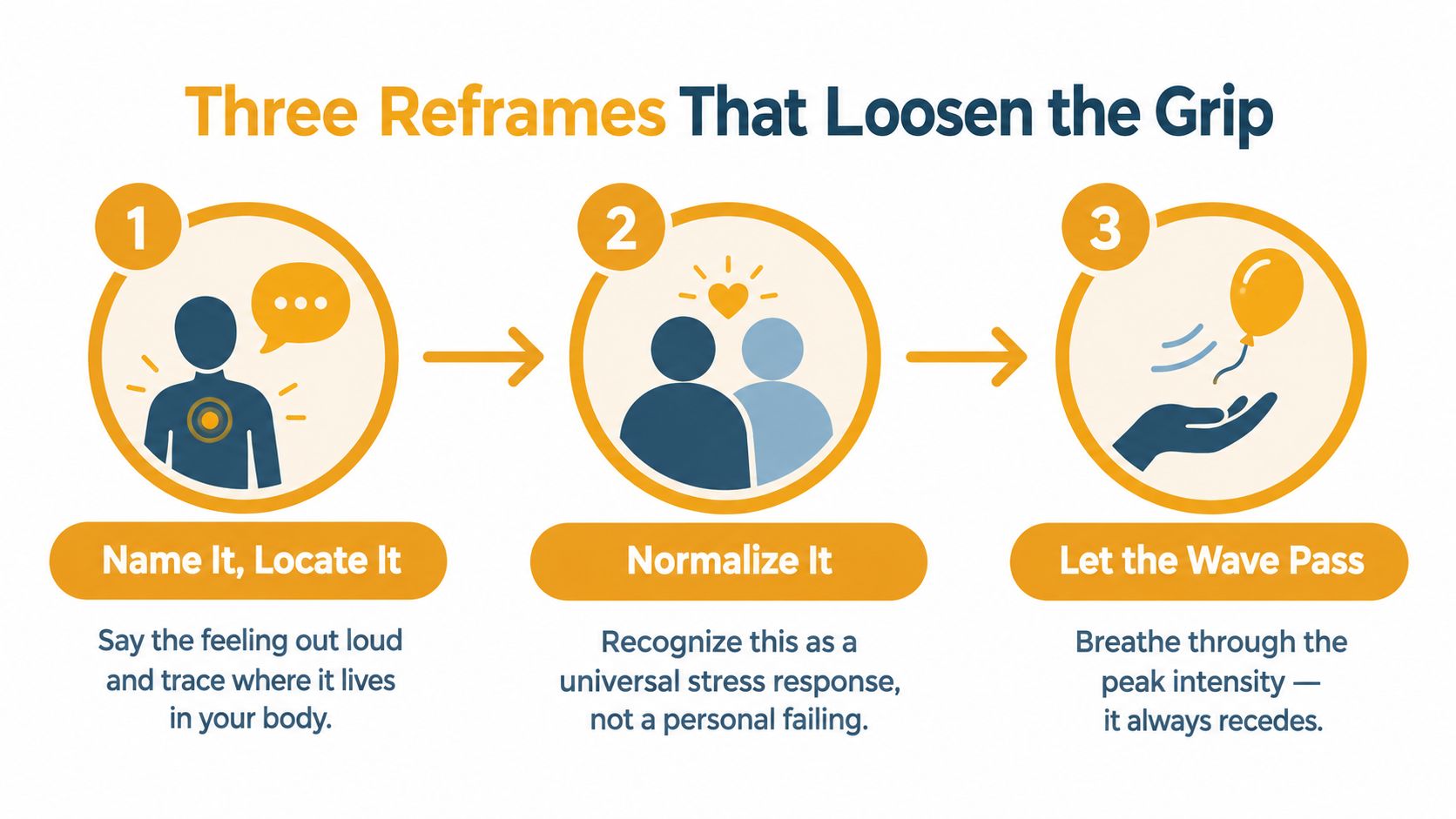
Name it and locate it
Use simple language. “I feel rejected.” “I'm angry and embarrassed.” “I notice self-pity showing up.” Then locate the experience in your body. You may notice a tight chest after criticism, a hot face after rejection, a clenched jaw during an argument, or heaviness in your arms when you want to withdraw.
Naming separates the event from the entire self. You aren't saying, “I am a failure.” You're identifying an emotional state that is happening in you. That small grammatical difference can make the experience feel less permanent.
Try one slow breath while you notice the sensation. You don't need to make it disappear. The purpose is to give your attention more than one place to stand.
Normalize it without excusing everything
Stress can make ordinary disappointments feel final. The urge to hide, complain, cancel plans, or ask “Why does this always happen to me?” doesn't prove that you're weak. It shows that your system is trying to protect you while it feels overloaded.
Normalization should never become an excuse to harm someone or avoid every responsibility. It means replacing “There's something wrong with me for reacting this way” with “Many people become self-focused and discouraged when they feel hurt or powerless.” That shift reduces shame, and less shame can make honest problem-solving easier.
You might say, “It makes sense that I want to withdraw after this. I don't have to obey the urge completely.”
Redirect toward one validated action
Choose an action that respects the pain instead of trying to outrun it. After a rejection, that could mean sending an honest text to a friend: “I had a rough day and could use company.” After an argument, it might mean writing down the boundary you want to discuss tomorrow. After a draining week, the next action could be eating something, taking a shower, or cancelling a nonessential commitment.
The action should be small enough to do while upset. If your plan depends on suddenly feeling motivated, it's probably too large. A validated action says, “This hurts, and I can still do one thing that supports me.”
The grip often loosens. You may not feel cheerful. You may notice that your shoulders drop, the story pauses, or one option becomes visible.
The visual process below captures the same sequence in a shorter form.
Two Stories About the Same Bad Day
The setback is identical in both versions. A promotion goes to a colleague. The manager says the decision reflected current role needs, but the explanation doesn't remove the sting.
In the first version, the employee walks back to their desk and compares themselves with the colleague. They search for evidence that everyone values other people more. That evening, they replay the meeting, imagine how coworkers are talking about it, and lose sleep over what the decision means for their future. They cancel the gym session because there is no point trying, eat without tasting the food, and wake up more convinced that the promotion proves something permanent about them.
In the second version, the employee still feels the sting. They sit in their car, notice a tight throat and a rush of anger, and say, “I wanted this, and I'm disappointed.” They don't force gratitude or tell themselves the decision doesn't matter. They call a friend, ask for ten minutes of listening, and later write down one question for their manager about the skills needed for the next opportunity.
| Moment in the Day | Rumination Track | Self-Compassion Track |
|---|---|---|
| Hearing the news | “They always overlook me.” | “This is painful because the promotion mattered.” |
| Returning to work | Searches for comparisons and hidden criticism | Completes the next necessary task without solving the whole future |
| Evening | Replays the meeting and predicts more rejection | Names the disappointment and asks a trusted person for support |
| Next step | Cancels movement and avoids the manager | Writes one practical question about skills and development |
| Emotional result | The original setback grows into a verdict about identity | The setback remains real but doesn't define every possibility |
Self-compassion doesn't guarantee a better outcome. The employee may still feel sad the next morning. What changes is the relationship with the event. The first narrative turns one decision into evidence of permanent defeat. The second keeps the facts, the feeling, and the possibility of response in the same picture.
You can take the disappointment seriously without making it responsible for your entire future.
If you use a digital self-care tool, check that you understand its privacy choices and how to remove your information. Luno's account deletion information is one example of the kind of control a user should be able to find easily.
Where Guided Self-Care Fits In
A guided companion can help when the problem is follow-through rather than insight. You may understand that naming, normalizing, and redirecting could help, yet lose the sequence when stress has overloaded your attention. A brief check-in, a gentle prompt, or a record of recurring moods can act like a handrail, giving you something simple to hold while you begin.
Digital tools can support reflection across concerns such as anxiety, low mood, burnout, grief, sleep, and relationship stress. The 2025 review of self-guided well-being apps found modest improvements in subjective quality of life, positive affect, mindful awareness, psychological flexibility, and self-compassion. The review also called for stronger randomized trials because of concerns including small samples, weak controls, high attrition, and low adherence.
That evidence suggests a useful role, with clear limits. The National Institute of Mental Health explains that mental health apps may not replace a professional. It also notes that no national standards evaluate the many available apps, and that most apps lack peer-reviewed research supporting their claims (NIMH guidance on technology and mental health treatment). A systematic review in npj Digital Medicine reached a similar conclusion: smartphone apps should not currently be recommended as standalone psychological interventions or substitutes for conventional treatment (the systematic review of standalone mental health apps).
Use an app for structure, not a diagnosis
Luno: Self Care is an AI mental wellness companion that turns daily check-ins and reflections into personalized next-day plans. It offers self-guided protocols across anxiety, sleep, burnout, grief, self-esteem, relationships, focus, and custom support. It is designed as structured self-help, with clear limits around crisis support and clinical care. If you want practical details about how a guided tool works, Luno's FAQ on plans and support explains how plans are generated and where the tool's boundaries lie.
The wider app market calls for the same careful scrutiny. A review of 1,009 publicly available psychosocial wellness and stress-management apps found that only 2.08% had published, peer-reviewed evidence of feasibility or efficacy, while 1.09% involved an electronic therapist (the JMIR review of psychosocial wellness apps). Most were intended as self-help interventions rather than professional treatment.
Seek a clinician when low mood persists for more than two weeks, when thoughts of suicide appear, or when distress seriously interferes with work, relationships, sleep, or basic care. A tool can help you notice a pattern or prepare what you want to say. It should support a validated-action response, not become a reason to postpone the care you need.
A Gentle Practice to Try This Week
You don't need a major reset. Try a small rhythm that gives the three reframes a place in your day. If two minutes feels like too much, take a single breath and write one word. Consistency matters less than returning without criticizing yourself for missing a day.
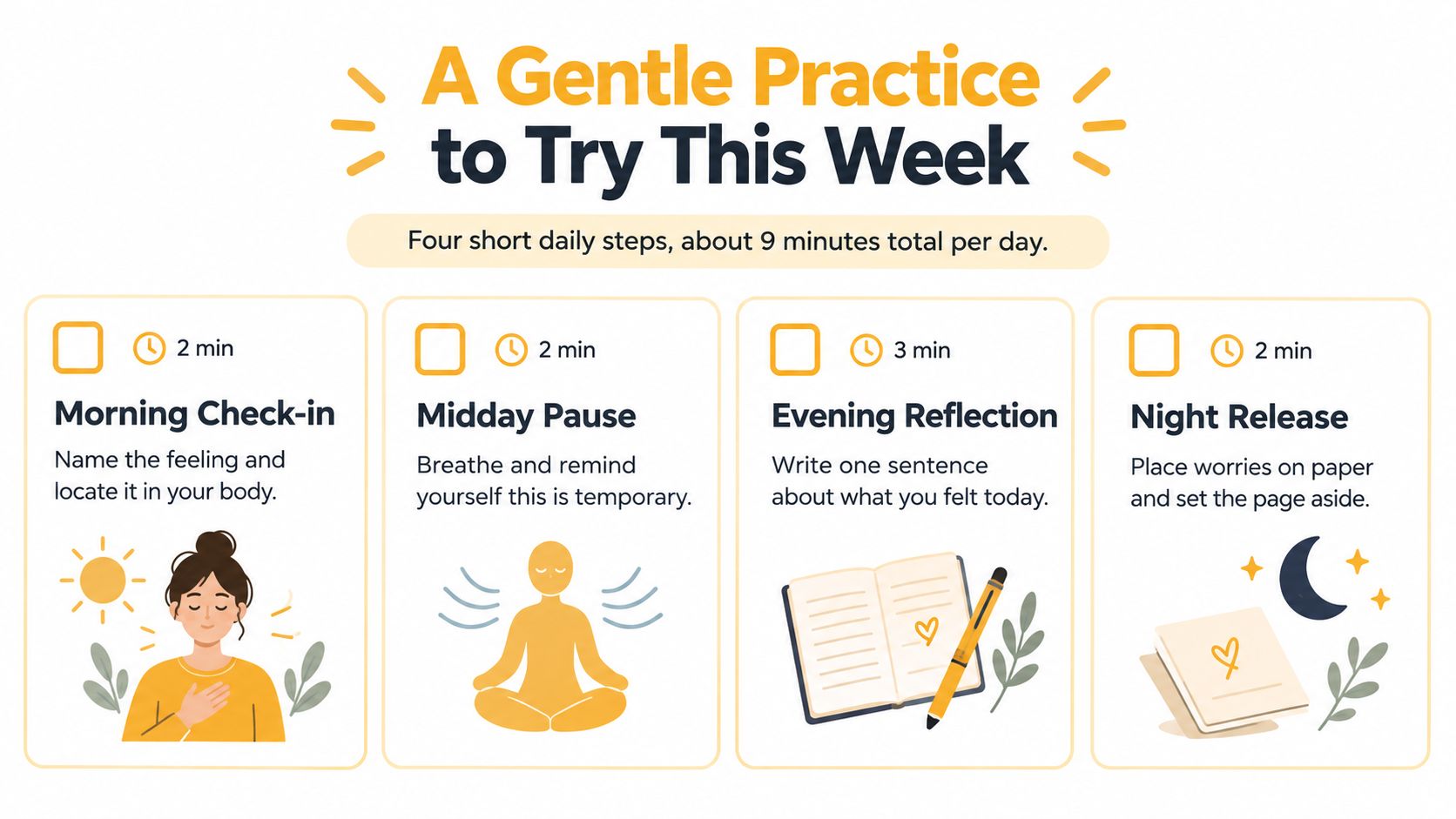
Morning check-in
When you can, take about two minutes to name what is present. Use a sentence such as, “I feel discouraged, and I notice it in my stomach.” Don't make yourself solve the feeling before breakfast. Naming it gives you a starting point rather than allowing a vague heaviness to direct the entire morning.
Midday pause
Set aside about two minutes to ask, “What might this feeling be asking for?” The answer could be rest, reassurance, food, a boundary, movement, information, or contact with another person. Take a few slower breaths and remind yourself that emotional intensity changes, even when the situation still needs attention.
Evening reflection
Spend about three minutes writing one sentence about what you felt and one sentence about what you did. For example: “I felt overlooked during the meeting. I waited before replying and asked for clarification.” This records agency without denying the disappointment.
Night release
Use about two minutes to put the recurring story on paper. Write the thought exactly as it appears, then place the page aside. You aren't declaring the thought false. You're telling your mind that it doesn't have to keep rehearsing the same material while you're trying to rest.
A weekly review can be brief. Look for one moment when you treated yourself with the same fairness you might offer a friend. It could be asking for help, taking a break before reacting, or doing one necessary task while still feeling low. That moment is evidence that self-compassion isn't passive permission. It can be a way to preserve responsibility and movement without adding punishment.
Ask yourself:
- Is the rumination loosening even slightly, or is it becoming more repetitive and consuming?
- What would feel like one degree less heavy tomorrow?
If the answer is small, let it stay small. A glass of water, one honest message, a shower, a walk to the end of the street, or an appointment request can all count as a response to pain.
Luno: Self Care offers personalized self-guided plans built from daily check-ins, reflections, journaling, and evidence-based approaches for concerns such as low mood, burnout, anxiety, grief, sleep, and self-esteem. If you want structured support while you practice moving from self-pity toward validated action, visit Luno: Self Care.
Published via the Outrank app