You wake at 2 a.m. after a bathroom trip, glance at the clock, and immediately calculate how little sleep you'll get before morning. Your body feels tired, but your mind is already reviewing tomorrow's workload, replaying a conversation, or listening for the next sign that sleep has disappeared.
Brief awakenings happen during normal sleep. The trouble begins when you stay alert, monitor the clock, and start treating wakefulness as an emergency. Learning how to fall back asleep isn't mainly about forcing your brain to switch off. It's about removing the behaviors that teach your brain that bed is a place for worry.
Why You Keep Waking Up at Night
Middle-of-the-night waking belongs to the sleep-maintenance category, which is different from having trouble falling asleep at bedtime. In U.S. data, 17.8% of adults reported trouble staying asleep in 2020, compared with 14.5% who reported trouble falling asleep, according to the CDC's analysis of sleep difficulties. More broadly, sleep-maintenance symptoms are reported by roughly 30% to 35% of adults internationally, while clinically defined insomnia affects about 10% to 15%, depending on the diagnostic criteria used.
That doesn't mean every awakening signals insomnia. A full bladder, a noisy neighbor, an overheated room, pain, or a child calling for you can create a one-off interruption. You wake, notice the disruption, and return to sleep without building a pattern around it.
The pattern changes when your brain shifts into wake-promoting mode. You may become physically tense, start estimating the remaining sleep opportunity, or scan your body for signs that something is wrong. The awakening itself is often less damaging than the conditioned hyperarousal that follows it.
Long-term research shows that returning to sleep can become a persistent difficulty, particularly in later life. A U.S. National Health and Aging Trends Study analysis found that difficulty falling back asleep was reported by approximately 15% of the population each year. Across the study years, 68% reported no difficulty in any year, 18% reported the problem in one year, and 14% reported it in two or more years, as detailed in the CDC-hosted study report.
Older adults may wake more frequently without necessarily losing the ability to resume sleep. One sleep-lab study found an approximately 2.7-fold higher awakening rate among older participants, while their rate of falling back asleep was similar to that of younger adults. The more useful question isn't merely, “How often did I wake?” It's, “What happened after I woke, and is the pattern affecting my daytime life?”
The First Five Minutes After You Wake
The first response matters because it can either lower arousal or add fuel to it. Don't reach for your phone, sit upright in a rush, or begin calculating your sleep debt. Give your nervous system a quiet opportunity to recognize that the night isn't over.
Start with stillness
Keep your body in the position where you woke, unless you're uncomfortable or need the bathroom. Take three slow breaths, inhaling for four seconds and exhaling for six seconds. A longer exhale can give your breathing a steady rhythm and shift attention away from the thought that you must get back to sleep immediately.
Then scan from your forehead down to your toes. Notice whether your jaw is clenched, your shoulders are raised, or your hands are curled. Release each area without trying to create a dramatic feeling of relaxation. The aim is to stop adding muscular effort to an already alert state.
Practical rule: If you're relaxed and drowsy after a couple of minutes, stay in bed. If you're alert, anxious, or caught in clock-focused thinking, change the situation rather than wrestling with it.
Give your mind one quiet task
Use a mental anchor that's familiar but not emotionally exciting. You might visualize walking a route you know well, noticing the order of streets, doors, trees, and turns. If the image becomes difficult, return to the physical sensation of breathing or the weight of your body against the mattress.
Avoid the phone, even for a “quick check.” Notifications, messages, news, and work-related thoughts create cognitive stimulation, while bright light can reinforce wakefulness. Keep the clock turned away if you can. If you need a time-based decision later, use an alarm rather than repeatedly checking the display.
Know when staying in bed stops helping
If you've been awake for roughly 15 to 20 minutes and feel increasingly alert, get up. You don't need to prove that you can remain motionless. A quiet change of setting often works better than allowing the mattress to become associated with frustration.
Core CBT-I Techniques for Returning to Sleep
Cognitive behavioral therapy for insomnia, or CBT-I, treats nighttime wakefulness as a learned pattern as well as a sleep problem. The central question is not whether you can force sleep. It's whether your actions are strengthening the connection between bed and sleep or between bed and alertness.
Use the 20-minute rule flexibly
If you can't return to sleep within roughly 20 minutes, leave the bed. You don't need to stare at a clock to make this exact. Use your experience as a guide. If you're tossing, planning, rehearsing arguments, or feeling your frustration rise, assume that remaining in bed is no longer useful.
Go somewhere quiet with dim lighting. Read a familiar paperback under a warm lamp, listen to an audio file you already know at a low volume, or perform gentle stretching on the floor. The activity should be boring, safe, and easy to stop. Avoid anything that makes you want to continue.
Apply stimulus control
Stimulus control gives the bed a narrower job. Use it for sleep and sex, not for television, scrolling, email, problem-solving, or extended periods of worrying. When you return only after genuine sleepiness appears, your brain gets a clearer signal from the environment.
Sitting in a chair is often better than settling onto the couch, where you may fall into an uncomfortable half-sleep or turn the activity into a second bedtime. Keep the route back to bed simple. When your eyelids feel heavy, your thoughts slow, or you begin nodding, return without evaluating whether the technique worked.
Try paradoxical intention
Some people become so focused on falling asleep that the effort itself keeps them awake. Paradoxical intention reverses the performance demand. Lie comfortably with your eyes open and tell yourself that you're allowed to remain awake, without checking the time or trying to stimulate yourself.
This isn't an invitation to watch television or plan tomorrow. It's a way to remove the command, “I must sleep now.” For people whose main problem is sleep-related performance anxiety, reducing the struggle can be more useful than adding another relaxation exercise.
These methods need repetition. A conditioned association between bed and wakefulness won't reset after one successful night. Practise consistently over two to four weeks, and chronic cases may benefit from combining stimulus control with a professionally designed sleep-restriction schedule. The 2025 VA and Department of Defense insomnia guideline places CBT-I among the central evidence-based approaches for persistent insomnia, while also emphasizing assessment for related sleep conditions.
Real-World Scenarios and How They Play Out
Maya is a 38-year-old teacher and parent of two. She wakes at 2:30 a.m. replaying a difficult parent-teacher conference. Her body is tired, but her thoughts are active and specific. She stays still briefly, notices that her mind is rehearsing the conversation rather than drifting, and gets up instead of turning the bed into a place for continued analysis.
Maya moves to the couch for a quiet reset, keeps the light low, and avoids her phone. She reads a few pages of a familiar book, then returns to bed within 30 minutes and uses paced breathing until sleep comes. Her success doesn't depend on making herself sleepy on command. It comes from matching the response to the problem, which is rumination and rising arousal.
Devon is a 34-year-old night-shift nurse who wakes at 4:15 a.m. anticipating his 5:30 alarm. He feels tense, but he isn't spiraling through a work problem. He resists checking the clock, completes a slow body scan, and remains in bed because his breathing is settling and his body still feels drowsy. His alarm sounds before he falls back asleep.
| Factor | Maya, stressed parent | Devon, shift worker |
|---|---|---|
| Main difficulty | Active rumination after an emotionally demanding day | Anticipatory alertness before an early alarm |
| First response | Leaves bed after noticing sustained mental activity | Stays in bed while remaining physically relaxed |
| Helpful tool | Quiet out-of-bed reset, then paced breathing | Body scan and no clock-checking |
| Why the choice differs | Wakefulness and frustration were increasing | Drowsiness was still present |
| Core lesson | Get up when bed is reinforcing alertness | Stay put when calm sleepiness is returning |
The stay-in-bed versus get-up decision isn't a test of willpower. It depends on wake duration, mental activity, physical arousal, and what your brain has learned to expect from the bed.
Habits That Make It Harder to Fall Back Asleep
Trying harder often backfires. People hold themselves rigidly still, command their minds to stop, and treat every thought as evidence that the night is ruined. That struggle adds monitoring, and monitoring keeps attention oriented toward wakefulness.
Replace forced sleep with paradoxical intention. Let your eyes remain gently open, keep your breathing slow, and give yourself permission to rest without demanding unconsciousness. Rest isn't the same as sleep, but removing the fight can lower the pressure that prevents sleep from returning.
Clock-checking creates a particularly efficient anxiety loop. You see the time, calculate how long you have before getting up, predict how tired you'll feel, and check again to see whether the situation has improved. Turn the clock face away or cover it, and don't calculate sleep debt at 3 a.m. Your morning schedule will still be there, but the calculation won't help you sleep.
The phone creates a second loop that looks harmless because it starts with one brief check. A message can trigger planning, a headline can provoke emotion, and a social feed can keep your attention active long after the original wake-up has passed. Park the phone outside the bedroom and prepare an analog relaxation kit instead:
- Paperback book: Choose something familiar and undemanding, not work material or an absorbing thriller.
- Paper journal: Write a short list of tomorrow's tasks, then close it rather than continuing to solve them.
- Warm drink: Keep it caffeine-free and modest so it doesn't create another bathroom interruption.
- Low light: Use enough illumination to move safely, but not enough to make the room feel like morning.
These behaviors aren't moral failures. They're learned responses. Replacing them repeatedly gives your brain a different sequence after waking, which is the practical foundation of counter-conditioning.
Common Triggers Behind Recurrent Wake-Ups
An isolated awakening becomes more persistent when the same physiological or psychological trigger appears night after night. Start with the most obvious lever rather than changing everything simultaneously.
Alcohol can make the first part of sleep feel easier while fragmenting sleep later and contributing to early-morning arousals. If you drink within three hours of bed, test a period without that timing and observe whether the second half of the night changes.
Caffeine taken after the early afternoon can remain active into the evening, particularly for people who metabolize it slowly. You may fall asleep without difficulty and still carry enough stimulation into the night to make ordinary arousals harder to recover from.
Bright screens in the last hour before bed can delay the body's transition toward sleep and keep the mind engaged. The fix isn't perfection. Dim the room, move stimulating content earlier, and avoid turning a nighttime awakening into a news, email, or social-media session.
Temperature also matters. A bedroom above 68 degrees Fahrenheit may make sleep less consolidated for some people. Test a cooler, breathable setup before buying supplements or adding complex routines.
Repeated waking can also reflect untreated obstructive sleep apnea, peri-menopausal hot flashes, nocturia, pain, reflux, restless legs, or generalized anxiety. Loud snoring, gasping, morning headaches, or significant daytime sleepiness deserve medical assessment rather than another self-help experiment.
Your Nightly Reset Plan and When to Get Help
Keep the plan short enough to use when you're tired. Tape this checklist to the nightstand:
- Evening light: Dim lights by 9 p.m.
- Alcohol timing: Avoid alcohol within three hours of bed.
- Bedroom temperature: Aim for 65 to 68 degrees Fahrenheit.
- Phone location: Park it outside the room.
- Wind-down: Spend 10 minutes with slow breathing or journaling.
- Night waking: Stay in bed while calm and drowsy, but leave when alertness and frustration build.
- Return: Go back to bed only when sleepiness returns.
Once a week, review a simple sleep diary. Record bedtime, estimated awakenings, caffeine timing, alcohol, wake time, and how impaired you felt during the day. Look for patterns instead of judging individual nights. A consistent wake time is often more useful than chasing a perfect bedtime because it gives your sleep schedule a stable anchor.
Seek clinical help if wake-ups persist more than three nights a week for over a month, if daytime fatigue affects driving or work, or if you snore, gasp, or wake with morning headaches. Current sleep guidance treats insomnia as more than nighttime discomfort when persistent sleep difficulty produces daytime impairment, and recurring awakenings may also point to apnea, mood disorders, medication effects, or another condition.
Self-guided tools have limits. Reviews of mental-health apps have found uneven evidence, and one systematic review concluded that standalone smartphone apps can't yet be recommended as substitutes for conventional treatment, as described in this review of app evidence and clinical limitations. The goal isn't perfect, unbroken sleep. It's a faster, calmer return when sleep does break, with professional CBT-I as the next step when home strategies stop working.
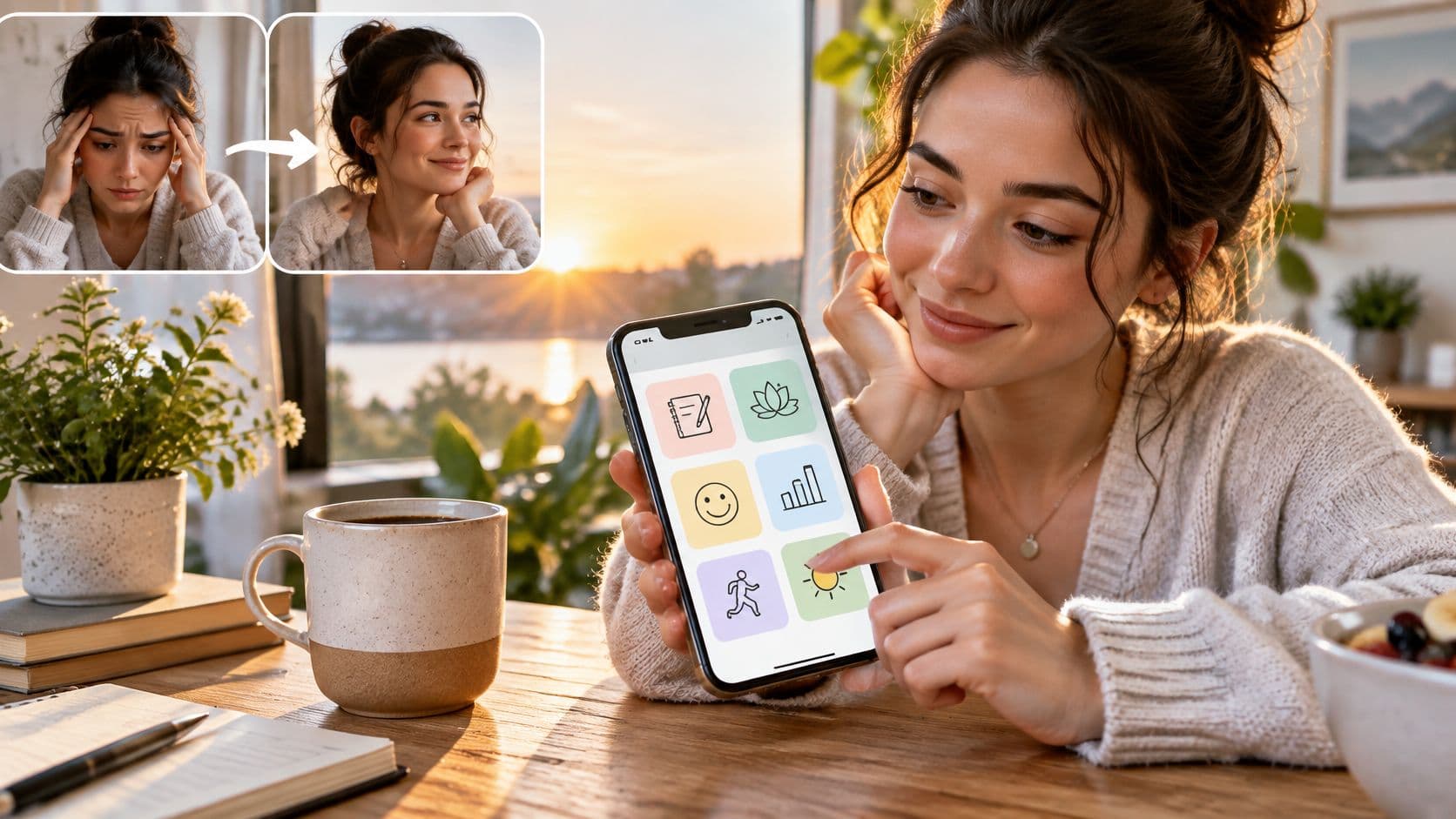
Luno: Self Care offers guided, personalized self-care plans that can help you practise sleep-focused CBT-I routines, breathing, journaling, and daily check-ins across the issues you're dealing with. It can feel like therapy in its structure, and you can find support for any topic you need, but it isn't therapy or a substitute for clinical care.
Built with Outrank app