
Yes, renewed love is real and measurable: in one Australian longitudinal study, 9% of separated cohabiting or married couples later reconciled and resumed living together. Whether that reunion becomes healthy love depends on safety, mutual willingness, and meaningful changes to what went wrong.
But if missing someone feels like love, how can you tell whether you want the relationship back or just want the pain of separation to stop?
That distinction matters. You can feel a powerful pull toward someone without being ready to build a better relationship with them. You can also begin rebuilding a worthwhile connection before the romantic excitement returns.
Yes, Love Can Return, and Here Is How Often It Happens
Can love really come back after a relationship ends? Yes, and reconciliation is a measurable relationship pattern rather than a wishful story. No single percentage, though, can predict whether your relationship will recover.
Much of the confusion comes from what researchers really count. Some studies track whether people start dating an ex again. Others count resuming a shared home after a marriage or cohabiting relationship dissolves. A few surveys just ask whether someone has ever reunited with an ex, which is a very different question from following separated couples forward over years.
Reported reunion rates after a breakup
| Group studied | Reported reunion rate | What it measures |
|---|---|---|
| Young adults aged 17–24 (peer-reviewed study) | A large share broke up and later reconciled | Reconciliations often happened more than once among those who broke up |
| Separated Australian couples (longitudinal survey) | A small share resumed living together | Couples who dissolved a cohabiting or marital relationship |
| Previously married couples, five years after separation | A slightly smaller share reunited | Renewed partnership or co-residence |
| Cohabiting couples, five years after separation | A slightly larger share reunited | Renewed partnership or co-residence |
| Married couples, 2024 (J. Kale Monk, via TODAY) | 12%–25% broke up and got back together | Share of married couples with a breakup and reunion |
| Adults surveyed in 2024 (4,534 people, Max Jancar, summarized by SofiaDate) | 32% got back together with an ex | Self-reported survey answers |
| Cohabiting couples, 2024 (Bedbible summary) | 37% broke up and reunited | Reported breakup and reunion |
| Married couples, 2024 (same Bedbible summary) | 23% broke up and reunited | Reported breakup and reunion |
The young-adult result describes people who experienced reconciliation at some point. It says nothing about the probability that any particular breakup will end in reunion. Repeated reunions also count differently from a single, lasting repair, which is worth remembering if you have already cycled through more than one.
The Australian rows ask a narrower question: did separated partners resume partnership or living together? Comparing those figures with a broad survey asking whether adults have ever returned to an ex would be misleading.
Read the range without turning it into a forecast
The married-couple estimates and the general adult survey broaden the picture, yet they rely on different definitions and sampling methods. Read them as evidence that reconciliation happens across many groups and life stages. They are descriptions of what occurred in particular samples, and they cannot be converted into personal odds.
Here is the deeper limitation. Every figure in that table counts a reunion. None of them measures what the reunion was made of. A couple marked "reconciled" might be two people doing real repair work, two people relieved that the ache of separation stopped, or one anxious person pulled back by the fear of being alone. The data cannot separate those outcomes, so the numbers alone should never decide for you.
Keep the distinction: A reunion tells you that people got back together. It says nothing about whether they resolved the reasons they separated.
The better question goes one level deeper than whether love can return. Ask whether the relationship you are weighing would be different enough to support it, and know that deciding it would not is a healthy answer too.
Why Love Can Return Without the Early Fireworks
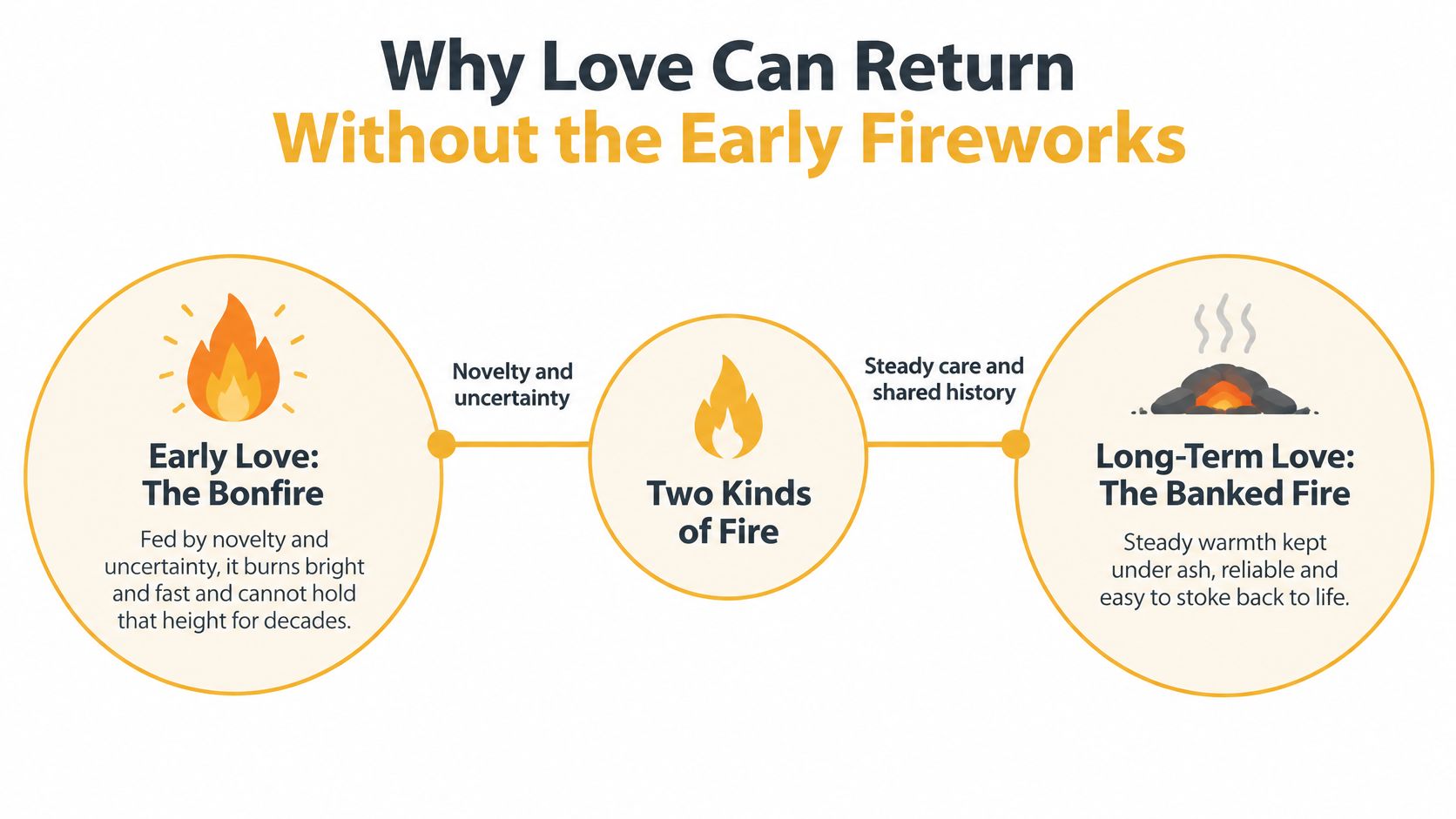
Early love can resemble a bonfire, fed by novelty and uncertainty. Long-term love is more like a banked woodstove: quieter, steadier, and capable of renewed warmth when someone gives it attention.
The analogy has a limit. A relationship isn't guaranteed to warm up just because you add more effort, and nobody should be expected to keep feeding it alone.
A review published in Review of General Psychology found that romantic love characterized by intensity, engagement, and sexual interest can exist in long-term marriages and is associated with greater marital satisfaction, well-being, and self-esteem. That supports the possibility of lasting romantic love, not a promise that every relationship can recover it.
Rebuild engagement rather than recreate the beginning
Think of renewed connection as rebuilding several working parts:
- Interest: Ask something you don't already know about your partner. What have they changed their mind about? What are they looking forward to?
- Desire: Make room for attraction without demanding sex. Notice what invites closeness and what makes either person tense.
- Emotional engagement: Choose an undistracted conversation rather than automatically retreating to separate screens. Respond to what your partner actually says.
- Investment: Do something that needs both of you, such as planning a garden, learning a recipe, or organizing a shared outing.
Affection can belong here without becoming a prelude to anything. Holding hands, if welcome, doesn't have to create an obligation to become more physically intimate.
Say a couple still manages the household efficiently but rarely talks beyond chores. Their first sign of renewal may not be a dramatic date. It may be discovering that they want to stay at the table after dinner because the conversation feels enjoyable again.
A quieter feeling isn't necessarily a weaker feeling
The early spark is a signal, not the whole engine. Excitement can accompany love, but uncertainty can also produce excitement, and calm doesn't automatically mean indifference.
Ask whether you feel more interested in your partner as they are now. Do you look forward to ordinary time together? Can affection happen without pressure, bargaining, or fear of disappointing them?
You don't have to reproduce the beginning to build something worth continuing.
Repeated opportunities for meaningful contact matter more than waiting passively for a sudden feeling. Warmth may first appear in small moments: an unforced laugh, a welcome touch, or genuine curiosity about the other person's day.
Conditions That Make Rekindling Possible or Unsafe
Pre-separation relationship satisfaction was the strongest predictor of reunion in the Australian HILDA reunion study, while relationship investment and demographic characteristics were weaker and less consistent predictors. The study found that 9% of couples who dissolved a cohabiting or marital relationship later resumed living together; a separate analysis reported reunion for 7% of previously married couples and 9% of cohabiting couples five years after separation.
The practical lesson is that the relationship's history matters. Time apart doesn't automatically turn a painful partnership into a workable one.
Shared possessions, children, familiar routines, or years together can make separation difficult. They don't establish that renewed intimacy would be healthy.
Conditions that support or block rekindling
| Condition | Supports rekindling when | Blocks it when |
|---|---|---|
| Relationship satisfaction before the split | It was warm or improving, with real care on both sides | It was mostly conflict, contempt, or emotional withdrawal |
| Safety | Both feel safe to talk about what happened | Coercion, threats, control, or physical or emotional abuse are present |
| Root cause | The reason for the split is named and both can describe it | The cause is never discussed or is dismissed as an ordinary difficult period |
| Willingness | Both want to try, or one wants to try and the other is genuinely open without pressure | One person is pressured or reaches out mainly to avoid loneliness |
| Life situation | There's enough calm to meet and talk without a crisis | Active addiction, an untreated crisis, or infidelity still being disputed prevents honest contact |
Read the support column as permission to consider a careful attempt, not a guarantee. If every row leans toward support, you have a more reasonable starting point.
A block means the attempt should wait until that condition changes. Missing someone doesn't resolve an untreated crisis, and an apology doesn't remove controlling behavior.
Safety isn't a score you average
A relationship can have affectionate memories and still be unsafe. You don't balance threats against good dates or excuse coercion because your partner also seems distressed.
Where abuse, control, or fear is present, shift the goal from reunion to protection. Contact a domestic violence advocate or a licensed professional with relevant expertise before arranging direct contact; joint conversations may expose someone to retaliation.
Our safety guidance explains the boundaries of self-guided support. If you're in immediate danger, seek local emergency assistance rather than relying on an app or a reconciliation conversation.
Willingness also needs careful interpretation. Both people don't have to feel romantic love at the same moment, but both must freely agree to participate. Being open means being able to say no, slow down, or stop without punishment.
You can care a great deal about someone and still decide that the conditions for trying again aren't present.
Telling Real Renewal Apart from Relief, Nostalgia or Anxiety
Longing after a split can feel unmistakably like love. Yet the same urgency can come from loneliness, relief that arguments have stopped, memories of happier times, or fear that you've lost your chance forever.
An unpredictable on-off pattern can make the next message feel unusually important. That intensity tells you you're emotionally activated; it doesn't prove that your partner has become more compatible with you.
An Association of American Universities summary of relationship-cycling findings reports that approximately 34% of partners experience at least one breakup–reconciliation cycle and describes associations with lower satisfaction, poorer communication, weaker commitment, uncertainty, and greater psychological distress over time.
Four sources of the pull back, side by side
Use a four-week observation window as a practical reflection exercise, not a diagnostic test or a research-established deadline. The patterns below are possibilities to watch for, not predictions about what must happen.
| Source of the pull | What it feels like | Behavior it drives | What changes after four weeks |
|---|---|---|---|
| Renewed love | Warmth that grows with honest, calm contact | Curiosity, patience, and following through on promises | Look for responsiveness and warmth rising in both people |
| Breakup relief | Calm while apart; tension returns when discussion reaches the issues | Seeking distance from conflict rather than closeness | The relief may fade once old conflicts return |
| Nostalgia | Urgent focus on the best memories and past versions of the partner | Replaying old moments and avoiding present-day problems | Few present-day changes; longing remains focused on the past |
| Attachment anxiety | Fear of loss, message-checking, and needing reassurance | Chasing or withdrawing depending on the last reply | Anxiety may remain, with reassurance needed repeatedly |
These feelings can overlap. You might genuinely love someone and also feel anxious about losing them. The question is which pattern organizes your decisions.
Test the present, not the imagined future
Compare what happens during ordinary contact with what you imagine while apart. Can you discuss a disagreement without being punished? Does your partner respect a boundary even when it disappoints them?
Say your former partner promises to listen better. The useful signal isn't a moving apology alone. It's whether they let you finish, ask what you meant, and respond differently when you raise something uncomfortable.
Nostalgia looks backward. Real renewal requires becoming interested in the person who exists now, including changes you may not like.
Keep a private journal with a short record of the interaction, your response, and any observable follow-through. Don't use it to build a prosecution file or persuade yourself to stay. Use it to notice whether hope matches your actual experience.
Signal test: Look for changes you could describe without using the words chemistry, destiny, or potential.
Ask yourself: What has changed in how we handle conflict since we split, and can I describe it in specifics?
What to Say When You First Reach Out
A first message should make room for a choice, not create an emotional emergency. You're inviting a conversation, not asking someone to relieve your distress or commit to a reunion.
A low-pressure opening sequence
Choose a neutral channel and a calm time. Use a channel they haven't asked you to stop using, and avoid late-night messages or contact immediately after a fight. A calm approach makes it easier for them to respond freely.
Own your part without requesting reunion. You might write that you've been thinking about how you withdrew during the last months together and recognize that it hurt them. Keep the message brief, and don't attach an explanation that shifts responsibility back onto them.
Ask about their experience if they're willing to talk. Ask how the final period of the relationship felt from their side. Listen without correcting their account, even if your memory differs.
Offer a short, specific meeting. For example, suggest 30 to 45 minutes in a public place, with a stated end time and an easy way to decline. A bounded meeting is less demanding than an open-ended conversation about your entire future.
Accept a no without pursuit. A refusal is an answer, not an invitation to improve your argument. If they don't reply, don't send repeated messages through other channels.
You don't need perfect wording. You need accountability, restraint, and respect for the other person's freedom.
An invitation is only low-pressure if declining it has no penalty.
If there has been fear, threats, control, or coercion, skip direct contact. Speak with a domestic violence advocate or appropriately qualified licensed professional first, including when you're unsure whether your experience counts as abuse.
How to Rebuild Connection One Small Step at a Time
Rebuilding works best as a shared experiment, not an audition in which one person performs and the other judges. Agree that either person can name discomfort, change the pace, or stop.
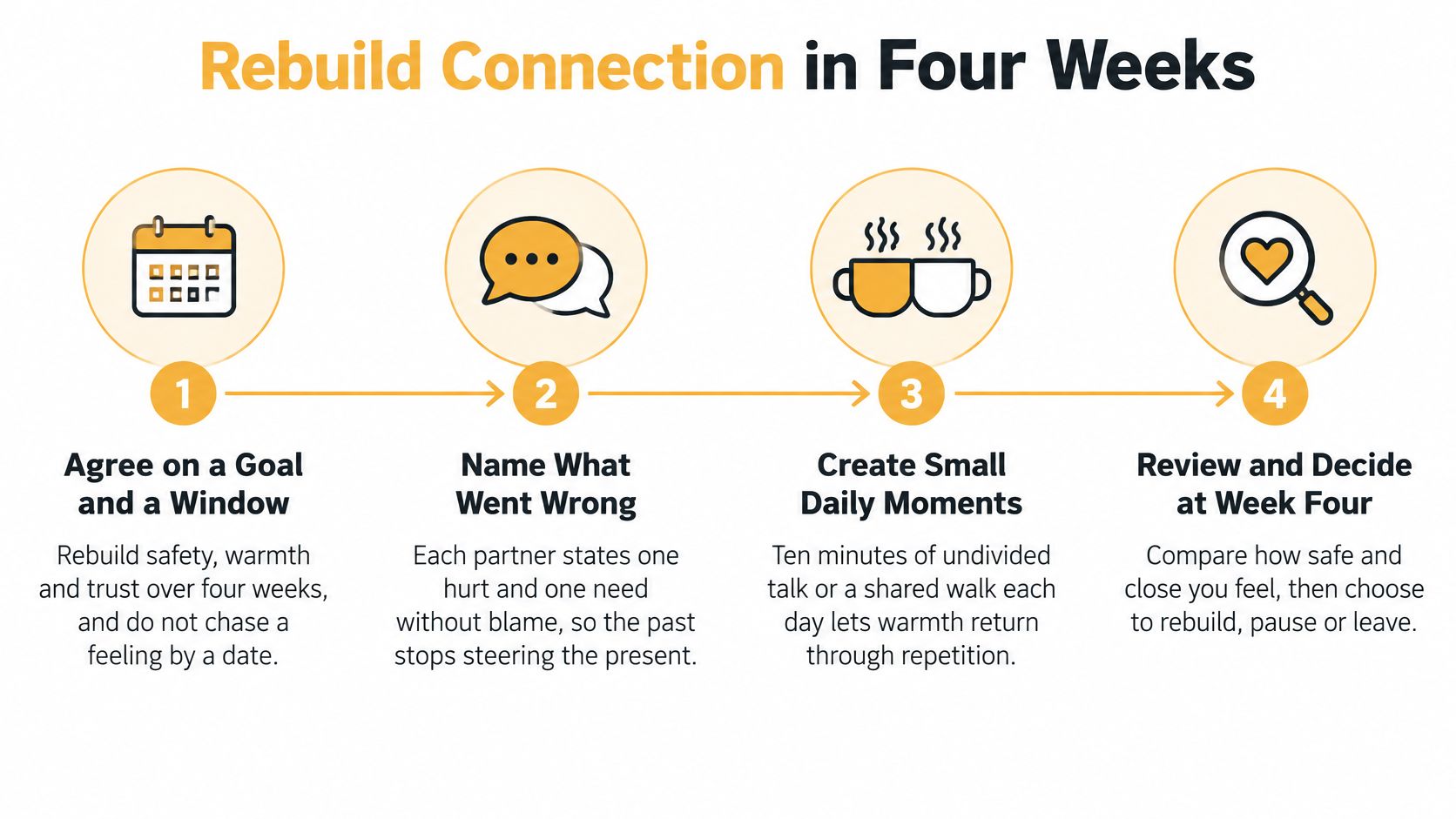
The following four-week procedure is a suggested structure for reflection. Its timing and ratings aren't a validated measure of romantic love.
A shared experiment with room to adjust
Agree on a goal and a window. Try rebuilding safety, warmth, and trust over four weeks, without demanding romantic feelings by the end. Define what participation looks like so neither person has to guess what the other expects.
Name the recurring rupture. Each person writes a sentence about the pattern, such as feeling ignored when plans change without warning or feeling cornered when disagreements continue without a break. Describe behavior and needs rather than assigning a character defect.
Practice specific appreciation. Identify what your partner did, its impact, and the quality behind it: “When you checked in after my difficult meeting, I felt supported; your attentiveness matters to me.” In a 2024 study of 825 people in relationships longer than six months, perceived partner responsiveness was strongly associated with satisfaction (β = 0.87) and statistically mediated part of gratitude's association with satisfaction. That association doesn't prove appreciation causes repair, and gratitude must never cover up control or fear.
Make shared time concrete. As a starting schedule, try two 30-minute sessions each week, including a new activity you both welcome. Alternate a meaningful conversation with something enjoyable so reconnection doesn't become an endless review of problems.
Track your own experience privately. Each evening, rate warmth, curiosity, and perceived responsiveness from 1 to 5, then compare your individual patterns at week two and week four. Use scores as conversation prompts, not evidence that your partner owes you a better rating.
Return to friction after calming down. Aim for a ten-minute check-in within a day when both people can participate safely. Name what happened, acknowledge the impact, and agree on a different response rather than forcing immediate forgiveness.
Resume after a lapse. If you miss a day or several, pick up at the next workable opportunity. Distinguish a scheduling lapse from repeatedly refusing agreed changes; those aren't the same problem.
Notice whether care is being received
Responsiveness means helping your partner feel understood, valued, and cared for. Doing what you consider loving isn't enough if the other person experiences it as intrusive, dismissive, or conditional.
Ask what landed well and what didn't. A welcome check-in for one person may feel like monitoring to another, so clarify rather than assume.
Continuity matters in personal self-care too. Tom A. described his experience this way: “Missing three days didn't break it. It just picked me back up where I was.” His Depression Lift experience lasted 14 days, with his reported mood improving from 3 to 7; that's an individual account, not evidence that a relationship exercise will produce the same result.
No improvement by the review date is information, not a reason to intensify pressure. Consider a pause, leaving, or professional support instead of extending the experiment indefinitely.
Decide Whether to Rebuild, Pause or Leave
A comparison summarized by Perspectives on Sexual and Reproductive Health found that reunited relationships lasted an average of 25.2 months after reunion, versus 16.4 months for continuously together relationships in that sample. The groups differed, so longer duration doesn't prove that breaking up repairs love; the same article reports the young-adult reconciliation figures covered earlier.
Choose based on what your relationship is becoming, not merely how long you can keep it going.

Match the decision to the situation
- Rebuild: Safety is present, both people participate freely, the root cause is named, and your review shows increasing warmth and responsiveness.
- Pause: Signals are mixed or promised changes haven't appeared during the suggested three-to-four-week window. Consider a defined 30-day pause, without reconciling until a concrete change appears.
- Leave or seek help: The same rupture keeps returning, reconnection increases anxiety, or loneliness is your main reason for returning. A licensed couples therapist may help where it's safe; use a domestic violence advocate when safety is involved.
Multiple warning signs strengthen the case for stopping, and a safety concern never needs a second signal.
Take time to reflect without treating another reunion as the automatic next step. A considered decision to leave is a valid result of this process.
Luno: Self Care offers daily check-ins and reflection, with self-guided protocol packages for people examining patterns like these. It can feel like therapy, though it is self-guided support rather than therapy, a crisis service, or a replacement for a licensed clinician; WHO guidance on digital interventions likewise says these tools shouldn't replace other interventions.
If you miss a day, week, or month, Luno re-anchors to your history and resumes the arc without guilt or a hard reset. Ending a reconciliation attempt after honest reflection can also be a successful outcome in its own right, not a failure of love.
Luno: Self Care turns daily mood check-ins and reflections into personalized next-day plans, with journaling and a Relationship patterns protocol package (DBT and attachment-based). If you'd like structured support for examining your feelings and choices without pressure to reunite, visit Luno: Self Care.