
You're rereading a message, trying to work out how a simple request became another apology from you. You remember what happened, but their version sounds so certain. Perhaps you're searching for “surviving the narcissist” with the screen turned away, wondering whether you're overreacting. You don't need to settle someone else's diagnosis tonight. You need room to think, support you can trust, and a next step that doesn't increase your risk.
The Moment You Start Questioning Everything
You might notice the confusion before you can name the problem. A conversation about household spending becomes a criticism of your character. You raise something that hurt you and finish the conversation reassuring the person who hurt you.
These are examples to examine, not proof of a diagnosis. The useful question isn't whether an internet description fits perfectly. It's whether you can express needs, disagree, access resources, and make ordinary decisions without intimidation or punishment.
Start with what you know
Separate the event from the explanation you were given. Perhaps you asked to see a shared account statement, and the other person refused, shouted, or threatened to withdraw support. Record those actions rather than trying to establish what they secretly intended.
You don't have to call the whole relationship abusive before speaking confidentially with someone. Nor must you make an immediate decision about leaving, confronting, forgiving, or staying. Uncertainty is a reason to gather support, not a requirement to endure more harm.
You can take your experience seriously without being certain what to call the other person.
Clinical understanding of narcissism distinguishes a personality disorder from difficult or selfish behavior, and prevalence estimates vary substantially with study design. That's another reason to prioritize observable experiences over amateur diagnosis, as explained in this clinical review of narcissism and narcissistic personality disorder.
Make the next decision smaller
Ask what would help you think more clearly today. That might mean eating before another difficult conversation, contacting someone privately, or postponing a nonurgent relationship discussion until you've had rest.
- Find a steady listener. Choose someone who won't confront the other person on your behalf without permission.
- Name your immediate concern. Is it confusion, restricted money, unwanted contact, or fear of what happens when you disagree?
- Protect your pace. You can explore options before announcing a decision.
For now, aim for enough steadiness to notice what's happening. You don't owe anyone a dramatic declaration of clarity.
Recognizing the Patterns Without Play-Dating Diagnosis
Patterns are information. Diagnoses are clinical judgments. Confusing those tasks can keep you studying someone's personality while overlooking what their behavior costs you.
Clinical descriptions of NPD include persistent grandiosity, excessive need for admiration, and impaired empathy across contexts, beginning by early adulthood. DSM-5-based diagnosis requires at least five of nine features, evaluated by a qualified clinician rather than inferred from a partner's checklist, according to the Merck Manual's diagnostic overview.
Use this distinction when reviewing relationship behavior.
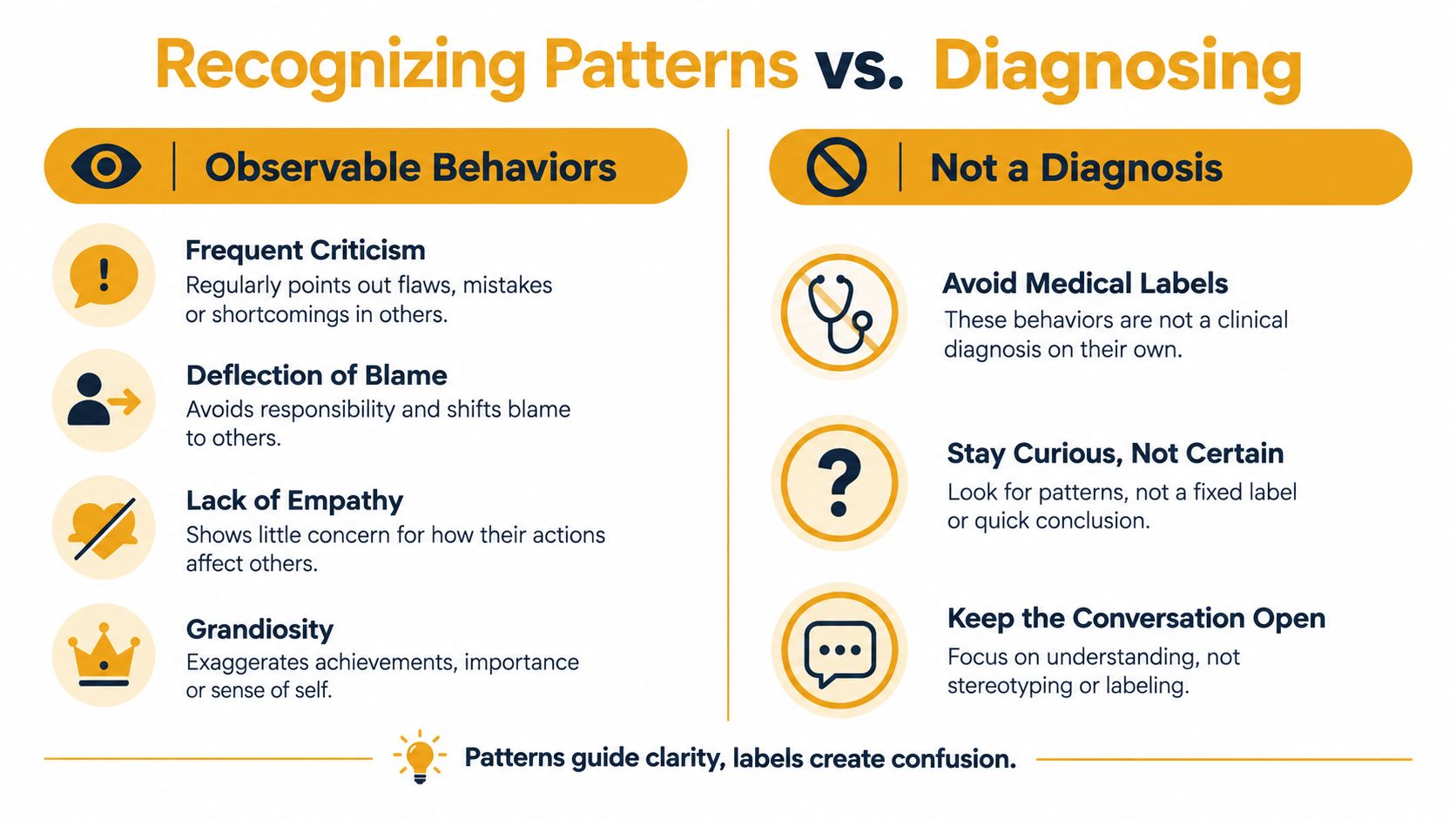
Translate labels into observations
Instead of writing that someone is entitled, describe the expectation they impose. Instead of concluding they lack empathy, record how they responded when you described pain or asked for accommodation.
| Concern | A concrete observation to record |
|---|---|
| Entitlement | They demand access to your messages while refusing equivalent access to theirs. |
| Exploitation | Help comes with an unannounced obligation, then refusal brings threats or punishment. |
| Admiration-seeking | They repeatedly redirect your concern toward demands for reassurance or praise. |
| Reality-denying behavior | They deny a specific exchange despite a preserved written record. |
These examples don't establish NPD. They give you something more useful for a support conversation: an account of what happened, in context.
Notice the response to disagreement
An unpleasant exchange isn't automatically a controlling pattern. Ask whether the person can acknowledge a specific action, tolerate your disagreement, and respect your independent choices afterward. Look beyond the apology to what happens when the same issue returns.
- Describe actions. “They interrupted and threatened to cancel transport” is clearer than “They were narcissistic.”
- Include context. Note what you requested and what happened when you declined.
- Track the effect. Record whether you changed plans, lost sleep, or avoided asking again.
Don't provoke a reaction to test your theory. Your task is to understand existing experiences, not create another dangerous encounter.
You don't need a verdict on someone's character to justify a limit. A clinician may explore diagnosis; you can decide what treatment you're willing to accept.
Mapping Coercive Control and Your Real Risk
A partner checking your messages, a parent making financial support conditional on obedience, or an ex repeatedly using practical arrangements to demand access deserves behavior-based assessment. Ask what happens when you say no, and whether the conduct restricts your choices.
Intimate-partner violence includes psychological harm, not only physical or sexual violence. That broader definition matters when considering monitoring, threats, isolation, and financial restriction, as described in this systematic review of intimate-partner violence.
An orderly place to collect information can help, but the record must be somewhere the other person cannot access.

Preserve evidence without increasing exposure
Keep dates, exact wording where available, screenshots, unwanted-contact records, and descriptions of financial restrictions. Distinguish what you witnessed from what you suspect. Include effects on sleep and daily functioning so an advocate can understand the practical impact.
- Digital access. Review location sharing, linked devices, recovery addresses, passwords, and possible spyware with appropriate support.
- Financial dependence. Identify which accounts, documents, transport arrangements, and essential expenses someone else controls.
- Post-separation contact. Include interference through parenting, money, accounts, or repeated boundary testing.
- Legal questions. Bring records to a local attorney or advocate rather than assuming every hostile act has the same legal remedy.
If changing an account could alert the person, discuss the timing with an advocate first. You can also review these self-guided support safety boundaries before putting sensitive reflections into a digital tool.
Treat escalation as a safety issue
Stalking, weapon threats, threats to kill, physical assault, and forced sexual contact warrant urgent specialist attention. SPARC's risk-assessment and safety-planning materials emphasize these indicators and individualized planning.
Don't announce an exit plan to someone actively stalking or threatening you. If there's immediate danger, contact local emergency services or a domestic-violence service from a safer device or location when possible. Documentation must never take priority over getting safe.
Setting Boundaries That Survive Contact
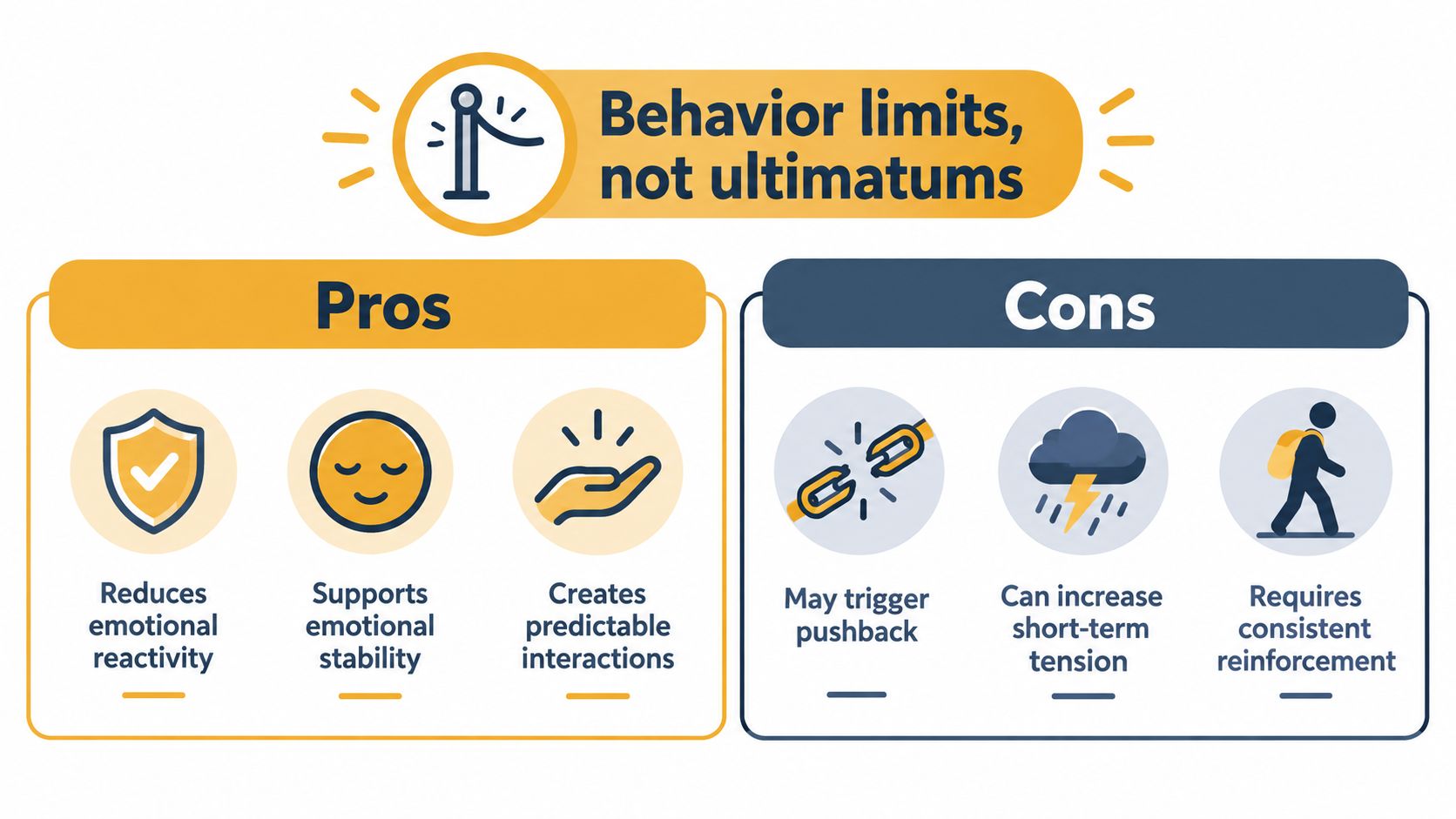
A boundary describes what you'll do in response to a behavior. It isn't a demand that someone understand you, admit fault, or become reasonable.
For surviving the narcissist, the practical question is whether the limit fits your actual circumstances. Blocking every channel may be workable after some separations, but not when parenting arrangements, shared housing, employment, or legal obligations require communication.
Build a limit you can carry out
A usable boundary needs a specific behavior, an action within your control, and a follow-through plan. “Stop disrespecting me” leaves too much to argue about. “If the call includes insults, I'll end it and address the scheduling question in writing” identifies an observable threshold.
Safety comes first: A boundary is not a protection order, an exit plan, or a guarantee that another person won't escalate.
Use this visual as a reminder of the trade-offs, not a promise that firmer wording will make someone safe.
Match the script to the contact
- Living together. If withdrawing is safe, try: “I'm stopping this conversation while there's shouting. We can discuss the bill in writing.” Don't announce an action that could leave you trapped or exposed.
- Co-parenting. Answer the necessary logistics: “I can collect at the agreed location. Please confirm the handover arrangement.” Leave the personal accusations unanswered.
- Late-night baiting. Where no urgent response is required: “I'll respond to practical questions during the day.” Avoid defending your whole history.
- Structured exchanges. Discuss a suitable witness, advocate, or formal arrangement when direct interaction creates risk.
- Post-separation contact. If ending communication is safe and legally appropriate, plan it rather than repeatedly reopening a channel to explain your decision.
Brief, neutral replies, sometimes called gray rock, are an option to assess, not a universal solution. Don't use emotional flatness as a test of whether someone will become more aggressive.
Research has found associations between pathological narcissism and coercive control, while broader personality-disorder severity showed stronger associations with both control and abuse. That nuance supports choosing communication strategies around actual conduct, not labels, in this research on narcissism, personality dysfunction, and coercive control.
A Staged Recovery Plan You Can Actually Follow
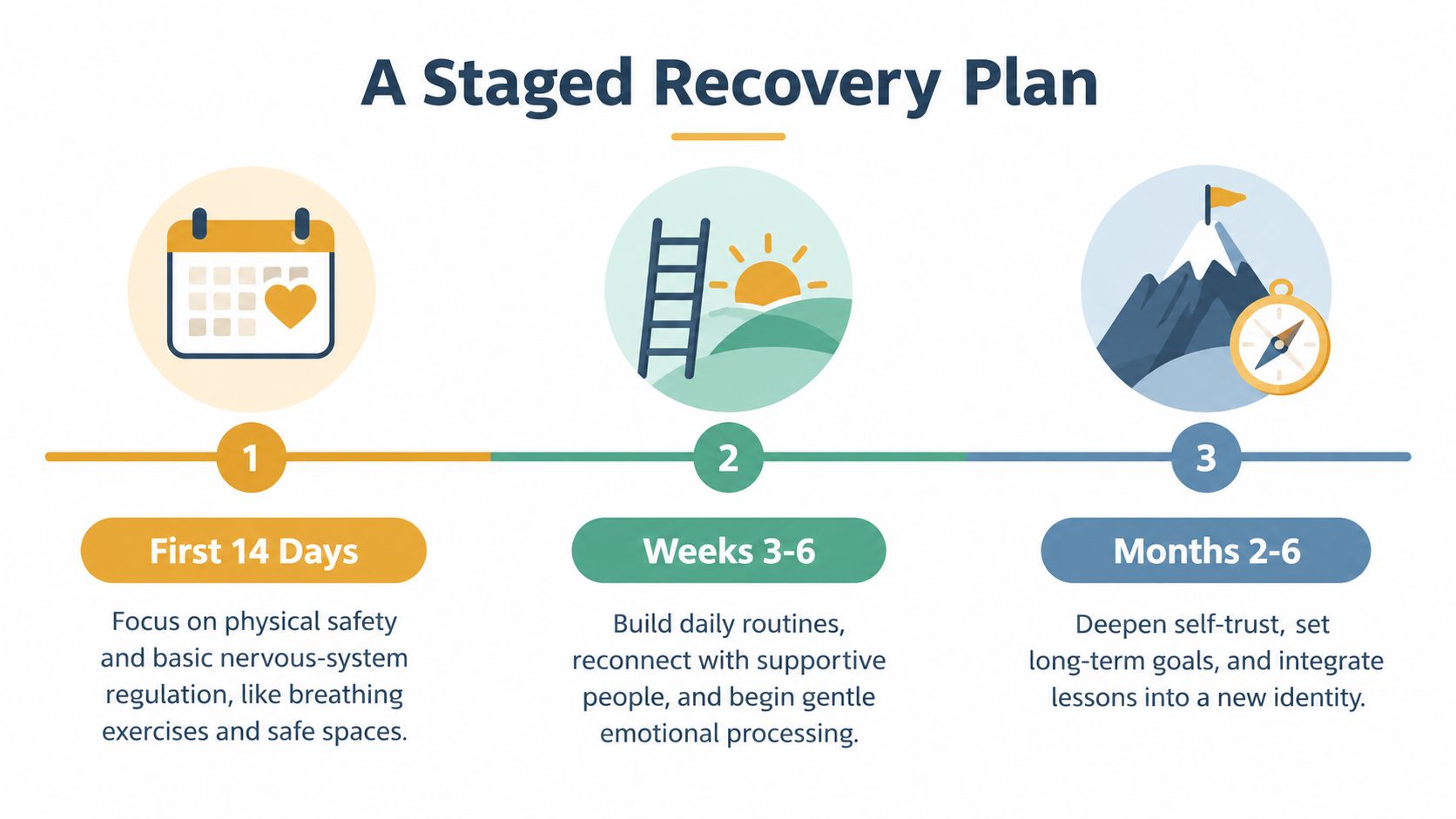
Stabilize first, consider trauma processing with appropriate care, then expand your independence and relationships. You can move between these tasks as circumstances change. Returning to basic routines after a difficult encounter isn't starting over.
Use the timeline as an organizing aid, not a recovery deadline.
Begin with daily functioning
A practical framework prioritizes sleep, food, hydration, grounding, trusted contact, and a reality record in the first 14 days, then introduces structured cognitive work and one measurable boundary or autonomy action per day during weeks 3–6, as outlined in this staged recovery guidance.
Put manageable actions on your calendar rather than assigning yourself the task of healing.
- Protect basic routines. Choose a workable waking routine, make food accessible, and identify someone you can contact when overwhelmed.
- Try present-focused grounding. Notice the support beneath your feet and name objects around you. Stop an exercise if it makes you feel worse.
- Keep a reality record. Separate the observable event, the explanation someone gave you, and your own response.
- Test an internalized belief. Place “everything is my fault” beside dated evidence. Ask what responsibility belongs to you.
- Choose a small autonomy action. Make a private appointment, express a preference, or complete a practical task that supports independence.
You don't need to complete every exercise. Choose what supports functioning without exposing you to further risk.
The accompanying video can be an optional reflection prompt, not an assessment of your situation.
Know when self-guidance isn't enough
Escalating nightmares, suicidal thoughts, severe dissociation, renewed danger, or inability to function require clinical or crisis support. Contact emergency or crisis services if you may act on suicidal thoughts or cannot stay safe.
Don't push through intense memory exercises alone. Self-guided exposure or trauma processing can intensify distress, and the recovery guidance cited above cautions that there isn't a validated success rate specific to narcissistic-abuse recovery.
Once you're steadier, make room for preferences and relationships that aren't organized around avoiding another person's reaction. That's a direction, not a deadline.
When Contact Cannot End and Healing Is Non-Linear
You may still share children, a business, housing, or financial responsibilities. Immigration questions may require specialist advice. An aging parent may need practical arrangements, or a partner may be participating in treatment while you're still deciding what you want.
Continued contact isn't evidence that you've failed. Work with the options you have, while identifying which dependencies could become less restrictive with support.
Separate feelings from decisions
You can miss someone and still recognize that contact harms you. You can grieve the relationship you wanted without agreeing to resume the relationship available to you. Ambivalence deserves space, but it doesn't have to determine today's communication.
Missing the good moments isn't an instruction to dismiss the harmful ones.
A meta-analysis of 22 studies involving 11,520 participants found a weak overall relationship between trait narcissism and intimate-partner-violence perpetration, r = .15; psychological and cyber abuse showed associations, while physical violence didn't reach significance in the meta-analysis of narcissism and partner violence. These findings don't assess your individual risk, but they challenge the idea that a personality label explains everything.
Keep unavoidable contact purposeful
Try language that identifies the task rather than reopening the relationship debate.
- For shared responsibilities. “Please send the document needed for the appointment.”
- For a parent's repeated pressure. “I can discuss the care arrangement. I'm not discussing my personal decision.”
- For reconciliation requests. “I'm not making that decision during this conversation.”
A rough day doesn't prove a particular diagnosis or erase your progress. Sleep difficulty, grief, concentration problems, or low mood deserve attention in their own right, including medical or mental-health assessment when needed.
Look for changes in functioning: asking for help sooner, completing an essential task, or recovering your footing after contact. Those are meaningful aims even while circumstances remain complicated.
Your Pivot Checklist and How Support Tools Fit
The most useful shift in surviving the narcissist is from explaining another person to deciding what you need. You can take that step without a confession, a confirmed diagnosis, or unanimous agreement from your family.
Keep a short decision aid somewhere safe. It should help you choose an action when you're overwhelmed, not become another standard you feel you're failing.
Keep the essentials accessible
- Describe rather than diagnose. Bring concrete examples to support conversations.
- Match help to risk. Use a domestic-violence advocate for safety planning, legal counsel for legal questions, and a clinician for assessment and treatment.
- Choose feasible limits. Plan around the contact you have.
- Protect functioning. Return to manageable routines when reflection becomes overwhelming.
- Recognize escalation. Use the warning signs already identified rather than waiting for certainty about a label.
Your plan can include a trusted contact, an appointment you intend to make, and the practical question you most need answered. Keep it short enough to use under stress.
Give digital tools a limited role
A self-guided wellness app may offer space for journaling, learning about difficult topics, organizing questions, and practicing coping exercises. Before using one, consider whether someone else can open your phone, read notifications, access backups, or view a shared account.
The American Psychological Association's advisory on chatbots and wellness apps states that these tools shouldn't replace qualified mental-health providers and warns that crisis-management performance is limited and unpredictable. A supportive conversation isn't psychotherapy, and an app isn't a reliable danger assessment.
Choose a tool for a defined purpose, such as preparing notes for a clinician, rather than asking it to decide whether you're safe or whether someone has NPD. If using it makes you more preoccupied with interpreting every interaction, pause and seek human support.
You don't have to rebuild your entire life today. Choose the next action that gives you more safety, clarity, or practical choice.
Luno feels like therapy, but it is not therapy: Luno: Self Care offers self-guided journaling and personalized daily plans informed by methods including CBT, ACT, IFS, and schema work. You can explore any topic you need, including relationship patterns, sleep, boundaries, and self-trust, while keeping clinical care and safety support separate. Visit Luno: Self Care to explore structured support for your next manageable step.