You wake up and reach for your phone before you've fully opened your eyes. For a moment, you expect their message, their presence, or the familiar shape of the life you had. Then reality returns. Your chest tightens, your motivation disappears, and the question comes back: How do I get over it when I still feel stuck?
Whether “it” is a breakup, bereavement, burnout, rejection, or a painful memory, you won't think your way out of it by demanding instant closure. You'll recover by building enough structure around yourself to keep moving while your emotions catch up. That means small actions, honest reflection, firmer boundaries, and support that matches the seriousness of what you're carrying.
Why Time Alone Does Not Heal Everything
Time can soften pain, but time by itself doesn't choose your next meal, get you outside, interrupt an avoidance loop, or help you process what happened. If you spend every day isolated, replaying old conversations and postponing ordinary responsibilities until you “feel better,” the waiting can become part of the problem.
Consider someone after a breakup who stops exercising, ignores friends, sleeps at irregular hours, and checks an ex-partner's social media whenever anxiety rises. They may tell themselves they're giving the wound time to heal. In practice, they're repeating the same loop: trigger, rumination, avoidance, temporary relief, deeper withdrawal. The calendar moves forward, but their daily life stays organized around the loss.
A death, a relationship ending, or prolonged exhaustion can create a similar pattern. You're not weak because basic tasks feel strangely difficult. Your nervous system is responding to disruption, and your mind may be trying to protect you from reminders, uncertainty, or another emotional hit. Compassion matters, but compassion without action can turn into surrender.
Practical rule: Don't wait for motivation to return before you rebuild your day. Use a small plan to give motivation somewhere to return to.
Recovery is better understood as daily architecture. You decide when you'll get up, what you'll eat, who you'll contact, where you'll put your phone, and which manageable task deserves your attention. These choices don't erase grief or heartbreak. They restore evidence that your life still contains movement, agency, and moments that aren't controlled by the thing you lost.
Start with three anchors: one action for your body, one action connected to responsibility, and one action connected to meaning or connection. A short walk, a shower, one completed work task, a meal with someone safe, or ten minutes of music can count. Keep the threshold low enough that you can begin on a bad day.
If your thoughts become unsafe, your distress feels unmanageable, or you're in immediate danger, self-guided exercises aren't enough. Review Luno's safety information, contact a trusted person, and seek urgent human support in your area.
Understanding the Real Recovery Timeline
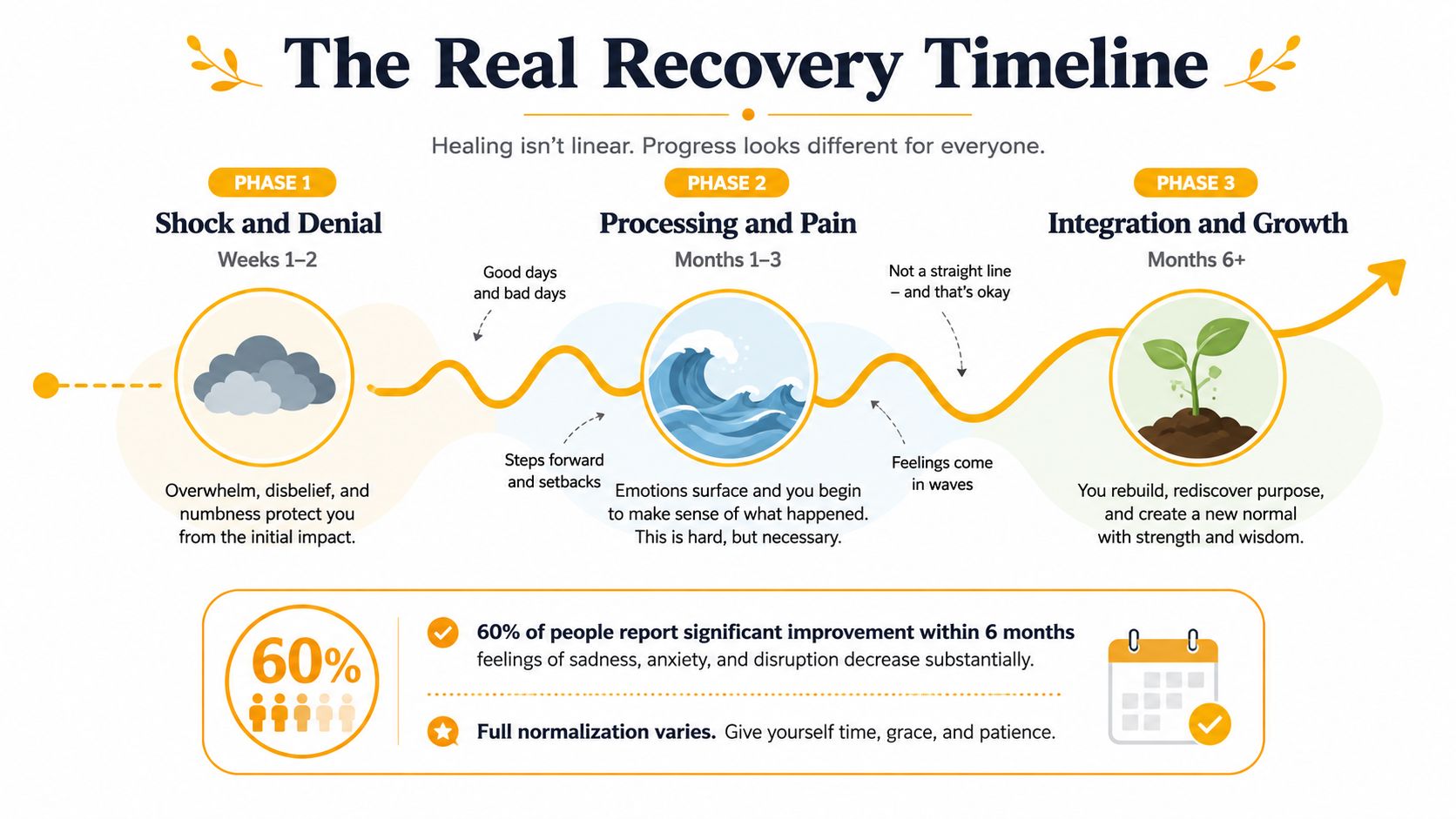
The demand to be “over it by now” creates unnecessary shame. Emotional recovery rarely follows a clean line. You may function well for several days, then wake up with the old heaviness after a song, anniversary, place, dream, or unexpected reminder. That setback doesn't mean you've returned to the beginning.
Bereavement data show why a rigid deadline is a poor measure of healing. A major U.S. review from the Department of Health and Human Services reported that 66.4% of adults had recovered from acute grief at the one-year mark without clinical intervention, while 25% of people with initially high grief had recovered by then. The same review estimated that about 7% to 10% of the U.S. population experiences persistent grief symptoms, and that roughly one in ten bereaved adults develops prolonged grief disorder or complicated grief. See the U.S. bereavement review for the underlying findings.
Those figures don't tell you exactly when you'll feel normal. They do establish two important truths. Many people gradually regain functioning over time, and a meaningful minority continue to need structured support. “I'm still hurting” isn't automatically a sign of failure, but persistent symptoms that interfere with daily life deserve attention rather than indefinite endurance.
Measure function, not emotional perfection
Grief is widespread and often affects the body as well as the mind. One U.S. review reported that 57% of Americans had grieved the loss of someone close within the prior three years. It also recorded depression, sleep disturbance, anger, and anxiety among reported grief symptoms. The summary of U.S. grief statistics provides that population context.
Instead of asking, “Do I still miss them?” ask better questions:
- Daily functioning: Am I eating, sleeping, washing, and completing essential responsibilities more consistently?
- Emotional range: Can I experience even brief moments of interest, calm, humor, or connection?
- Recovery after triggers: When something reminds me of the loss, can I return to the present more quickly?
- Support needs: Am I managing, or am I becoming more isolated and unable to care for myself?
These measures respect the fact that healing can include sadness. You don't need to stop loving someone, forget what happened, or feel cheerful every day. You need to regain room for the rest of your life.
A practical timeline has stages, not a finish line. Early recovery may focus on stabilization and basic routines. Later, you may have enough capacity to process the story, challenge avoidance, and reconnect with plans that once felt impossible. If symptoms persist beyond a year or continue to worsen, treat that as a reason to consider structured care, not as evidence that you've done grief incorrectly.
Rebuilding Momentum Through Behavioral Activation
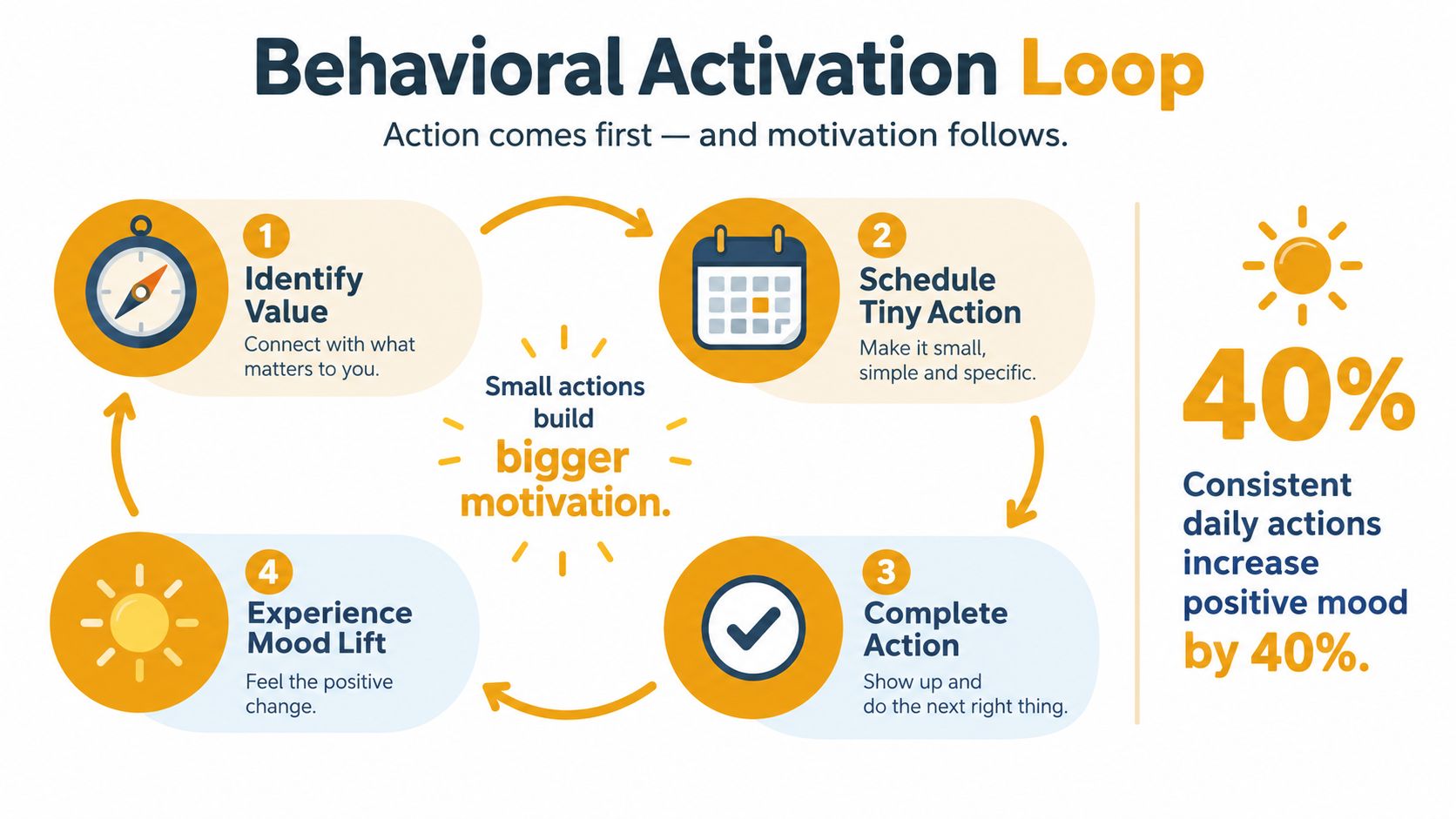
When depression, low motivation, or avoidance has taken over, waiting to feel ready usually keeps you stuck. Behavioral activation reverses the order. You choose a small action linked to your values, complete it before your mood improves, and use the result to plan the next step.
A meta-analysis of 105 trials involving 13,933 patients found that behavioral activation improved adult outpatient depression compared with control, with a standardized mean difference of 0.67. Self-guided behavioral activation still showed a measurable benefit, with a standardized mean difference of 0.36, according to the published meta-analysis. The results varied across people and implementations, so treat the method as a practical framework, not a promise of instant relief.
Use a small daily loop
Name the avoidance loop. Write down what happens before you shut down. For example: “I feel lonely, I check old photos, I stay in bed, and then I feel more helpless.” Naming the sequence creates a gap between the trigger and the usual response.
Choose a value, not a mood. Ask what kind of person you want to be today. Reliable, caring, healthy, creative, connected, and responsible are useful values. Pick one, then translate it into an action that takes little effort.
Schedule a tiny task. “Reconnect with my life” is too vague. “Put on shoes and walk to the end of the street after lunch” is workable. “Fix my entire sleep schedule” is too large. “Put my phone across the room before bed” is specific.
Record completion and mood. Before the task, note your mood in a few words. Afterward, record what you did, how difficult it was to start, and whether anything changed. Don't demand happiness. A small lift in energy, pride, calm, or self-respect counts.
Build tomorrow from today's evidence. If the task was impossible, reduce it. If it was easy, expand it slightly. Your plan should adapt to your actual capacity rather than punish you for having limits.
The common mistake is overloading the schedule with an ambitious recovery program. A long list can become another reason to feel inadequate. Choose actions that are easy to start, meaningful enough to matter, and repeatable tomorrow.
Try this morning, afternoon, and evening:
- Morning: Drink water, open the curtains, and wash or dress.
- Afternoon: Complete one practical responsibility and leave the room if possible.
- Evening: Contact a safe person, write a short reflection, or follow a calming routine.
The point isn't to force yourself into constant productivity. It's to give your brain repeated experiences of action, completion, and choice. A self-guided plan from Luno: Self Care can support this process by turning check-ins and reflections into personalized next-day plans, but the value comes from doing the manageable actions, not from collecting plans.
Here's a short demonstration of how behavioral activation can be applied in practice:
Setting Boundaries and Processing the Narrative
You can't recover while repeatedly reopening the same wound. That may mean limiting contact with an ex-partner, muting updates, leaving a group chat, declining emotionally draining conversations, or taking distance from places that keep you activated. A boundary isn't a punishment. It's a decision about what your current capacity can safely hold.
Use a simple test: Does this contact help me act according to my values, or does it reliably pull me into rumination and dysregulation? If the answer is the second, create a clear limit. You don't need a dramatic explanation. “I'm not available for this conversation right now” is enough.
Protect your present
Write boundaries in behavioral terms rather than emotional wishes:
- Digital access: Mute, unfollow, archive, or remove shortcuts that lead you into compulsive checking.
- Conversation limits: Tell friends whether you want listening, practical help, distraction, or no discussion of the person today.
- Time protection: Set periods without emotionally loaded messages, social media, or difficult calls.
- Physical recovery: Keep food, sleep, movement, and medication routines separate from whether another person responds.
Boundaries work best when you decide them before the trigger arrives. In the moment, a lonely evening can make an unhealthy connection feel like the only available comfort.
Processing the past requires a different skill. Avoiding every reminder can keep the experience emotionally “unfinished,” but forcing yourself into intense exposure can overwhelm you and make you avoid more. Structured grief-focused CBT and psychosocial interventions use stabilization, narrative processing, examination of unhelpful beliefs, and gradual re-engagement with reminders. A review of bereavement interventions found medium post-treatment effects of g = 0.65 and large follow-up effects of g = 0.90, while a review of web-based bereavement care reported effects for grief and PTSD. The systematic review of grief interventions explains this structured approach.
Process without flooding yourself
Set a timer for a short journaling session. Write what happened, what you miss, what you're angry about, what you fear the loss means, and what you need now. End by orienting to the room: name what you see, feel your feet on the floor, and take slow breaths until your attention returns to the present.
Don't chase perfect closure. You may never receive the explanation, apology, or changed behavior you wanted from someone else. Internal closure means deciding what the experience means about your values and next choices, without pretending it didn't hurt.
Use a gentler question when self-blame appears: What would I say to someone I love who went through this? Then write that answer to yourself. Self-compassion isn't excusing harm. It's refusing to add a second injury through relentless self-attack.
If journaling leaves you panicked, detached, unable to function, or at risk, stop the exercise and seek professional support. Processing should expand your capacity over time, not repeatedly push you beyond it.
Using Self-Guided Tools for Daily Support
Professional therapy and self-guided support solve different problems. A licensed clinician can assess symptoms, diagnose conditions, provide psychotherapy, manage treatment, and respond to risk. A self-guided app can offer prompts, education, reminders, reflection exercises, and structure between appointments or during the early stage when you're trying to establish a routine.
Access and willingness also matter. One cross-sectional study found that only 28.3% of adults who screened positive for depression and or anxiety had contact with any provider, with barriers that included financial constraints, busy schedules, self-reliant attitudes, and limited awareness of services. A separate U.S. analysis found that about two-thirds of adults with subclinical mental health needs wanted to manage problems independently or feared being forced into care. Those findings appear in the study on barriers to mental health support.
That preference for autonomy deserves respect, but it shouldn't become an excuse to avoid necessary care. Think of self-guided tools as a scaffold. They can help you notice patterns, practice coping skills, and follow through on small commitments. They can't take responsibility for your safety or replace a therapeutic relationship.

Compare the tool to the need
| Your need | A self-guided tool can help with | A professional can provide |
|---|---|---|
| Daily consistency | Check-ins, reminders, journaling, and next-step planning | Treatment planning when symptoms disrupt functioning |
| Emotional awareness | Mood tracking and pattern recognition | Clinical assessment and diagnosis |
| Coping practice | Breathing, reflection, behavioral activation, and grounding | Psychotherapy tailored to complex or persistent symptoms |
| Grief support | Structured prompts and paced self-reflection | Grief-focused therapy and evaluation for prolonged grief |
| Crisis or immediate danger | Directing you toward human help | Urgent assessment, safety planning, and crisis intervention |
Luno feels like therapy but it is not therapy. It offers people a way to find the topic they need, including grief, difficult memories, low mood, anxiety, sleep, boundaries, and relationship patterns, then work through self-guided exercises at their own pace. That makes it suitable as a daily support layer, not as a diagnostic or treatment service.
Use an app deliberately. Check in at a consistent time, answer truthfully rather than trying to produce an impressive reflection, and complete one exercise before opening another. Review your patterns periodically. If the app keeps showing severe distress, worsening function, or risk signals, use that information to contact a qualified professional instead of trying to solve the problem alone. You can find practical answers about use and scope in the Luno frequently asked questions.
Sustaining Your Recovery and Knowing When to Pivot
Recovery becomes sustainable when you stop treating it as a dramatic breakthrough and start maintaining a few repeatable supports. Your daily checklist can stay simple:
- Body: Eat something, hydrate, move gently, and protect sleep.
- Action: Complete one responsibility before negotiating with your mood.
- Connection: Speak with someone safe or spend time in a supportive environment.
- Processing: Write, reflect, or use a structured exercise without forcing emotional intensity.
- Boundary: Remove one avoidable trigger or protect one period of quiet.
- Review: Notice what helped and adjust tomorrow's plan.
Expect uneven days. A difficult morning doesn't cancel a month of effort. The useful question is whether you return to your supports sooner and with less self-punishment.
Self-guided care should remain optional support, not a test of endurance. Pivot to professional help when symptoms persist, worsen, or interfere with work, relationships, sleep, eating, personal care, or safety. Seek urgent human help if you may harm yourself, feel unable to stay safe, experience a crisis, or lose contact with reality.
The American Psychological Association states that wellness and AI mental health apps shouldn't deliver psychotherapy, and that diagnosis and treatment remain the responsibility of licensed clinicians. Read the APA advisory on AI chatbots and mental health before deciding what an app can responsibly do for you. You can also review Luno's privacy information before using a digital support tool.
You don't need to feel completely healed to take the next right action. Build the day you can manage, repeat what supports you, process the past at a tolerable pace, and ask for more help when your current tools aren't enough.
Luno: Self Care offers personalized daily plans, check-ins, reflections, and self-guided journeys for concerns such as grief, difficult memories, low mood, anxiety, sleep, and burnout. Visit Luno: Self Care to add structured support to your recovery routine, while remembering that it isn't therapy or a crisis service.