
Roughly 55% of people have had at least one lucid dream in their lifetime, and about 23% report them regularly, so this is a learnable sleep skill, not a rare gift. Most of those who make progress do it through steady practice with intention and sleep routines, and the results usually show up as sporadic successes over weeks rather than nightly control.
You may already know the feeling. You wake from a dream that was so vivid it lingered for minutes, then realize something in it was impossible, strange, or slightly off. That flicker of recognition is the raw material for lucid dreaming, and the job of practice is to make that recognition easier to catch, not to force the brain into perfect obedience.
Embracing Your Natural Capacity for Lucid Dreams
The first lucid dream often starts with something small. A hallway may have the wrong doors, a friend may appear in the wrong place, or an ordinary scene may feel slightly off. That moment of recognition is the opening, and lucid dreaming usually grows out of recognition rather than effort.

A quality-effects meta-analysis of 34 studies estimated that about 55% of people have experienced at least one lucid dream in their lifetime, with about 23% having them regularly, although estimates vary widely by sample and method. That matters because it corrects a common myth. Lucid dreaming is not reserved for a special minority, it is a human capacity many people already touch spontaneously. The meta-analysis summary
Start with what already happens
If you have had a dream that felt almost self-aware, you already have the right material. The practical job is to notice patterns and strengthen recall, because training usually improves awareness and frequency rather than creating a brand-new sleep phenomenon from scratch.
Practical rule: treat every dream as evidence that your mind is already generating the space where lucidity can happen.
A calm routine works better than pressure. Keep sleep regular, pay attention to recurring dream cues, and set the intention to notice when something seems off. If you want a guided place to start, Luno's self-guided support can help people organize that kind of practice without turning it into a rigid performance test.
Building Dream Recall and Reality Testing Habits
Dream recall is the foundation because you can't notice patterns you don't remember. When you wake up, stay still for a few seconds and let the dream reassemble in reverse order. Start with the final scene, then move backward through people, places, objects, and odd transitions until the thread becomes clearer.
Capture dream signs while they're fresh
Write down specific details, not just “I dreamed I was late.” Note the recurring location, the impossible event, the unusual person, or the emotion that kept showing up. Those repeating features are your dream signs, and they become the best cues for future lucidity because they tell you what your dreaming mind likes to reuse.
During the day, perform a small number of high-attention reality tests when something feels unusual. Read text twice, check a digital clock twice, and ask whether the last few minutes make coherent sense. The point is not repetition for its own sake, it's conscious curiosity. If the check becomes automatic, it loses force.
Reality testing alone does not consistently increase lucid dreams, and the evidence is stronger when it's paired with other methods such as wake-back-to-bed and mnemonic practice. That's why the habit should feel thoughtful, not obsessive. The reality-testing review
A reality check only works when your attention is awake enough to question the moment.
A simple rhythm works well: recall first thing in the morning, review dream signs before bed, and use a handful of daytime checks tied to real anomalies. For a quick reference on technique basics, the FAQ page can be a useful companion while you build the habit.
Applying MILD and WBTB Techniques Effectively
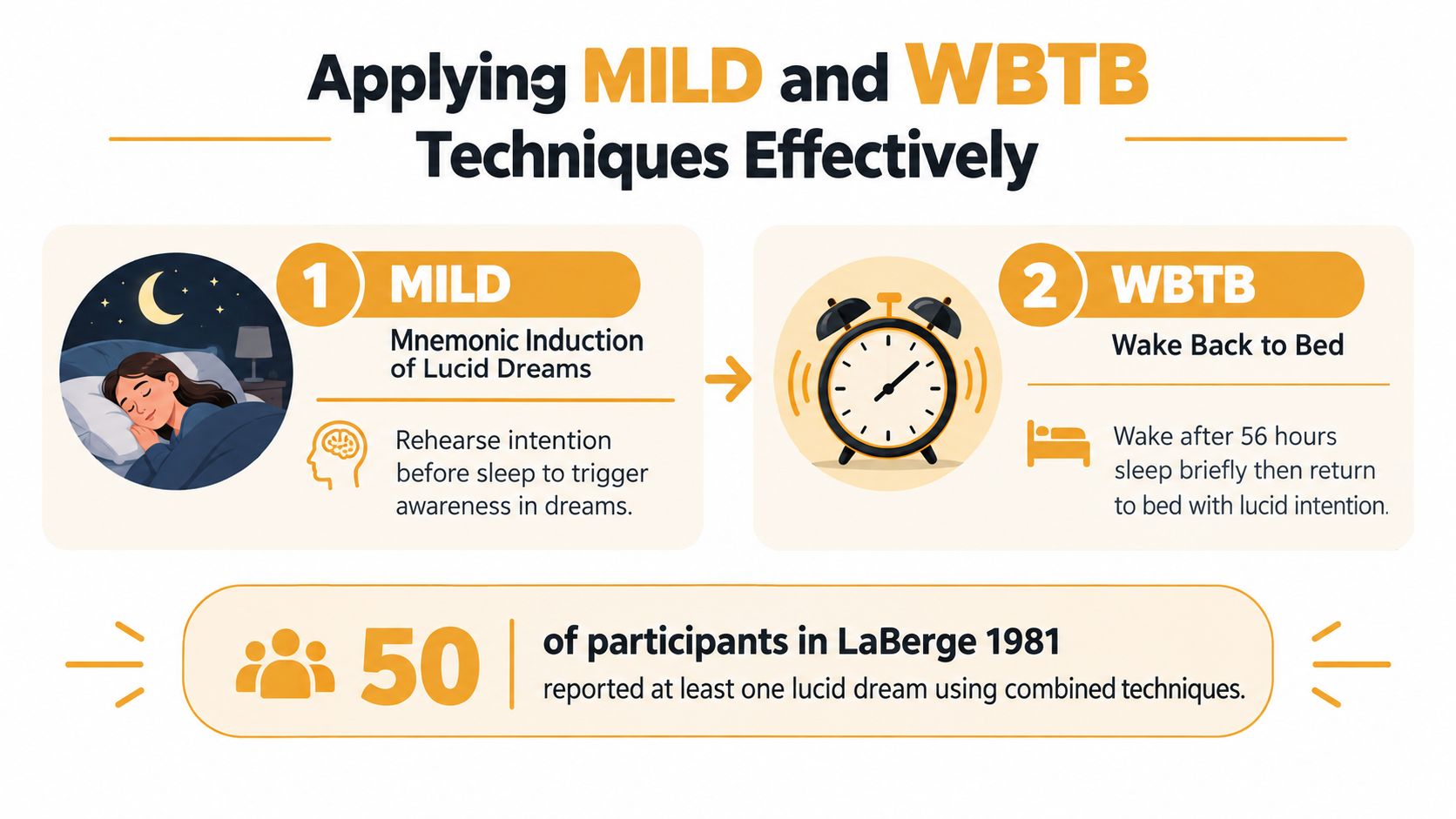
The strongest practical methods are usually MILD, which is mnemonic induction of lucid dreams, and WBTB, which is wake-back-to-bed. MILD works by rehearsing the intention to recognize the dream state before falling asleep. WBTB uses a brief awakening to make the next sleep period more likely to include that sharp, REM-ready awareness.
Use intention before sleep
As you lie down, repeat a focused intention in your own words, such as remembering that you're dreaming when a dream begins. Keep it calm and specific. You're not demanding a result, you're training a recognition habit. If your mind wanders, gently return to the intention without restarting the whole ritual.
Make WBTB brief and low-friction
With WBTB, wake briefly, stay alert enough to remember your intention, then return to bed without turning the night into a project. The biggest mistake is staying awake too long. That can fragment sleep, make the next day foggy, and reduce the chance that the method feels sustainable.
A structured study found that combining reality testing, WBTB, and MILD increased lucid dream reports from 9.4% of nights in the first week to 17.4% in the second week. That doesn't promise the same rate for everyone, but it does show that a combined protocol can shift the odds over a short period. The study report
One practical adjustment matters more than perfection, return to sleep calmly. If you're tense, counting success before you've fallen asleep again, you're more likely to wake fully and lose the benefit.
Evaluating Evidence and Common Pitfalls
Not every technique deserves equal confidence. A systematic review rated MILD as the only technique with clear evidence of effectiveness, while several other methods had insufficient or ambiguous support. That makes lucid dreaming a skill with uneven evidence, not a universal formula. The systematic review
What tends to fail in real life
Dream journaling helps recall, but journaling alone doesn't guarantee lucidity. Reality testing can be useful, but only when paired with genuine reflection and intention. Dream diaries, frequent checks, and novelty-seeking can all become busywork if they aren't grounded in a consistent routine.
The biggest practical obstacle is usually not technique, it's sleep quality. Poor recall, irregular sleep, waking too fully during WBTB, and switching methods every night all make progress harder to see. When people think nothing is working, the core issue is often that they're measuring success too narrowly.
Track the whole night, not just whether lucidity happened.
That means paying attention to sleep continuity, dream recall, false awakenings, and daytime fatigue alongside lucid episodes. A method that produces a vivid experience but leaves you exhausted isn't a good fit. A gentler approach often lasts longer and teaches more.
For readers who want a structured system without overcomplicating the routine, the terms page is a good reminder that any tool should support your practice, not take it over. The best approach is usually the simplest one you can repeat consistently.
Creating a Sustainable Weekly Practice Plan
Consistency beats intensity here. Pick one primary technique, keep the routine stable for a short window, and let the results tell you whether to continue. A two-week trial is enough to learn something useful without turning the process into a lifestyle overhaul.
A workable rhythm
Use the same basic pattern each day. Morning, record what you remember before checking messages or getting out of bed. Evening, review recurring dream signs and rehearse your intention once. On selected nights, add MILD, and only use WBTB when you can protect your sleep the next day.
Keep a simple log with sleep duration, awakenings, recall quality, method adherence, and lucid-dream reports. That record matters because memory is selective, and progress can be subtle. Many people notice better recall before they notice full lucidity, and that still counts as movement in the right direction.
A useful weekly structure looks like this:
- Days 1 to 3: focus on recall, write dreams immediately, and identify recurring signs.
- Days 4 to 7: add one evening intention practice, then keep daytime checks limited and purposeful.
- Week 2: evaluate sleep quality first, then decide whether to keep, simplify, or pause the method.
If the practice starts costing rest, scale it back.
That's not failure. It's good calibration. The point is to build a habit that can survive ordinary life, because a routine you can maintain is more valuable than a burst of effort that leaves you depleted.
Prioritizing Safety and Knowing When to Pause
Lucid dreaming is a self-guided exploration, not therapy, and it shouldn't be treated like a substitute for clinical care. It can feel reflective or even therapeutic, but that feeling doesn't make it treatment. People can explore many topics through sleep practice, yet serious mental-health concerns still belong with qualified support, not with dream control alone.

Deliberate attempts to induce lucid dreams have been associated in some studies with sleep problems, stress, dissociation, and other psychological symptoms, so a cautious, monitored approach is the right one. The safety review
Watch for warning signs
Pause if insomnia gets worse, if you start feeling detached or unreal during the day, or if the practice is leaving you more anxious than curious. The same caution applies if you have a history of nightmares, dissociation, trauma-related symptoms, or severe mood instability. In those cases, sleep protection comes first.
Avoid making sleep itself the price of experimentation. Repeated alarms, long wake periods, and aggressive chasing of lucid states can backfire. If the practice is causing fatigue or confusion, step away and re-center on ordinary rest.
For readers who want a private place to keep that boundary in view, the safety page is the kind of resource that supports cautious experimentation without pretending to replace professional help. A calm rule helps here, if the practice makes your life worse, stop.
Moving Forward with Mindful Progress
The healthiest way to learn lucid dreaming is to treat it like a gradual literacy, not a test you pass or fail. Some nights will be vivid, some will be dull, and some will give you nothing at all. What matters is the trend in attention, recall, and steadiness.
Celebrate small signs of progress. Better dream memory is progress. Noticing a recurring setting is progress. Having one lucid moment after a quiet week is progress. Those wins may look modest, but they're the genuine markers that the practice is taking root.
Keep your expectations humane. You're learning to notice while asleep, and that takes time, patience, and a protected sleep routine. The people who improve usually respect the pace of the process instead of demanding control on command.
If you want to keep your practice private and organized, the privacy page is a useful place to understand how that kind of support handles your information. Stay gentle with the work, keep the focus on awareness over perfection, and let the practice deepen at a pace your sleep can sustain.
If you want structured support for sleep, reflection, and consistent self-guided routines, Luno: Self Care offers a way to turn daily check-ins into practical next-day plans. It's a fit for people who want a calm, paced companion while building habits like dream recall, intention setting, and better sleep consistency.