
Your partner hasn't replied, but they've been online. You open their profile, notice a familiar name under a photo, and start replaying yesterday's conversation. Part of you wants reassurance. Another part wants proof.
If you're asking, “How do I stop jealousy?” start with a kinder, more useful question: What am I reacting to, and what response fits the evidence? An imagined threat, an upsetting digital trigger, and a real broken agreement don't need the same solution. You can learn to handle the feeling without dismissing yourself or controlling someone else.
Sort Your Jealousy by Its Real Trigger
Jealousy involves three positions: you, a relationship you value, and someone you perceive as threatening that bond. Unlike merely wanting what another person has, jealousy includes fear of losing a connection. The American Psychological Association's definition of jealousy includes friendships and family relationships, not just romance.
That distinction matters. A sibling getting the praise you wanted might stir envy, jealousy about your parent's affection, or both. A screenshot showing your coworker's new friendship might hurt because you miss being included, not because anyone has betrayed you.
Find the fear beneath the reaction
Look for what feels threatened before deciding what to do. Slower replies may leave you wanting connection; contradictory explanations may leave you needing clarity. Neither feeling, by itself, settles what really happened.
Jealousy triggers and the first move for each
| Trigger | What it sounds like | What it needs | First move |
|---|---|---|---|
| Fear of losing affection | Partner replies slower, seems distant or gets short | Specific reassurance and a clear check-in | Write: I am afraid I am becoming less important to them |
| Mistrust | Replaying messages, imagining what happened, hunting for proof | Facts separated from guesses, plus a boundary talk | Write: The fact is X, and my story about it is Y |
| Competition for attention | A friend, coworker or sibling gets praise, time or closeness | Your own sense of worth and a request for time | Write: I want to feel included in this |
| Rivalry in friendships or family | Feeling replaced, overlooked or compared to someone | Reassurance that you matter to the group | Write: I feel left out of this and want to name it |
You don't have to fit neatly into a category. Pick the trigger that felt loudest this week and write the matching sentence, using your own words. That gives you something specific to work with instead of the global judgment that you're “just a jealous person.”
How to Stop Jealousy in Five Steps
Use this sequence as a short written practice, roughly ten minutes rather than an open-ended investigation. The suggested timing is a practical container, not a treatment dose or a promise of relief.
Name the trigger in one line. Describe the event and your feeling: “My partner liked an old friend's photo, and I felt replaced.” The common slip is putting an accusation inside the description, such as “They were trying to attract someone else.” Write what you could actually observe.
Write the prediction. Finish the thought your mind started: “They're losing interest and will leave.” This separates the event from the future you fear. Don't soften the prediction to sound reasonable, but don't treat writing it down as confirmation.
List evidence for and against. Make two columns and include observable facts: messages sent, plans kept, agreements broken, words actually spoken. A like happened; an intention usually isn't directly observable. The slip here is counting anxiety as evidence while dismissing anything reassuring as irrelevant.
Write a less extreme explanation. Try: “They liked a post. That alone doesn't establish whether their feelings have changed.” You're looking for an explanation that fits the evidence, not forcing yourself to believe everything is fine. If there's a documented broken agreement, keep it in the picture.
Choose a behavior that respects trust and your boundaries. Ask a clear question, describe what you noticed, or postpone a nonurgent conversation until you've rested. You might choose a 24-hour pause as a personal experiment, not a rule for unsafe situations. Don't stop at a balanced thought and leave the practical issue untouched.
This visual offers a reminder of the broader process, including pausing and returning your attention to daily life.
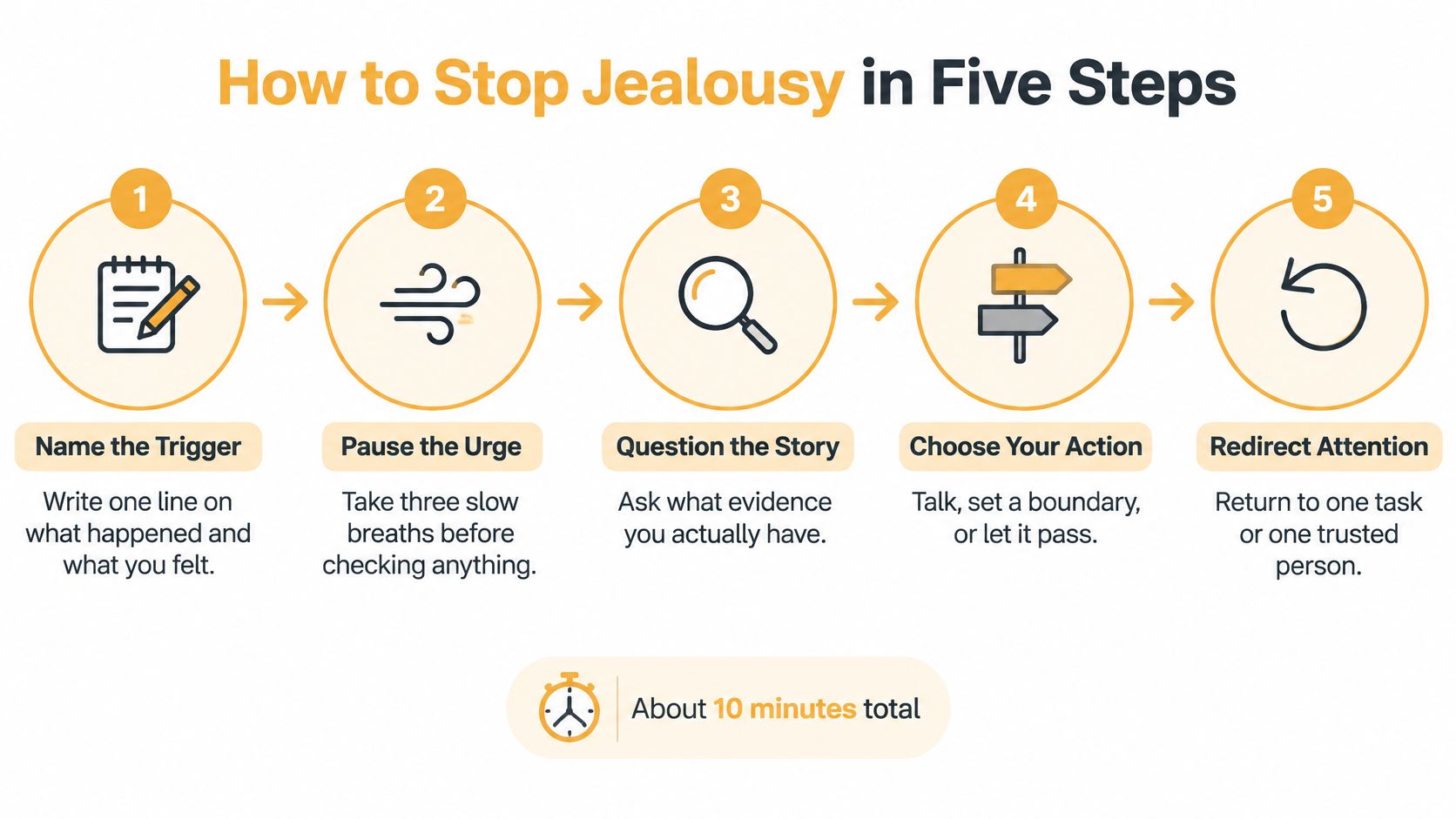
Use the exercise without turning it into an investigation
The sequence borrows from structured cognitive work. In a controlled study of cognitive therapy for severe, persistent jealousy, most treated patients improved, while the waiting-list group showed no significant change during the waiting period. That supports the approach's rationale, but a self-guided worksheet isn't equivalent to clinical treatment.
If your body is racing, take two slow breaths before writing anything. Avoid doing an exhaustive evidence review at 2 a.m., when you're exhausted and tempted to keep searching.
Practice rule: Finish with a chosen action, not another search for certainty.
Start with a mild trigger. You're practicing a skill, not testing whether you can stay composed during your hardest moment.
Breaking the Checking Loop Before It Starts
Checking can bring brief relief: you look, find nothing conclusive, and relax. The difficulty is that you may start relying on another check whenever uncertainty returns. Reassurance-seeking can become something you repeat rather than something that resolves the concern.
Active surveillance means deliberately searching profiles, rereading messages, or asking friends to investigate. Unavoidable exposure means encountering a notification or a mutual friend's post without seeking it out. You can interrupt the former directly; the latter needs a plan for what you do after seeing it.
The Cleveland Clinic's guidance on dealing with jealousy offers a starting point for identifying triggers and responding more deliberately. A useful practical distinction is to address both the online material that upsets you and your response to it, rather than making “never feel jealous online” the target.
Give yourself permission to step away from the screen.

Build a before, during and after routine
- Before exposure: Mute or pause high-trigger content. Choose a delay before opening an ex-partner's profile, for example 24 hours, and write: “What do I expect to find?” This is an optional practice boundary, not an evidence-based cutoff.
- During an urge: If you open a public profile anyway, use a two-minute timer as an exit cue, then close the app. Don't use the timer as permission to access private accounts or messages.
- Afterward: Compare your prediction with what you observed. Record the difference, then take a walk, splash cool water on your face, or contact a friend about something other than investigating your partner.
Prepare for familiar setbacks: an ambiguous timestamp, an ex's profile, or algorithm-served content. Decide in advance to close the content and return to your written prediction instead of following related accounts.
For a one-week experiment, record urge intensity from 0 to 10, daily checks, and any sleep disruption. These are personal tracking choices, not diagnostic measures. A lapse is information about where you need a stronger pause, not a reason to abandon the practice.
Talking About Jealousy Without Accusing
The relationship around you matters. A five-year longitudinal study of 891 young adults across 1,507 relationships attributed 39.8% of variation in cognitive jealousy to differences between relationships, compared with 28.2% to stable differences between individuals. Those findings don't diagnose your situation, but they challenge the assumption that jealousy is just a fixed personality flaw.
Before talking, identify the condition you want to address: unclear boundaries, past betrayal, inconsistent communication, or a specific perceived threat. “I need us to clarify our agreement” is more actionable than “I need to stop being insecure.”
Describe the condition and make a concrete request
Use a simple sequence: describe what happened without blame, name your feeling, request a specific change, and agree on when you'll check in again. Keep the request within something both people can reasonably discuss and choose.
What to say when jealousy comes up
| Situation | Try saying | Avoid saying |
|---|---|---|
| Partner's behavior is unclear | When you go quiet after work, I start worrying. Can you text me when you're running late? | Why do you always disappear on me? |
| Past betrayal still shapes your reactions | Some of this comes from what happened before. I need slower trust and clearer honesty for a while. | You're exactly like my ex. |
| A friendship makes you uneasy | I'd like to talk about the friendship with you. What would help me feel respected in it? | Stop seeing them or I'm done. |
| Communication is inconsistent | Can we agree to check in on Thursdays so I'm not guessing where we stand? | You never tell me anything. |
The accusing versions turn a concern into a verdict about someone's character. They also make it harder to identify what would resolve the problem.
A collaborative opening doesn't mean you must accept any answer. You can listen, ask for clarification, and decide whether the proposed agreement meets your needs.
A boundary describes what you'll accept and what you'll do. It isn't an instruction to surrender someone else's privacy.
Choose a time when neither person is hungry, exhausted, or already arguing. As a practical focus limit, try keeping the first conversation under twenty minutes, then agree on a follow-up if needed. You don't have to settle every past hurt in the same discussion.
When Jealousy Points to a Real Boundary Problem
Not every jealous feeling needs to be calmed away. Sometimes you need to question your interpretation; sometimes you need information; sometimes you need protection from behavior that isn't acceptable.
Use these categories as decision support, not as labels for your partner.
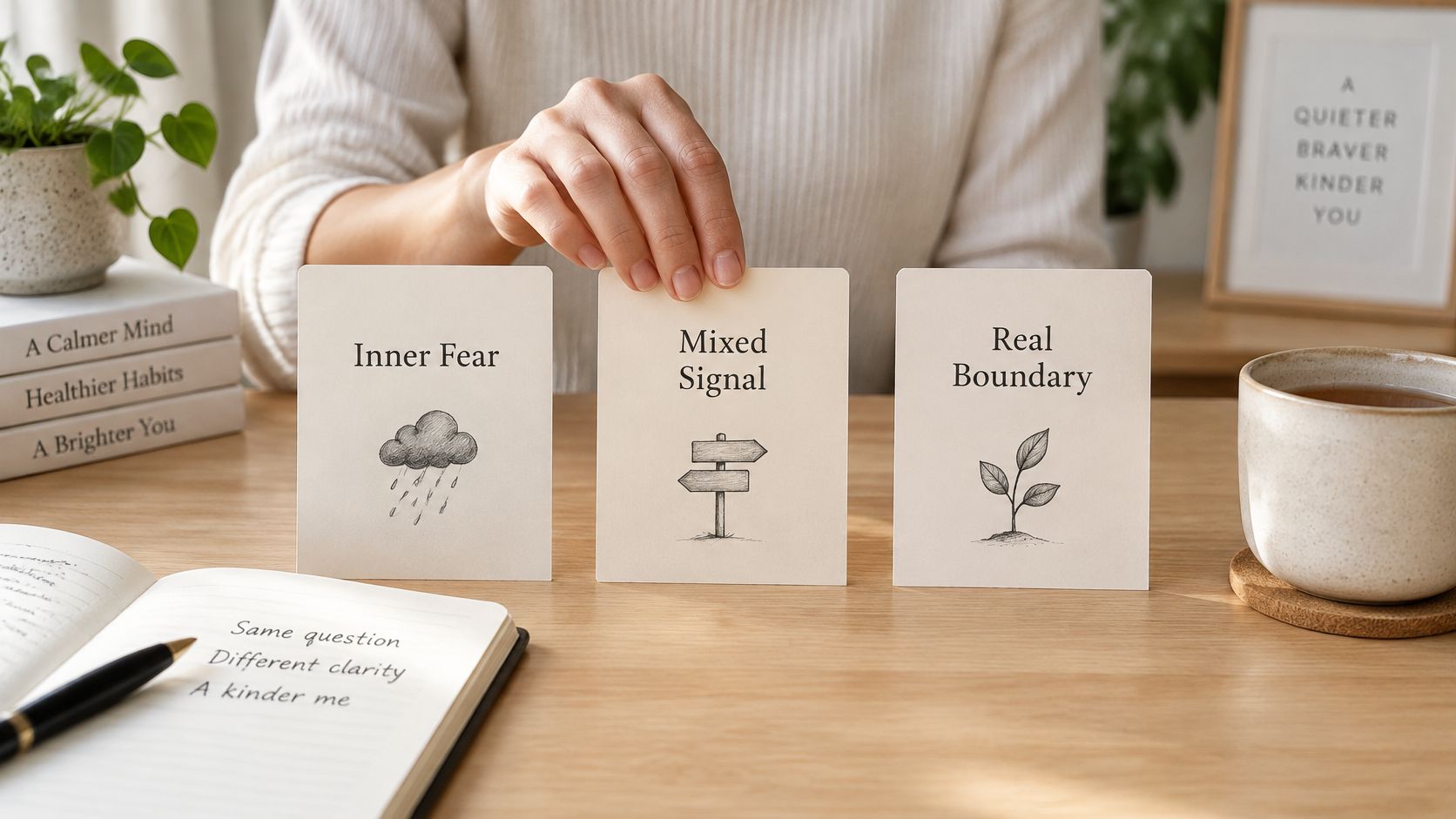
Match your response to the situation
The Psyche guide to handling jealous feelings provides a useful starting point for approaching the emotion thoughtfully. The practical distinction here is between an uncomfortable feeling and an observable pattern that requires action.
Three cases and the right response to each
| Case | What it looks like | What to do | Who to involve |
|---|---|---|---|
| Internal fear with little evidence | Racing thoughts, no concrete event, the same worry returns | Use How to Stop Jealousy in Five Steps and a ten-minute daily written practice | A trusted friend, or a therapist if it persists |
| Ambiguous behavior | Vague replies, unexplained gaps, a message thread that feels off | Ask a calm clarifying question, then observe whether the explanation holds | Your partner, in a direct conversation |
| Repeated deception or boundary breaking | Repeated lies, password demands, location tracking, isolation from friends | Set a firm boundary, create distance where safe, and document what happened safely | A qualified professional, and local emergency services if you're in danger |
An unclear message doesn't prove betrayal. Hear the explanation without immediately interrogating, but don't force yourself to ignore contradictions or recurring deception.
Ask yourself:
- Evidence: What specifically happened, separate from my interpretation?
- Pattern: Is this concern recurring?
- Safety: Can we discuss it without intimidation or retaliation?
- Boundary: What would be reasonable, mutual, and enforceable through my own choices?
The same limits apply to your behavior. If you're demanding passwords, tracking someone without consent, or restricting their friendships, stop those actions and seek support without treating shame as your solution.
If you choose to watch the accompanying video, keep those questions beside you.
Threats, stalking, violence, or inability to function need qualified professional help. Immediate danger calls for local emergency services; don't prioritize a relationship conversation over getting safe.
Our safety information explains our scope: LUNO is a self-guided mental wellness companion for reflection, emotional awareness, and daily practice. It isn't a replacement for therapy or a crisis service.
Pick One Step to Practice This Week
Choose the trigger you named earlier and match it to a practice. Use a written pass for mistrust or fear of losing affection, the checking routine for digital triggers, or a conversation when relationship expectations are unclear. Don't turn every uncomfortable moment into an assignment.
Make the practice small enough to repeat
Try this seven-day plan as a personal experiment, not a clinical test:
- Daily practice: Set aside ten minutes for a written pass or your selected exercise.
- Before and after: Rate the urge from 0 to 10 and record how often you checked.
- Final review: Look for a change in intensity, fewer checks, or a conversation you'd been avoiding.
A week can help you notice patterns, but it isn't a deadline for recovery. If nothing shifts or the distress remains disruptive, a therapist or counselor is a better next step than harsher self-talk. Use the boundary questions above if the problem involves someone else's repeated behavior.
Luno: Self Care is a self-guided mobile app offering daily check-ins and personalized next-day plans grounded in evidence-based methods. It can provide between-session structure or help you build a reflection habit independently. Luno can feel like therapy, but it is not therapy, diagnosis, crisis care, or a replacement for a clinician.
“It felt like therapy homework that someone actually designed for me.”
Lena M. shared that feedback about Self-Esteem after 14 days, with confidence improving from 4 to 8. That's an individual account, not evidence of a jealousy outcome or a promise of similar results.
People can find any topic they need through an appropriate professional or resource, whether that's relationship boundaries, self-worth, or coping with uncertainty. Luno is one option among several; choose support that fits the problem you have.
Luno: Self Care offers structured check-ins, journaling, and personalized next-day plans to support daily reflection. If you'd like help making space between a jealous thought and your next action, visit Luno: Self Care and start with the trigger you want to understand.