
40% of newlyweds report post-wedding sadness, and most of those cases last less than two weeks. A smaller group feels it much longer, which is why being depressed after wedding can be a real adjustment issue, not a personal failure.
You can be smiling in photos, answering congratulations, and still feel a drop once the noise ends. That mismatch is unsettling, but it's also common enough that it deserves a calm, honest name.
The Quiet After the Celebration
The flowers are gone, the guests have flown home, and the calendar that once ruled your life is suddenly blank. That blank space can feel louder than the wedding itself. For many newlyweds, the first thing they notice is a strange hush that makes the chest feel heavy.

A woman might sit on the edge of the sofa in her wedding dress, shoes off, phone silent, and wonder why the happiest day of her life now feels so flat. That feeling does not mean she married the wrong person. It usually means her nervous system moved from constant attention and planning into sudden ordinary silence.
When the party ends, the mind catches up
A wedding can become the center of emotional life for months. People plan, anticipate, rehearse, and imagine the day so often that the event itself starts to feel like a summit. When it ends, the body may still have energy left, but the goal that organized that energy is gone.
A post-celebration mood drop often works like a runner stopping after a race. The body is still awake, but the thing that kept it moving has disappeared. That is why the low mood can feel physical, not only emotional.
Practical rule: a drop in mood after a major celebration is often a transition response, not a verdict on your marriage.
The figure from the Queen Smith survey overview shows that this reaction is familiar to many newlyweds, not rare or strange. The same source says many cases fade within days or a couple of weeks, which fits the pattern of a temporary comedown rather than a lasting shift in mood. If you are in that first quiet week, you may be feeling the emotional afterimage of something intense.
What the silence is really asking for
The question underneath the sadness is often simple, even if the feeling is not. “What now?” is an adjustment question, not a failure of gratitude. The brain likes patterns, and wedding planning gives it a large one, then stops it all at once.
A structured support tool such as Luno: Self Care can help turn that vague drop into something easier to name and manage. It is not a substitute for therapy, but it can give shape to the days when everything feels unstructured. For someone who feels emotionally untethered after the wedding, even small check-ins can make the quiet feel less confusing.
Why Your Brain Crashes After the High
Wedding preparation can keep the body on alert for a long time. Even when the planning is exciting, it still asks for constant decisions, social coordination, and emotional performance. By the time the celebration arrives, many people are already tired beneath the excitement.
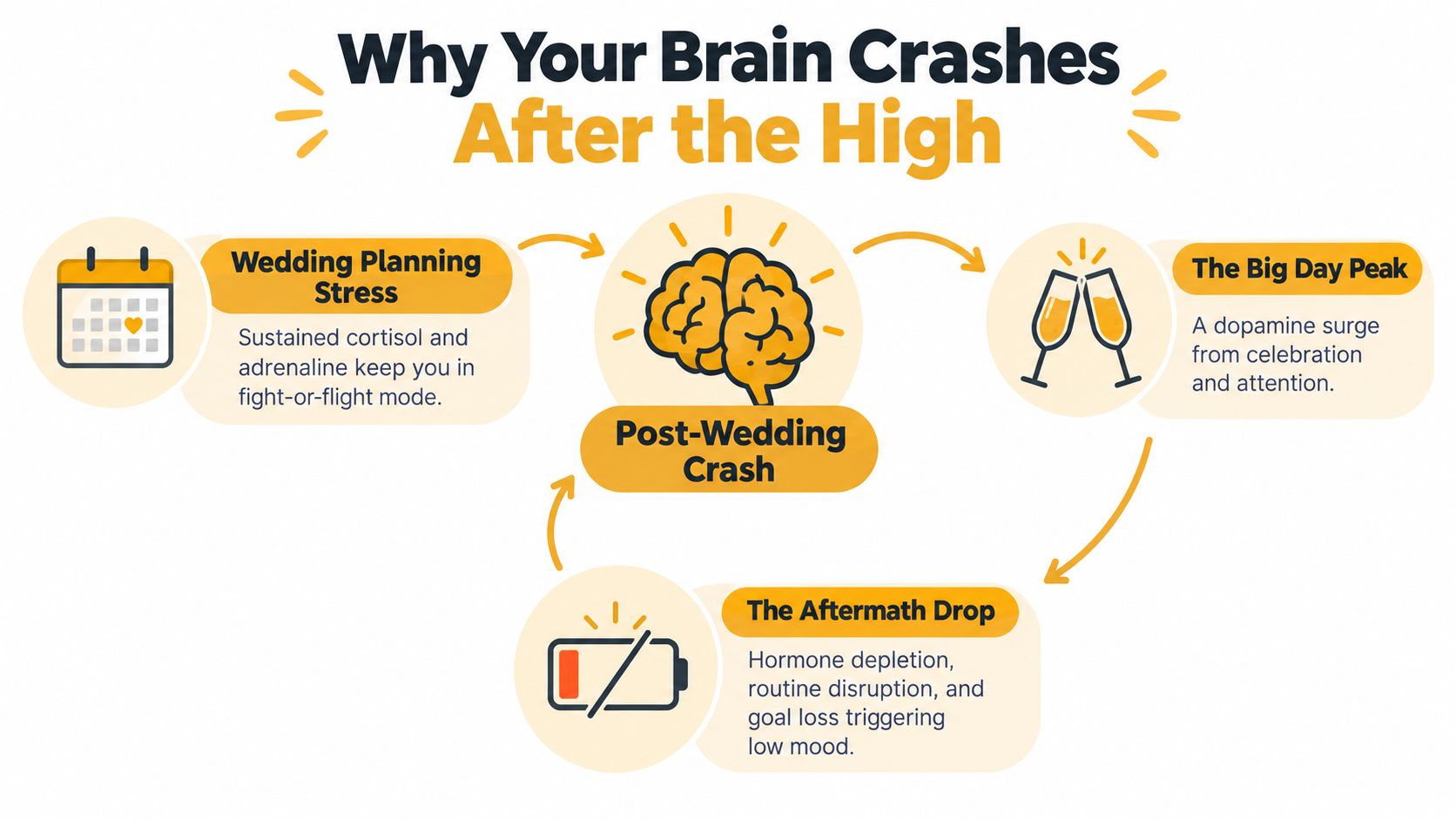
The crash is not just “in your head” in the dismissive sense. It's also a predictable reaction to a large change in stress, anticipation, and identity. The wedding day asks your mind and body to sprint, then suddenly tells them to stand still.
Stress, reward, and the drop afterward
During the lead-up, the body can stay in a heightened stress state for a long time. On the day itself, attention, celebration, and reward pile up all at once. Once the event ends, the system loses that immediate target and often feels depleted rather than delighted.
The feeling is similar to what happens after a big performance or competition ends. There's a high, then a quiet, then a sense that your energy has nowhere to go. That's why the post-wedding slump can feel physical, not just emotional.
The relational shift matters too
One study of 152 newly married women found that nearly 12% showed reliable, clinically meaningful increases in depressive symptoms six months after the wedding (Wiley study). The same research linked worsening mood with higher self-uncertainty, partner uncertainty, relationship uncertainty, and partner interference. That matters because it shows the issue is often tied to adjustment stressors inside the relationship, not just a vague post-celebration letdown.
The wedding may end in one day, but the identity shift can take much longer to settle.
That's the core reason some people feel worse after marriage rather than better. The ceremony is over, but the mind is still trying to understand what changed, what didn't, and what life now expects.
Distinguishing Normal Blues from Clinical Depression
A wedding can end, and the emotional afterglow can still fade into a quiet low mood. That does not automatically mean something is wrong. For many people, it is the mind and body adjusting after a major life event, like the stillness that follows a long, intense performance.
The practical question is whether the feeling is passing through or settling in. Brief sadness tends to ease as routines return. Clinical depression is more likely when the low mood keeps returning, deepens over time, or starts making ordinary life harder.
What normal adjustment can look like
Normal post-wedding blues often move in waves. Someone may feel tearful in the evening, then steadier the next day. Photos, messages, or reminders of the event can bring the feeling back for a while, but the day is not usually dominated by it.
As noted earlier, survey data suggests many cases resolve within two weeks, while a small minority last much longer. That contrast helps separate a short adjustment period from a pattern that deserves closer attention. A temporary comedown can feel heavy, yet still remain tied to the transition itself.
When the pattern starts to look clinical
Clinical depression usually reaches beyond sadness. It can include loss of interest, low energy that does not lift, sleep changes, poor concentration, guilt, hopelessness, or thoughts of self-harm. The biggest clue is often impairment. Work, relationships, and basic routines start to suffer.
A useful way to judge the situation is simple. If the mood is making it hard to get through the day, or if the heaviness is becoming more constant than occasional, the issue may be more than post-wedding adjustment.
The difference matters because it changes the response. Short-lived sadness points to recovery and patience. A persistent low mood calls for support, especially when it grows heavier instead of lighter. That shift is a signal to take the feeling seriously rather than assume it will disappear on its own.
Practical Steps to Manage Post-Wedding Low Mood
When you feel depressed after wedding, the first instinct is often to think harder. That usually backfires. Mood tends to shift more when you add small, steady actions to kinder self-talk and consistent support.
Start with movement, sleep, and one small task
Behavioral activation is simple, but it works by interrupting the freeze that comes with low mood. Do one meaningful thing before you feel ready. A five-minute walk, a short journal entry, or a text to a trusted friend can restart a sense of motion.
Sleep deserves attention too. If the wedding and honeymoon threw off your routine, emotions can feel sharper and less manageable. Regular bedtimes, less late-night scrolling, and a calmer wind-down help because tired minds often treat ordinary disappointment as something much bigger.
Replace the wedding story with a marriage story
Some sadness comes from the private belief that the wedding should have fixed something. It could not. The wedding was a milestone, not a cure, and married life usually feels different from the ideal version people imagine for months.
Catch the thought that says, “I should feel happy all the time now.” Then answer it with something more accurate, like, “I just went through a major transition, and my feelings need time.” That kind of cognitive restructuring can steady you.
Use support before isolation starts
Hiding the slump usually makes it feel heavier. Speak with someone who will not judge you for feeling flat after a day that was supposed to feel joyful. A calm conversation can make the experience feel human again.
- Name the feeling out loud. Saying “I feel flat after the wedding” is clearer than pretending everything is fine.
- Keep one daily anchor. A walk, breakfast, prayer, or journaling habit can give the day a shape.
- Reach for steady people. Friends who watched the planning unfold often understand the comedown better than casual acquaintances.
For people who want a structured companion while they rebuild routine, Luno: Self Care FAQ explains how guided self-check-ins work. It can support the day-by-day process without asking you to pretend everything feels easy.
How Structured Self-Care Support Makes a Difference
A hard transition feels lighter when the next step is already chosen. Structured digital support can help at that point because it gives your day a shape when emotions feel scattered, and it offers something concrete to do on the days when motivation feels thin.
Why guidance matters more than automation
Mental health tools tend to work better when human support is part of the process, rather than when everything runs on autopilot. Reviews of digital mental health programs have found better effectiveness, better adherence, and lower dropout when interventions include an in-person element or professional guidance (systematic review). Another review noted that professional guidance helps engagement, and people often prefer tools that include support instead of pure self-help.
That aligns with the experience of post-wedding blues. You may not need intensive therapy for a brief slump, but you do need structure that feels responsive, not generic. A plan that adjusts to what you are feeling in the moment can be more useful than a static list of tips.
Supportive tools should stay in the right lane
The American Psychological Association says generative AI chatbots and wellness apps should not replace a qualified mental health provider, though they can be helpful adjuncts to ongoing care (APA advisory). Harvard Health has also reported that mobile apps can complement therapy through tracking, reminders, and skill reinforcement, but not replace a trained clinician (Harvard Health review summary).
That is the right frame here. Self-guided support can help you stay with the basics, but it should not pretend to be therapy. Used well, it works like a scaffold while your emotions settle back into place.
If you want to review how your data is handled, see the privacy policy.
Support works best when it helps you stay connected to real life, not when it asks you to disappear into an app.
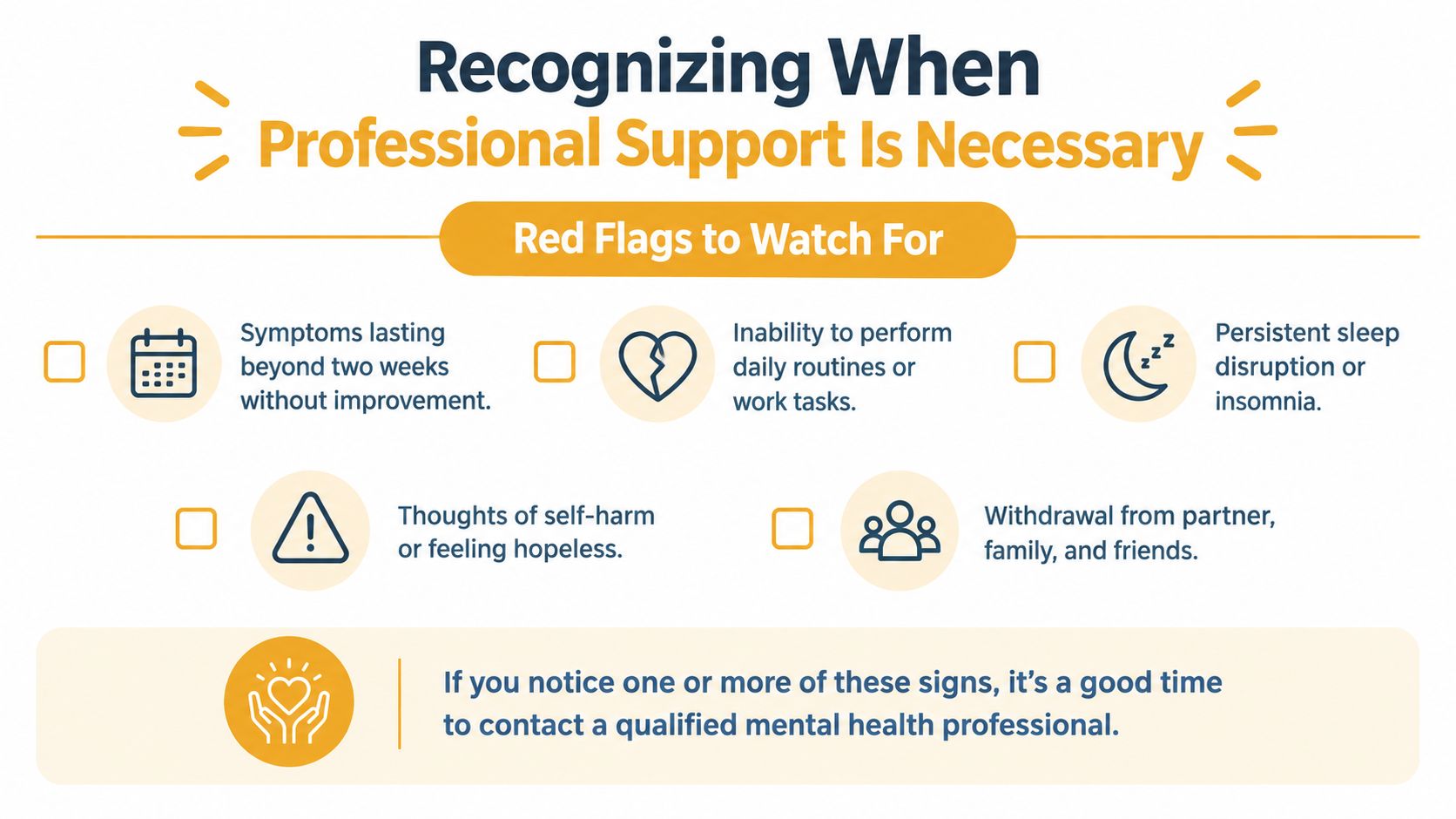
Recognizing When Professional Support Is Necessary
A wedding can leave people standing in the quiet after a very loud day. If sadness fades on its own, that is often part of adjustment. If it stays put, grows heavier, or starts shaping daily life, it deserves a closer look.
Red flags that call for escalation
The clearest signal is persistence. When low mood keeps going without real relief, or when you begin missing work, falling behind on household tasks, or skipping basic self-care, the problem has moved beyond ordinary post-wedding blues. Ongoing sleep disruption, hopelessness, withdrawal from your partner or friends, and thoughts of self-harm also call for prompt attention.
- Symptoms that don't ease. Sadness that stays intense and does not lift with time should be reviewed by a professional.
- Daily life that starts slipping. If work, sleep, or routines are breaking down, help is needed sooner rather than later.
- Safety concerns. Thoughts of self-harm are never something to sit with alone. Use the safety resources right away and seek immediate help.
What professional help can look like
Professional support can start in a few different places. A therapist can help sort through the emotional load, a primary care clinician can check for related health concerns, and a psychiatric consultation may be appropriate if medication needs to be discussed. The right starting point depends on how severe the symptoms are, your personal history, and how much your functioning has changed.
A simple rule helps here. If the feeling is still light enough to come and go, support may focus on monitoring and coping. If it is becoming sticky, widening into more parts of life, or harder to manage day by day, bring in another person with training. That is a careful response, not a failure.
Building Resilience for Your Married Life Journey
The quiet after a wedding can reveal patterns that are easy to miss during the celebration. It shows how you respond to pressure, how you ask for help, and how you speak to yourself once the confetti is gone. That information is not a verdict. It is a starting point.
Treat adjustment as a skill, not a test
Marriage includes ordinary days, not only meaningful milestones. Learning to sit with disappointment, speak openly, and recover together is part of building a stable life with another person. If this season feels tender, it may just mean you are in a normal adjustment period.
A monthly check-in can keep that adjustment visible. Keep it simple and free of judgment. Ask what feels heavy, what feels steady, and what each of you needs more of right now.
Build your own early-warning plan
A personal wellbeing plan works best when it is specific. Write down your earliest signs of strain, the coping tools that usually help, and the people you trust to take you seriously. Then you are not trying to invent a plan while already overwhelmed.
- Notice your signals early. Maybe you pull away, sleep poorly, or become unusually irritable.
- Choose a few reliable resets. Walking, journaling, prayer, or a call with a trusted friend can all help.
- Protect your support circle. Keep the names of the people you can reach when you need perspective.
Small wins matter here. A steadier morning, one honest conversation, or a better night of sleep may seem minor, yet they often mark real movement. Recovery rarely moves in a straight line.
Let support become part of the marriage, not a threat to it
Asking for help does not mean the marriage is failing. It means you care enough to handle a hard season well. That mindset can protect both your mental health and your relationship over time.
Your digital tools should be easy to manage and clear about what they do. If you try something structured, choose support that respects your boundaries and keeps your data under your control, including options like account deletion when you need them.
Luno: Self Care offers structured, self-guided mental wellness support that turns daily check-ins into personalized next-day plans. If you're feeling depressed after wedding, it can help you stay steady with small, practical steps while you decide whether you need more support.