
You're catching your breath after a demanding workout, enjoying the heat of a spicy meal, or noticing that an intense sensation briefly quiets a difficult feeling. Then a question arrives: Why do I sometimes welcome something that hurts? Before you turn that question into a judgment about yourself, it helps to separate the sensation from what you're seeking through it.
A Moment That Raises the Question
Consider an ordinary example: you finish a challenging exercise session and feel satisfied by the effort. You might enjoy the challenge, the achievement, or the relief afterward rather than the discomfort itself. That distinction matters, because describing all of those experiences as liking pain can obscure your true meaning.
An intimate situation raises different questions. Someone may welcome a negotiated, consensual sensation because it feels exciting within a trusted relationship. Another person may seek painful sensations during emotional overwhelm because they want their inner distress to change. These examples aren't diagnoses or accounts of particular patients. They illustrate why the same everyday phrase can describe very different experiences.
Begin with the purpose, not the label
A useful starting question is What am I hoping this experience will do for me? You might be seeking pleasure, emotional relief, or an opportunity to hurt yourself. Those possibilities deserve different responses, even if the physical sensation sounds similar.
A useful starting point: Describe what happens before, during, and after the experience before deciding what to call yourself.
You don't have to adopt an identity because you're curious about an experience. Nor do you have to dismiss discomfort with your own behavior because someone else considers it ordinary.
Try distinguishing these statements:
- Enjoying a challenge: You value the activity or accomplishment, while discomfort is something you tolerate.
- Welcoming a chosen sensation: The sensation itself is wanted within particular boundaries.
- Seeking escape from distress: Your immediate aim is to change an overwhelming emotional state.
For a person who likes pain, understanding the function is more informative than finding the fastest label. Self-compassion doesn't mean ignoring risk. It means asking honest questions without treating curiosity as evidence that something is wrong with you.
Where the Word Comes From
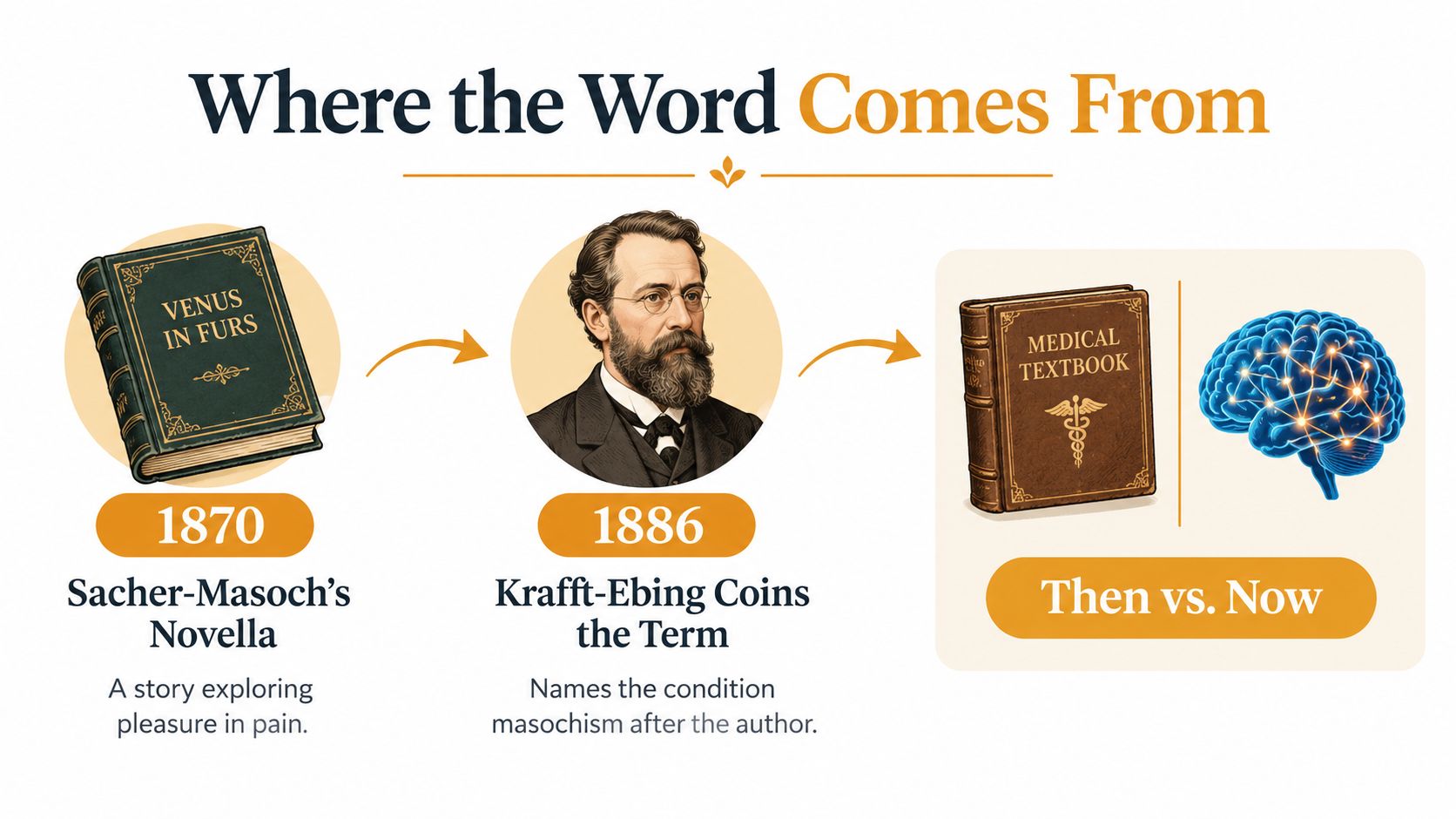
Masochism has a specific history, but people now use the word much more loosely. Austrian psychiatrist Richard von Krafft-Ebing introduced the modern term in his 1886 book Psychopathia Sexualis, naming it after Leopold von Sacher-Masoch, whose 1869 novella Venus in Furs portrayed erotic submission, including being whipped, as described in this historical account of masochism's origins.
Krafft-Ebing used the term for sexual interest in being abused, humiliated, or placed in a passive role. His classification treated that interest as pathological, reflecting the medical and moral assumptions of his period. Knowing that history helps explain why the word can still sound like an accusation rather than a description.
The visual below connects the literary origin with the medical label.
A preference isn't a clinical diagnosis
Modern assessment makes a distinction that the historical label didn't: consensual interest and sexual masochism disorder aren't interchangeable. Under DSM-5-TR, the disorder involves recurrent, intense sexual arousal from humiliation, beating, binding, or otherwise suffering for at least six months, together with clinically significant distress or functional impairment; distress caused solely by social disapproval doesn't establish the disorder, according to the Merck Manual's explanation of sexual masochism disorder.
That isn't a checklist for diagnosing yourself. It's a reminder that clinicians assess more than whether an interest exists. They consider how someone is functioning and whether the experience involves distress or harm.
| Term | What it describes |
|---|---|
| Fantasy | Something imagined, which may never be acted on |
| Preference | Something a person wants or enjoys under particular conditions |
| Identity | A label someone chooses to describe themselves |
| Disorder | A clinical determination involving diagnostic requirements |
When reading older descriptions, ask whether the author is describing an experience or judging it through the assumptions of their era. A historical psychiatric label isn't proof that every person who relates to it needs treatment.
How the Brain Links Pain and Reward
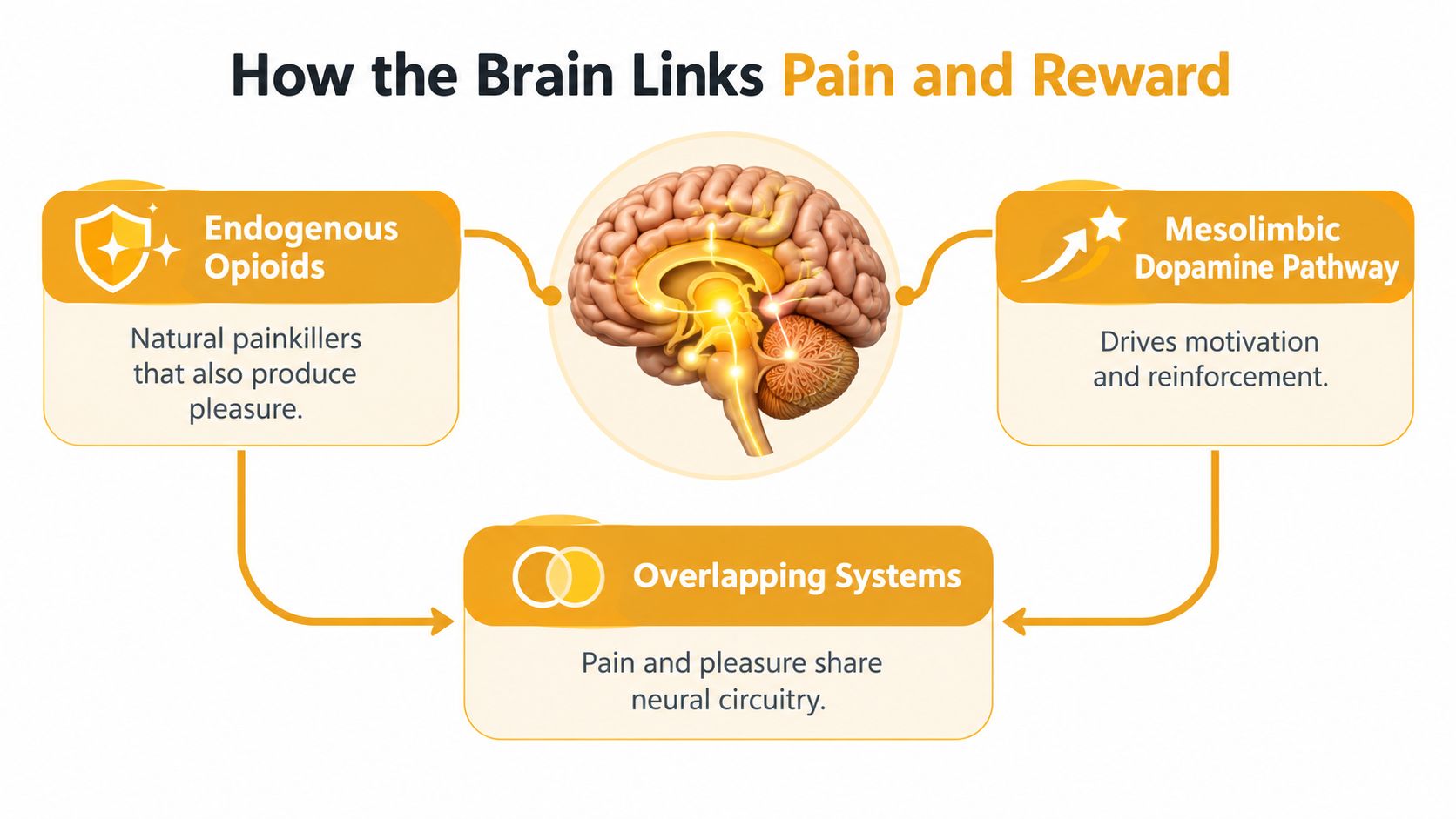
Pain and pleasure do not rely on completely separate systems. Reviews describe overlapping opioid and dopamine circuitry: endogenous opioids help reduce pain and contribute to pleasure, while mesolimbic dopamine is involved in motivation, reinforcement learning, and the rewarding quality of pain relief, as discussed in this review of the relationship between pleasure and pain.
Your nervous system registers sensations and also helps shape how you interpret them, anticipate what may follow, and respond to relief. These processes can overlap without making pain pleasant or meaning that anyone should endure pain they do not want.
The diagram shows how endogenous opioids and dopamine pathways contribute to the connection between pain and reward.
A candle by a window
A candle gives off light and heat at the same time. You can welcome its glow while keeping your hand away from the flame. Related brain processes can contribute to different experiences, though the candle is only an analogy, not a literal model of the brain.
Reward isn't identical to enjoyment. Motivation is about what draws you toward an experience; pleasure is about how it feels. Relief afterward can contribute to the experience too.
It can help to distinguish three parts:
- Intensity: How strong was the sensation?
- Emotional quality: Did it feel pleasant, unpleasant, mixed, or emotionally numbing?
- Meaning: Did you value the sensation, its context, or the relief that followed?
Context changes how a sensation may feel. A chosen sensation in a trusted setting can be experienced differently from an unexpected one that feels threatening. Control, anticipation, trust, and relief help explain these differences, but they do not make injury harmless or prove that a behavior is safe.
Feeling rewarded by an experience does not show that it is good for you.
The short video below explains how opioid and dopamine pathways interact during painful and pleasurable experiences.
Notice more than how much something hurts. Ask what you wanted, how you felt, and what happened afterward. Pain tolerance alone does not measure emotional resilience.
Three Different Functions Pain Can Serve
A person who likes pain may be describing an erotic preference, emotional regulation, or self-injury. These are functions, not fixed categories of people. Someone can have more than one function operating at different times, and the same behavior can serve mixed purposes.
Consensual erotic interest isn't an exceptionally rare curiosity. A Canadian survey of 1,040 adults aged 18–64 found that 23.8% reported a desire for masochism, while 19.2% reported having experienced it at least once, figures discussed in this review of masochistic interests and pain experiences. Those estimates describe that sample and its survey definitions, not a global prevalence rate or the likelihood that any individual has a disorder.
Three Functions of Liking Pain Compared
| Dimension | Erotic Preference | Emotional Regulation | Self-Injury |
|---|---|---|---|
| Main aim | Sexual pleasure or wanted submission | Changing an overwhelming emotional state | Intentionally hurting oneself, sometimes to obtain emotional relief |
| Consent | Freely chosen, with agreed boundaries when others participate | Interpersonal consent may not apply; autonomy still matters | Being self-directed doesn't establish safety |
| Privacy or secrecy | Privacy may reflect ordinary personal boundaries | Concealment may make coping harder to discuss | Hiding harm can be a warning sign |
| Controllability | Ability to stop and respect limits matters | Ask whether other coping options remain available | Feeling unable to stop warrants support |
| Aftermath | May involve satisfaction or wellbeing | May bring relief without resolving the underlying distress | May involve temporary relief, shame, or further urges |
| Risk | Requires attention to boundaries and physical safety | Depends on the behavior used | Any self-injury deserves professional attention |
Similar sensations, different intentions
Erotic preference centers on wanted sexual experience. For example, someone might enjoy a negotiated sensation during intimacy but have no interest in it outside that setting. The context is part of what they want.
Emotional regulation is broader. A person might describe seeking intensity because they feel overwhelmed and want their emotional state to shift. This describes an intention, not permission to use harmful methods: once a strategy involves self-injury, its regulating function doesn't make it safe.
Self-injury requires particular care because relief and harm can occur together. A person might feel calmer afterward and still need support to stop injuring themselves.
Use the table as a conversation aid, not a diagnostic test. Privacy isn't automatically secrecy, pleasure doesn't exclude risk, and emotional relief doesn't tell you the whole story. The most useful distinction is between a wanted, bounded experience and a pattern that causes harm or becomes difficult to control.
When to Ask Questions and When to Get Help
You don't need to solve your identity before seeking support. Start with what you're doing, why you're doing it, and whether you're safe. A function-based check-in can help you explain your experience, but it can't replace clinical assessment.
Self-harm research describes people seeking painful sensations to regulate psychological distress, including experiences of relief and altered pain sensitivity, as discussed in this review of psychological pain and self-harm. That makes the purpose of the behavior important, but it also means that feeling better briefly shouldn't be your only safety test.
A function-based check-in
Answer these questions in ordinary language. You can write your responses, discuss them with a clinician, or use them to begin a conversation with someone you trust.
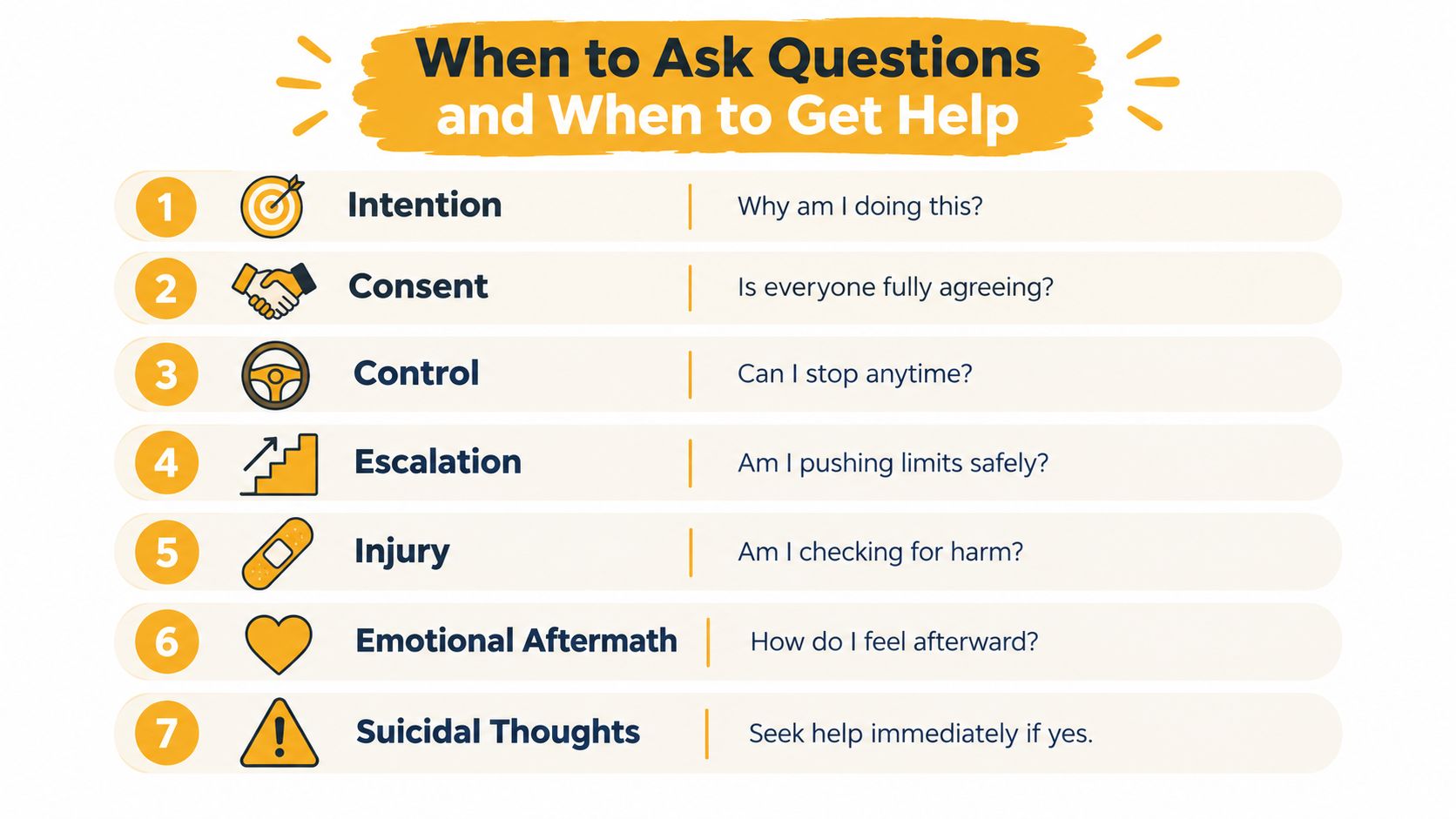
- Intention and trigger: What happened just before the urge? Am I seeking pleasure, emotional relief, punishment, or injury?
- Consent: Is everyone freely agreeing, without pressure, and able to withdraw that agreement?
- Control: Can I stop when I decide to, or do I feel driven to continue?
- Escalation: Am I moving beyond my previous boundaries or seeking increasingly harmful experiences?
- Injury: Has this caused harm, or am I dismissing signs that I need medical attention?
- Emotional aftermath: Do I feel settled and satisfied, or ashamed, frightened, temporarily relieved, or compelled to repeat it?
- Suicidal thoughts: Am I thinking about dying, hoping not to survive, or unsure whether I can keep myself safe?
The checklist below offers a visual reminder of these areas.
Respond to warning signs without waiting for certainty
Seek professional support for any self-injury, increasing harm, loss of control, or a pattern that's disrupting daily life. Concealing injuries or feeling unable to tell anyone what's happening is also a reason to reach out, not a reason to blame yourself.
Any suicidal thoughts warrant prompt human support. If you might act on them, can't stay safe, have a serious injury, or are in immediate danger, contact local emergency services or a crisis line now. If possible, tell a trusted person and avoid being alone while you arrange help.
Non-consent and dangerous restriction of breathing require an immediate safety-oriented response. They aren't situations to troubleshoot through journaling or reinforce through repeated practice.
Safety first: You don't have to prove that your situation is serious enough before asking for help.
The safety guidance for self-guided support provides an additional place to review scope and safety limits. Don't delay human help to finish a checklist, read more content, or decide which label fits. These questions should make it easier to communicate, not create another hurdle between you and care.
Self-Care That Feels Like Therapy but Isn't
A reflective exercise can feel therapeutic without being psychotherapy. Self-care includes promoting health, maintaining wellbeing, preventing illness, and coping with illness independently or with professional support, according to the World Health Organization's definition of self-care. WHO also places self-care alongside the formal health system when needed, not outside it.
That distinction matters when you're exploring a charged topic. A journal prompt may help you put feelings into words. A structured routine may help you follow through on a helpful intention. Neither establishes a diagnosis or creates a clinician-patient relationship.
Structure and clinical care aren't interchangeable
The NHS describes guided self-help as a cognitive behavioural therapy-based treatment in which a Psychological Wellbeing Practitioner helps someone understand difficulties and use self-help materials, as explained by CNWL Talking Therapies' overview of treatment options. The trained practitioner's involvement is a defining part of that approach. An autonomous app doesn't supply that oversight.
WHO reports that structured guided and unguided psychological self-help can reduce depression and anxiety symptoms, but that evidence concerns particular interventions and delivery conditions, as outlined in its psychological self-help guidance. It isn't a promise that every wellness product provides equivalent treatment.
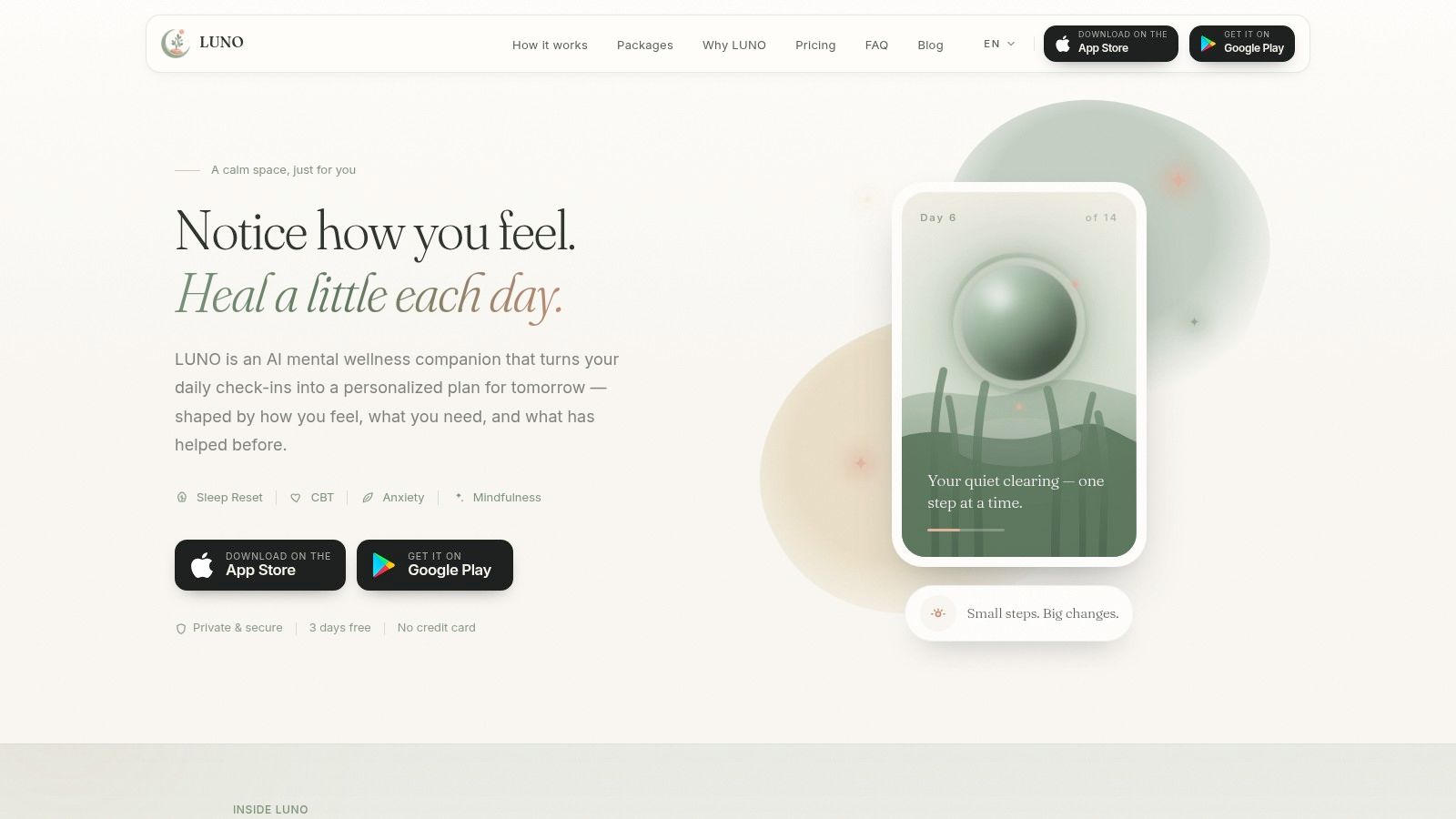
The screenshot below shows an example of a self-guided wellness interface.
Make reflection concrete
For this topic, useful self-directed work might involve recording the trigger, the desired emotional change, and the aftermath. Instead of writing only that you wanted intensity, describe whether you wanted excitement, distraction, relief, or punishment. Bring concerning patterns to a qualified professional rather than asking an app to determine whether they're harmless.
- Choose a relevant topic: Look for support around the need you're noticing, such as anxiety, boundaries, sleep, or relationship patterns.
- Keep the task manageable: A short reflection or grounding exercise can be a starting point, not an obligation to disclose everything.
- Check the limits: Review privacy practices, data controls, and how the service directs users to human help.
The American Psychological Association warns that mental-health apps may have testing and privacy gaps and recommends a rapid route to human crisis support in its review of mental-health app red flags. Helpful structure should make your choices clearer. It shouldn't encourage you to mistake automated support for professional care.
Three Misconceptions Worth Letting Go
Labels can become misleading when someone uses them to explain more than they know. The function-based approach offers a way to stay specific: ask what the person wants, what they do, and how it affects them. Avoid turning a single preference into a story about their entire life.
Liking pain always means trauma
A preference alone doesn't establish a trauma history. Someone may have experienced trauma, but you can't infer that from what they enjoy or imagine.
A more respectful question is whether the person finds the experience wanted, distressing, or connected to something they'd like help understanding. That leaves room for their account rather than imposing an explanation.
Liking pain always means BDSM
Everyday language is broader than sexual terminology. Someone describing intense exercise, emotional relief, and erotic sensation may use the same phrase while referring to unrelated experiences.
BDSM shouldn't be assumed from an ambiguous description. If you're talking with another person, clarify what they mean before introducing sexual labels. If you're reflecting on yourself, name the context rather than forcing every example into one category.
Liking pain always means self-harm or disorder
The clinical distinction described earlier prevents this shortcut. A wanted preference doesn't automatically indicate a disorder, while an enjoyable or relieving experience doesn't automatically rule out harm.
You can respect someone's autonomy without assuming that every behavior is safe.
The reverse mistake is also worth avoiding: deciding that self-injury doesn't need attention because it provides relief. Mixed functions don't cancel the need for care.
A better replacement for all these assumptions is specificity without certainty. You can say that you welcome a sensation in a particular setting, that you sometimes seek intensity when overwhelmed, or that you've begun doing something harmful. Each statement gives you and a potential helper more useful information than a sweeping label.
Moving Forward With Self-Knowledge
Understanding a person who likes pain begins with purpose, not judgment. Erotic preference, emotional regulation, and self-injury may sound similar in casual conversation, but they call for different kinds of reflection and support. You don't need a perfect explanation before making a safer choice.
Use your check-in to identify one practical next step: clarify a boundary, record an emotional trigger, or arrange a conversation with a qualified professional. If you're injuring yourself, seek human help rather than relying on self-guided reflection.
Curiosity can help you understand yourself. Support can help you respond when understanding alone isn't enough.
Structured self-care may feel therapeutic, but it remains distinct from therapy. If you're in crisis or can't keep yourself safe, contact local emergency services or a crisis line. For a non-urgent concern, begin with an honest description of your experience and the kind of help you want.
Luno: Self Care offers mood check-ins, journaling, and personalized next-day plans to help you reflect on emotional patterns and build manageable routines. People can explore the topics they need, including anxiety, boundaries, and relationship patterns, while remembering that Luno can feel like therapy but is not therapy or a crisis service. Visit Luno: Self Care to explore self-guided support for understanding what you're seeking and choosing a thoughtful next step.